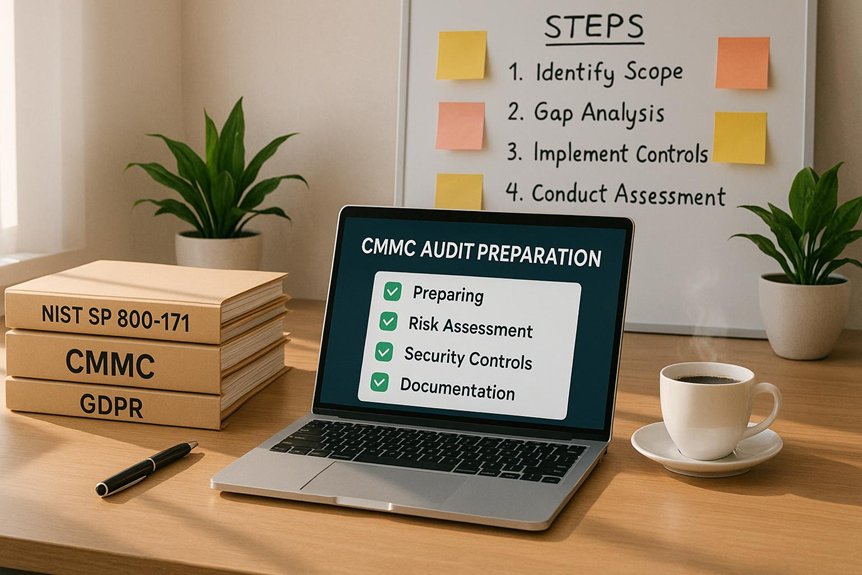
You’ll need to start CMMC audit preparation months in advance by conducting a thorough gap analysis against NIST SP 800-171 requirements, building a cross-functional readiness team, and implementing essential security controls like multi-factor authentication and encryption. Document everything in a System Security Plan, create detailed evidence repositories, and schedule mock assessments to identify weaknesses. Select your Certified Third-Party Assessment Organization early, as availability becomes limited during peak periods. This strategic foundation guarantees you’re positioned for certification success.
Key Takeaways
- Conduct comprehensive gap analysis using NIST SP 800-171 tools to assess current security posture against CMMC requirements.
- Build cross-functional readiness team with designated leadership, clear roles, and regular progress meetings for coordinated preparation efforts.
- Implement required security controls including multi-factor authentication, encryption, and comprehensive documentation in System Security Plans.
- Select experienced C3PAO early based on industry expertise, reputation, and proven audit success records in your sector.
- Maintain detailed inventories, automated logging systems, and complete evidence documentation to strengthen third-party assessment readiness.
Understanding CMMC Requirements and Certification Levels
Before you can begin preparing for a CMMC audit, you’ll need to understand the framework’s three-tiered structure and determine which certification level applies to your organization.
Each certification level builds upon the previous one, requiring progressively more stringent cybersecurity practices and security controls.
Level 1 targets organizations handling Federal Contract Information (FCI) with 17 basic practices.
Level 2, designed for Controlled Unclassified Information (CUI), demands 110 security controls.
Level 3 requires 130 extensive practices for advanced protection.
Your compliance journey involves a formal third-party assessment conducted by a Certified Third-Party Assessment Organization (C3PAO).
These assessors verify you’ve met all requirements for your target certification level.
Starting in fiscal year 2025, no bidding on DoD contracts will be permitted without proper certification, making early preparation for CMMC 2.0 requirements essential.
Conducting a Comprehensive Gap Analysis of Current Security Posture
Once you’ve identified your required certification level, you’ll need to assess where your organization currently stands against CMMC requirements. This gap analysis compares your current security posture with the CMMC framework’s compliance requirements to identify deficiencies that could impact your third-party assessment.
Review all existing documentation, security controls, and employee training programs systematically. Use NIST SP 800-171 tools and checklists to evaluate your cybersecurity practices against specific CMMC standards. Engage cross-functional teams during this process—different departments offer valuable perspectives on existing controls and potential vulnerabilities.
Cross-functional collaboration during gap analysis reveals critical vulnerabilities that single-department reviews often miss, strengthening overall CMMC compliance efforts.
Document every gap you discover, prioritizing them by severity and implementation complexity. Incorporate scheduled internal audits and build structured evidence collections to support continuous monitoring and readiness for the formal assessment.
Establish a continuous compliance strategy that includes regular gap analysis updates, ensuring you maintain alignment with evolving CMMC standards and remain prepared for future assessments.
Building Your Cross-Functional CMMC Readiness Team
While your gap analysis reveals what needs fixing, assembling the right team determines whether you’ll successfully address those deficiencies before your CMMC assessment.
Building an effective CMMC readiness team requires strategic planning and clear structure. Your cross-functional team should include representatives from IT, compliance, legal, and operations to guarantee thorough cybersecurity compliance oversight.
Here’s how to structure your team:
- Designate a Team Leader – Appoint someone to coordinate efforts, manage timelines, and serve as primary contact with your Certified Third-Party Assessment Organization.
- Involve Senior Leadership – Ensure alignment with business objectives and emphasize importance throughout your organization.
- Assign Specific Roles and Responsibilities – Streamline documentation preparation, training, and security controls implementation.
Schedule regular meetings to foster continuous communication, discuss progress, address challenges, and update strategies as needed.
Engage a CMMC Third Party Assessment Organization early to align your team’s preparation with the assessment methodology and documentation requirements outlined for certification.
Implementing Required Security Controls and Technical Safeguards
After assembling your cross-functional team, you’ll need to implement the specific security controls and technical safeguards required for CMMC compliance.
Focus on NIST SP 800-171‘s 110 security requirements, which form the foundation for CMMC Level 2 certification. Deploy essential technical safeguards including multi-factor authentication, data encryption for information at rest and in transit, and continuous network monitoring systems. Organizations pursuing Level 3 must also address at least 20 NIST SP 800-172 controls and maintain objective evidence aligned to the 320 assessment objectives.
Document all implemented security controls in a thorough System Security Plan (SSP) that demonstrates your compliance posture during audits.
Conduct regular vulnerability assessments and penetration testing to identify security gaps and validate your defenses against evolving threats.
Don’t overlook employee training on cybersecurity protocols and proper use of security controls. Your team’s understanding of these safeguards is vital for maintaining compliance and protecting sensitive information throughout your organization.
Preparing Essential Documentation and Evidence for Auditors
Thorough documentation serves as the backbone of your CMMC audit preparation, requiring you to gather and organize critical evidence that demonstrates your organization’s security posture.
Essential documentation proves your cybersecurity practices meet CMMC requirements through concrete evidence for auditors.
Your compliance demonstration hinges on three critical components:
- System Security Plan (SSP) – Document your current security state, controls, and extensive cybersecurity measures that auditors will scrutinize during assessment.
- Plan of Action & Milestones (POAM) – Address identified deficiencies with clear remediation steps and timelines for closing security gaps.
- Supporting Evidence – Compile configuration files, security logs, audit trails, and employee training records that verify your implemented controls and staff awareness protocols.
This organized approach streamlines the audit process and strengthens your compliance position. Additionally, ensure your evidence aligns with the NIST SP 800-171 controls and is ready for third-party assessments at CMMC Level 2.
Training Personnel on CMMC Standards and Cybersecurity Protocols
Your documentation efforts won’t achieve their full potential without properly trained personnel who understand CMMC requirements and can execute cybersecurity protocols effectively.
Training personnel on CMMC standards requires thorough coverage of Level 1’s 17 fundamental practices and Level 2’s 110 security requirements, emphasizing protection of Federal Contract Information (FCI) and Controlled Unclassified Information (CUI).
Effective CMMC training must comprehensively address both foundational practices and advanced security requirements while prioritizing FCI and CUI protection protocols.
Implement regular training sessions that combine theoretical knowledge with practical application through simulations and drills. These exercises reinforce cybersecurity practices and help employees apply protocols in real-world scenarios.
Provide clear documentation of your organization’s policies during training sessions, ensuring personnel understand implementation procedures.
Establish continuous education programs that foster compliance culture throughout your organization. This ongoing approach maintains readiness for CMMC assessments while ensuring long-term adherence to cybersecurity standards and protocols.
As you mature training programs, consider that C3PAO assessments will be mandatory for all DoD contractors starting in 2025, making staff readiness critical for successful third-party evaluations.
Selecting and Scheduling Your Certified Third-Party Assessment Organization
How do you guarantee your CMMC audit meets DoD standards and achieves successful certification? Selecting the right Certified Third-Party Assessment Organization (C3PAO) is fundamental to your CMMC Audit Process success. Your chosen C3PAO must be DoD-recognized to maintain credibility and compliance with cybersecurity standards.
Here’s how to secure the best C3PAO for your assessment:
- Research thoroughly – Compare C3PAOs based on experience, reputation, and industry requirements expertise specific to your CMMC level.
- Verify compatibility – Confirm they understand your sector’s unique compliance needs and can provide clear documentation of their assessment timeline.
- Schedule early – Book your scheduling assessment well in advance, as availability becomes limited during peak audit periods.
Choose a C3PAO that offers transparent processes and proven audit success records. Additionally, ask prospective C3PAOs about their experience supporting C3PAO audits and total audit costs, including coordination with consulting firms and expected preparation activities.
Executing Mock Assessments and Internal Compliance Reviews
Before your official CMMC audit arrives, executing thorough mock assessments transforms potential surprises into manageable preparation steps.
You’ll simulate the actual third-party assessment process, allowing you to identify gaps in your cybersecurity practices before they become costly issues.
Your internal compliance reviews must align precisely with CMMC requirements, verifying that documentation, policies, and security controls function as intended.
Engage team members across departments during these assessments to guarantee extensive compliance evaluation and build organization-wide awareness of responsibilities.
Use CMMC-based checklists to streamline your preparation process and maintain consistent evaluation standards.
Regular internal reviews help you track progress and address previously identified weaknesses.
This systematic approach guarantees you’re thoroughly prepared when your certified assessor arrives for the official audit.
Additionally, ensure your reviews include verification of NIST SP 800-171 control implementations, with particular focus on logging, access control, and continuous monitoring practices highlighted in recent audit findings.
Managing Common Pitfalls and Risk Areas During Assessment
Even with thorough mock assessments completed, organizations frequently stumble on predictable obstacles that can derail their CMMC certification efforts.
These common pitfalls can undermine your security posture and compromise assessment success if you’re not vigilant.
Key risk areas that consistently challenge organizations during CMMC audit include:
- Incomplete documentation – Your cybersecurity protocols must be thoroughly documented with clear records of security controls and procedures, or you’ll face audit failure.
- Weak asset management – Assessors need detailed inventories of all hardware and software handling FCI and CUI, making poor tracking a critical vulnerability.
- Inadequate technical controls – Missing multi-factor authentication or encryption creates glaring weaknesses that auditors will flag immediately.
Don’t overlook third-party risks and guarantee consistent training reinforces compliance practices across your organization.
Implementing automated logging and maintaining centralized repositories helps close evidence gaps by strengthening audit trails and ensuring timely access to control documentation.
Frequently Asked Questions
What Are the Typical Costs Associated With CMMC Certification and Assessment?
CMMC certification costs vary considerably based on your organization’s size and maturity level.
You’ll face assessment fees ranging from $15,000-$150,000, plus compliance expenses for gap remediation, training investments, and documentation expenses.
Budget planning should include consultancy charges for audit preparation, ongoing maintenance costs, and potential remediation costs if you fail initially.
Training investments and infrastructure upgrades can add $50,000-$500,000+ depending on your current security posture and required improvements.
How Long Does the Entire CMMC Certification Process Usually Take?
Careful certification calculations vary considerably—you’ll typically need 6-18 months for complete CMMC certification.
Your timeline factors include organization readiness evaluation, compliance documentation checklist completion, and CMMC training programs.
Assessment preparation strategies accelerate certification phases overview, while stakeholder involvement importance can’t be overlooked.
You’ll undergo certification impact analysis, establish continuous monitoring practices, and understand audit frequency requirements.
Proper preparation greatly reduces your certification timeline and guarantees smoother third-party assessment success.
What Happens if We Fail the Initial CMMC Assessment?
If you fail your initial assessment, you’ll face compliance implications and timeline extensions while developing remediation strategies.
You’ll need reassessment options after addressing deficiencies, considering additional cost factors.
Focus on risk management and stakeholder communication during this period. Document lessons learned to improve future audits.
Though setbacks are frustrating, they’re opportunities to strengthen your security posture before achieving certification benefits through a successful follow-up assessment.
How Often Must CMMC Certifications Be Renewed or Updated?
You’ll need to renew your CMMC certification every three years, though certification validity depends on your maturity level.
Assessment intervals remain consistent across levels, but you’ll face ongoing education requirements and compliance timelines throughout.
Start planning renewal costs early and develop maintenance strategies to guarantee audit readiness.
The certification process doesn’t pause between renewals—you’ll need continuous updating requirements to meet evolving cybersecurity standards and maintain your competitive edge.
Can We Maintain CMMC Certification While Working With Non-Compliant Subcontractors?
No, you can’t maintain CMMC certification while working with non-compliant subcontractors.
You’re responsible for ensuring subcontractor compliance throughout your supply chain. Your contractual obligations require implementing robust vendor management and oversight responsibilities.
You’ll need assessment strategies, mitigation plans, and regular compliance audits to verify cybersecurity standards are met.
Effective risk management means choosing compliant partners or helping subcontractors achieve compliance before engagement.
Conclusion
You’ve laid the groundwork for CMMC success, but here’s the truth: perfect preparation doesn’t guarantee flawless execution. Despite following every step, unexpected issues will surface during your assessment. Don’t let this discourage you—it’s normal. The theory that extensive preparation eliminates all risks is false. Instead, your thorough preparation gives you the agility to address surprises quickly. You’re not aiming for perfection; you’re building resilience to adapt when challenges inevitably arise.