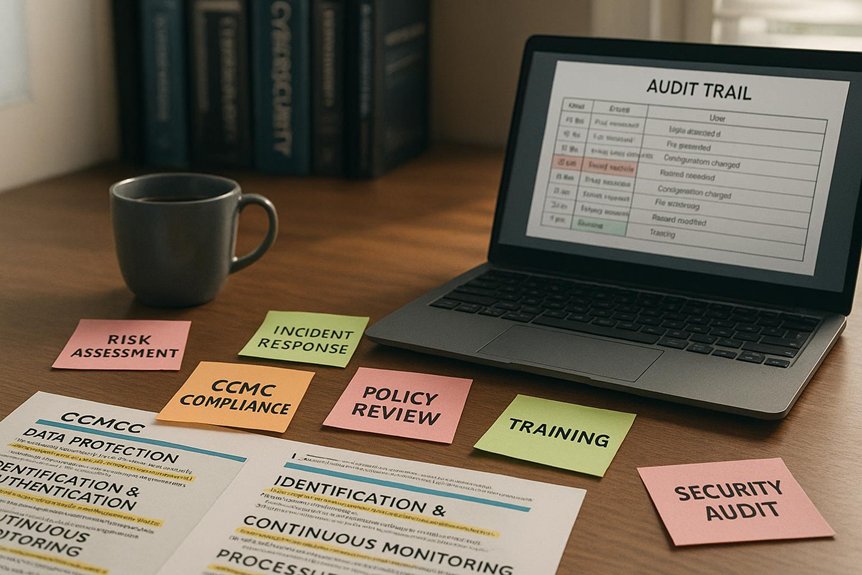
You’ll fix CMMC documentation gaps by establishing an extensive framework covering all 110 security controls with detailed policies, procedures, and evidence collection processes. Create centralized repositories for streamlined management, implement automated logging solutions for accurate audit trails, and develop remediation plans for missing documentation. Conduct regular internal reviews, maintain continuous monitoring processes, and schedule quarterly risk assessments to verify accuracy. These strategic approaches will transform your compliance posture and assessment readiness.
Key Takeaways
- Establish comprehensive documentation frameworks covering all 110 CMMC security controls with detailed policies, procedures, and evidence collection processes.
- Implement automated logging solutions to capture security activities and maintain audit trails for compliance verification and investigation support.
- Create centralized repositories for streamlined management, regular updates, and easy access to all compliance documentation and records.
- Develop systematic remediation plans to address missing documentation gaps through thorough risk assessments and continuous monitoring processes.
- Conduct regular internal reviews and quarterly risk assessments to ensure documentation accuracy and prevent future evidence gaps.
Understanding Common CMMC Evidence Gaps That Lead to Assessment Failures

When organizations prepare for CMMC assessments, they often discover critical evidence gaps that can derail their certification efforts.
You’ll commonly encounter inadequate documentation of security policies and procedures, which is essential for proving CMMC compliance. Without thorough audit logs of security-related activities, you can’t demonstrate that your security controls are functioning properly during assessments.
Thorough documentation and comprehensive audit logs serve as the foundation for demonstrating effective security control implementation during CMMC assessments.
Insufficient ongoing monitoring and testing creates significant evidence gaps, making it difficult to show active implementation of required controls.
You’ll also face challenges if you’ve neglected regular risk assessments, as these must be documented for compliance verification.
Additionally, failing to maintain a detailed Defect Resolution Log can lead to unaddressed security gaps, hindering your remediation efforts and creating assessment failures when auditors can’t track your progress.
Building a Comprehensive CMMC Documentation Framework
Since addressing evidence gaps requires a structured approach, you’ll need to establish a thorough CMMC documentation framework that encompasses all 110 security controls required for Level 2 certification.
Your framework must include extensive policies, procedures, and evidence collection processes that demonstrate actual implementation rather than just documented intent.
Create a centralized repository to streamline management and facilitate auditing by C3PAOs. This system should house your System Security Plan (SSP), which details your security architecture, and your Plan of Action and Milestones (POA&M) for tracking remediation efforts.
You’ll need to maintain logs, reports, and activity records that prove compliance with each security control.
Regular updates guarantee your documentation reflects current practices, maintaining accuracy and alignment with evolving security requirements throughout your certification journey.
Establishing Effective Audit Trail Systems for CMMC Compliance

While thorough documentation forms the foundation of CMMC compliance, you’ll need robust audit trail systems to prove your controls are actually working. Your audit trail must extensively log all security-related activities, creating accountability and traceability across your organization’s security posture.
To establish effective systems for CMMC compliance:
- Implement automated logging solutions to capture access attempts, system changes, and incident responses with enhanced accuracy.
- Collect and retain logs documenting adherence to all 110 CMMC controls for compliance documentation requirements.
- Conduct regular reviews of audit trails to identify anomalies and unauthorized access patterns.
- Preserve audit trails for specified durations to support thorough investigations during assessments.
These practices guarantee you’ll generate the evidence needed to demonstrate your security requirements compliance and facilitate seamless evidence generation during CMMC audits.
Remediation Strategies for Missing or Inadequate Security Control Evidence
Even with robust audit trail systems in place, you’ll inevitably discover gaps where security control evidence is missing or inadequate during your CMMC assessment preparation.
When evidence gaps surface, you must develop a thorough remediation plan addressing each deficiency systematically. Start by cataloging missing documentation for all 110 security controls, prioritizing critical cybersecurity measures that pose the highest compliance risk.
Conduct thorough risk assessments to identify root causes and implement continuous monitoring processes to prevent future gaps. Focus on collecting essential evidence including policies, configurations, and audit logs that demonstrate effective implementation.
Consider engaging CMMC specialists who can provide expert guidance on addressing complex deficiencies and improving your overall documentation quality for successful compliance.
Streamlining Documentation Processes to Prevent Future Compliance Issues

After addressing immediate documentation gaps, you’ll need to establish systematic processes that prevent future compliance issues from developing.
Your CMMC documentation strategy requires a thorough systematic approach that transforms how your organization manages policies and procedures.
Implement these essential streamlining measures:
- Establish centralized repositories for all CMMC documentation, consolidating policies, procedures, and evidence in accessible locations that maintain accurate audit trail records.
- Deploy structured templates and checklists to guarantee thorough capture of security configurations, compliance requirements, and evidence collection standards.
- Schedule regular documentation reviews to update processes as policies change, preventing outdated information from creating compliance issues.
- Conduct thorough staff training on proper documentation practices, fostering accountability and awareness that reduces evidence gaps and strengthens your organization’s compliance posture.
Maintaining Continuous Documentation Standards for Ongoing CMMC Readiness
Once you’ve streamlined your documentation processes, maintaining continuous standards becomes your organization’s cornerstone for sustained CMMC readiness.
You’ll need to establish regular internal reviews that systematically evaluate your policies and procedures against the 110 mandated security controls. These reviews help you identify gaps before they become compliance issues that lead to audit failure.
Create centralized repositories where your team can easily access and update documentation. You must guarantee that every change to your processes generates corresponding evidence of compliance.
Every process change must generate corresponding compliance evidence within your centralized documentation repository to maintain CMMC readiness.
Schedule quarterly risk assessments to verify your documentation remains current and accurate.
Frequently Asked Questions
How Long Does It Typically Take to Complete CMMC Documentation Fixes?
CMMC timeline estimates vary considerably based on your organization’s size and existing documentation gaps.
You’ll typically need 3-6 months for thorough documentation improvement strategies and gap analysis techniques.
Your audit preparation checklist should include evidence review processes, stakeholder engagement tips, and training needs assessment.
Implementing project management frameworks accelerates progress, while compliance documentation best practices guarantee quality.
Don’t forget ongoing documentation maintenance—it’s essential for sustained compliance readiness.
What Are the Average Costs Associated With Hiring CMMC Documentation Consultants?
A mid-sized defense contractor recently discovered CMMC consultant fees ranging from $150-$300 hourly, with flat-rate projects costing $25,000-$75,000.
You’ll find documentation service rates vary markedly based on scope of services and consultant pricing models.
When budgeting for compliance, conduct a cost-benefit analysis comparing hourly vs. flat rate options.
Industry benchmarks suggest investing 2-5% of contract value guarantees strong return on investment.
Your documentation project budgets should reflect complexity and timeline requirements.
Can Artificial Intelligence Tools Help Automate CMMC Evidence Collection and Documentation?
You can leverage AI integration and automation strategies to streamline evidence collection and boost documentation efficiency.
These tools enhance compliance monitoring through continuous risk assessment while maintaining data security standards.
You’ll see significant process improvement and cost reduction when selecting the right AI solutions.
However, you must guarantee proper tool selection that meets CMMC requirements and maintains audit trail integrity throughout your automated documentation processes.
Which Third-Party Software Platforms Are Most Effective for CMMC Documentation Management?
You’ll find several effective platforms for managing compliance documentation.
Leading CMMC management software includes specialized compliance management systems like ServiceNow GRC and RSA Archer.
Cloud-based documentation platforms such as SharePoint and Confluence excel at collaboration.
For all-encompassing solutions, consider certification readiness applications like Comply365 or Cyber AB-approved audit preparation platforms.
Project management software like Monday.com integrates well with evidence collection solutions, while risk assessment tools enhance your documentation tracking capabilities considerably.
How Often Should Organizations Conduct Internal CMMC Documentation Readiness Assessments?
The early bird catches the worm when establishing your CMMC readiness frequency. You should conduct internal assessments quarterly, emphasizing internal assessment importance through systematic documentation gap identification.
This schedule supports effective audit preparation techniques while maintaining compliance review schedules. Integrate these reviews with risk management integration and staff training needs assessment.
Implement continuous improvement strategies alongside cybersecurity policy updates, ensuring your evidence collection methods remain current and audit-ready throughout the year.
Conclusion
You’ve now equipped yourself with the tools to transform your CMMC documentation from a compliance nightmare into a well-oiled machine. By addressing evidence gaps, building robust frameworks, and establishing clear audit trails, you’re not just meeting requirements—you’re creating a fortress of documentation that’ll protect your organization like a shield against assessment failures. Your proactive approach guarantees you’ll maintain readiness and avoid costly remediation down the road.