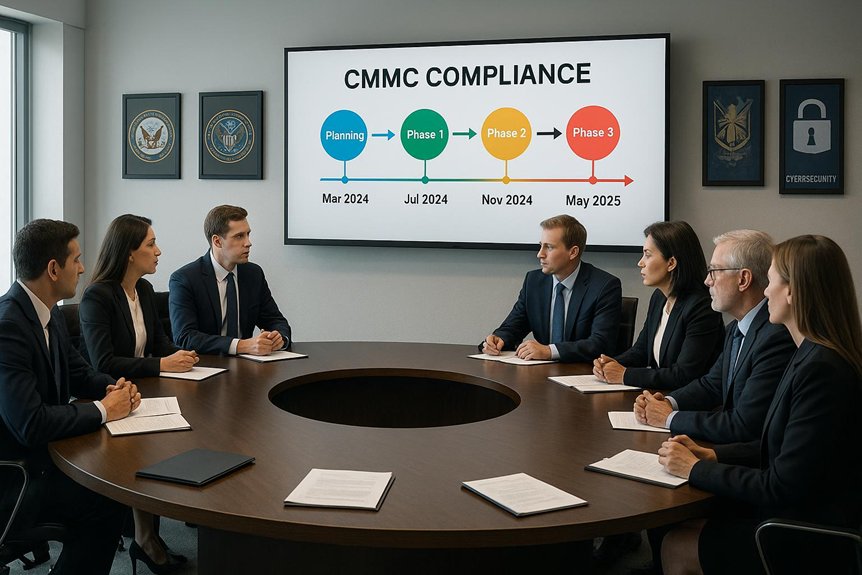
You’ll need to act fast on CMMC compliance since assessments began January 2, 2025, and all applicable DoD contracts will require certification by November 10, 2025. Achieving readiness typically takes 6-18 months, so time’s running short. Level 1 requires final certification before contract award, while Levels 2 and 3 offer conditional status during remediation. Your entire supply chain must also comply, making verification protocols essential. Understanding these phased requirements and deadlines will determine your organization’s contract eligibility.
Key Takeaways
- CMMC Final Rule becomes effective December 16, 2024, with assessments beginning January 2, 2025.
- All DOD contracts must include CMMC requirements by November 10, 2025, affecting contractor eligibility.
- Contractors need 6-18 months to achieve assessment readiness for CMMC Level 2 certification.
- Level 1 requires final certification before contract award; Levels 2-3 allow conditional status.
- CMMC compliance flows down through entire supply chains, requiring prime contractor verification of subcontractors.
CMMC Program Rule and Implementation Schedule
Since the CMMC Final Rule took effect on December 16, 2024, defense contractors now face a concrete timeline for achieving compliance with cybersecurity requirements.
The implementation schedule creates clear milestones you’ll need to meet as a DoD contractor.
Starting January 2, 2025, CMMC assessments begin, allowing you to evaluate your organization’s readiness for certification.
You can now assess your organization’s CMMC certification readiness as assessments officially launched January 2, 2025.
The Department of Defense won’t incorporate CMMC requirements into contracts until after November 10, 2025, giving you time to prepare.
The phased rollout means you’ll see CMMC requirements in select contracts during the first three years, with full implementation across all applicable contracts by Year 4.
Since achieving assessment readiness typically takes 6-18 months, you should begin your compliance timeline preparations immediately to meet these cybersecurity milestones.
Contractors handling CUI should plan for Level 2 third-party assessments aligned to NIST SP 800-171 while documenting SSPs and POA&Ms to stay on schedule.
Three-Year Phased Rollout Strategy
The DoD’s three-year phased rollout strategy spreads CMMC implementation across a manageable timeline, allowing you to adapt without overwhelming your organization’s resources.
Starting December 16, 2024, the CMMC compliance timeline introduces requirements in select contracts during the initial phase. You’ll see full implementation of DOD cybersecurity requirements by November 10, 2025, with all applicable contracts including CMMC by Year 4.
Since assessments typically require 6-12 months of compliance preparation, you should start planning immediately.
Your CMMC status directly impacts contract eligibility, with Level 1 requiring final certification at award time.
Don’t forget that implementation extends beyond your organization—you must verify subcontractors’ compliance before awarding contracts, ensuring your entire supply chain meets these cybersecurity standards.
For organizations handling Controlled Unclassified Information, CMMC Level 2 requires third-party assessments aligned to NIST SP 800-171, so early gap analysis and SSP development are critical.
CMMC Level Requirements and Assessment Timelines
Understanding CMMC’s three compliance levels helps you determine your assessment timeline and preparation strategy.
The CMMC level requirements establish clear cybersecurity assessments based on data sensitivity. Level 1 requires 17 practices for Federal Contract Information (FCI), while Level 2 demands 110 practices aligned with NIST SP 800-171 for Controlled Unclassified Information (CUI). Level 3 adds advanced controls for highly sensitive data.
Your CMMC compliance timeline depends on your target level. You’ll need 6-18 months for Level 2 certification readiness, starting preparation now for the Q1 2025 assessment launch.
The CMMC Final Rule requires 80% minimum scores for conditional certification. Prime contractors must guarantee subcontractors compliance throughout their supply chains, making early coordination essential for meeting the November 2025 contract requirement implementation.
Under CMMC 2.0, many contractors handling FCI can perform annual self-assessments, while Level 2 organizations handling CUI generally require third-party validation.
Contractor Certification Status and Deadlines
Beyond preparation timelines, contractors face specific certification deadlines that will determine their ability to compete for DOD contracts.
You’ll need valid contractor certification status starting November 10, 2025, when CMMC requirements become mandatory for new solicitations. By Year 4, all applicable DOD contracts will require CMMC compliance, making early preparation essential to meet these deadlines.
If you’re pursuing Levels 2 or 3, you can receive conditional status for up to 180 days during remediation, providing temporary relief while completing assessments.
However, Level 1 contractors must achieve final certification before contract award. You’ll also need to verify your subcontractors’ CMMC status before awarding contracts.
Non-compliance means you can’t win DOD contracts, making adherence to cybersecurity standards and these deadlines critical for business continuity.
Small businesses should note that CMMC Level 2 requires implementing all 110 NIST SP 800-171 controls and typically involves third-party assessments, which can affect timelines and budgeting.
Supply Chain Flow-Down and Compliance Preparation
As CMMC compliance requirements extend throughout your entire supply chain, you must secure that all subcontractors handling Federal Contract Information (FCI) or Controlled Unclassified Information (CUI) meet the specified compliance standards.
The DoD requirements create direct responsibility for prime contractors to maintain cybersecurity standards across all supply chain levels.
Your compliance preparation strategy should include:
- Verification protocols – Establish processes to confirm subcontractors’ current CMMC status before contract awards.
- Flow-down documentation – Confirm all subcontracts clearly specify required CMMC levels and compliance obligations.
- Phased implementation planning – Prepare for gradual rollout starting Year 1, reaching full enforcement by Year 4.
Non-compliance by subcontractors triggers contractual remedies including withheld payments or termination, making thorough supply chain oversight essential for successful CMMC compliance. Additionally, implement continuous monitoring to track vendor compliance metrics and quickly identify non-compliance issues throughout the supply chain.
Frequently Asked Questions
What Is the Timeline for CMMC Compliance?
You’ll face CMMC assessments starting Q1 2025, with full DoD enforcement beginning November 10, 2025.
You should start your CMMC assessment process now, following compliance certification steps and contractor preparation strategies.
Implementation occurs in phases through 2028. You’ll need cybersecurity training programs, a risk management framework, and must meet documentation requirements checklist.
Consider funding assistance options while developing audit readiness tips and continuous monitoring solutions to fulfill DoD contractor obligations.
What Is the Dod Cybersecurity Maturity Model Certification CMMC?
CMMC is the DoD’s cybersecurity framework requiring defense contractors to demonstrate specific security capabilities through a structured certification process.
You’ll need to meet compliance requirements across three levels, with Level 2 involving third-party assessments of 110 NIST controls.
The framework emphasizes risk management and continuous monitoring, ensuring you’re protecting sensitive government information.
This industry-wide impact affects all contractors handling FCI and CUI, requiring thorough implementation strategies for successful certification.
What Is the CMMC Program Mandates Cybersecurity Standards for Defense Contractors?
Ready to strengthen your defense contracting position? The CMMC program mandates cybersecurity standards requiring you to implement specific security measures based on your contract’s sensitivity level.
You’ll face compliance requirements ranging from 17 foundational practices to 110 advanced controls. Your contractor responsibilities include developing implementation strategies, undergoing the assessment process, and maintaining continuous monitoring.
Effective risk management guarantees you meet these cybersecurity standards throughout your defense contractor operations.
How Long Does It Take to Become CMMC Compliant?
You’ll typically need 6-18 months to become CMMC compliant, depending on your current cybersecurity posture and target level.
Timeline variations stem from compliance challenges like implementing 110 Level 2 practices and resource allocation decisions.
Your implementation strategies should include early training requirements and selecting certification bodies well before mid-2025 enforcement.
Assessment processes create bottlenecks, so you can’t afford delays given cost implications and industry benchmarks showing increasing audit frequency demands.
Conclusion
You’re steering through treacherous waters where CMMC compliance serves as your lighthouse, guiding defense contractors safely to shore. The three-year phased rollout isn’t just a timeline—it’s your lifeline. Without proper certification, you’ll find yourself shipwrecked, excluded from DoD contracts while competitors sail past. Don’t wait for the storm to hit; chart your course now, secure your vessel’s defenses, and make sure you’re seaworthy before the regulatory tide turns against you.