
You’ll need to meet specific CMMC cybersecurity standards based on three levels: Level 1 requires 17 basic security controls for Federal Contract Information, Level 2 demands 72 out of 110 NIST SP 800-171 controls for Controlled Unclassified Information, and Level 3 requires all 110 controls for critical national security data. Over 300,000 small businesses must comply to bid on DoD contracts, with third-party assessments required for Levels 2 and 3. Understanding these requirements will help you navigate the certification process effectively.
Key Takeaways
- Small businesses must achieve CMMC certification to bid on DoD contracts handling Federal Contract Information or Controlled Unclassified Information.
- Level 1 requires implementing 17 basic cybersecurity practices with self-assessment documentation for Federal Contract Information protection.
- Level 2 demands 72 out of 110 NIST SP 800-171 security controls with mandatory third-party assessment validation.
- Level 3 requires all 110 security controls plus annual assessments by Certified Third-Party Assessment Organizations for critical information.
- Over 300,000 small businesses must meet CMMC standards, with non-compliance preventing DoD contract eligibility entirely.
Understanding CMMC Framework and Its Three Compliance Levels
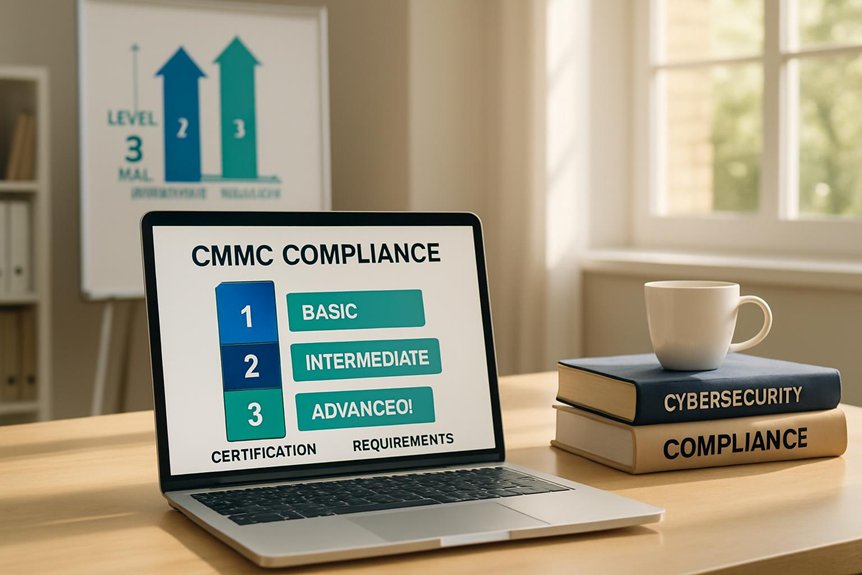
While traversing federal contracting requirements can seem overwhelming, the CMMC framework simplifies cybersecurity compliance by organizing standards into three distinct levels based on the sensitivity of information you’ll handle.
Level 1 targets basic cybersecurity practices for Federal Contract Information (FCI), requiring you to implement 17 fundamental security controls. This foundational level guarantees baseline protection for all federal contractors.
Level 2 focuses on safeguarding Controlled Unclassified Information (CUI) and aligns with FAR 52.204-21 requirements. You’ll need more extensive security measures at this level.
Level 3 incorporates advanced protections from NIST SP 800-172 for critical national security information, mandating third-party assessments.
CMMC 2.0 streamlines compliance by eliminating maturity processes and enabling annual self-assessments for many contractors across these compliance levels.
Which Small Businesses Must Comply With CMMC Standards
Understanding these compliance levels helps you determine your obligations, but knowing whether your small business falls under CMMC requirements depends on your specific role in federal contracting.
You’ll need CMMC certification if you’re bidding on Department of Defense contracts involving Federal Contract Information (FCI) or Controlled Unclassified Information (CUI). This applies regardless of whether you’re a prime contractor or subcontractor anywhere in the supply chain.
CMMC certification is mandatory for all DoD contractors and subcontractors handling Federal Contract Information or Controlled Unclassified Information.
Over 300,000 small businesses are expected to meet these cybersecurity standards.
You must carefully review contracts and solicitations for references to DFARS 252.204-7012, which indicates NIST SP 800-171 and CMMC compliance requirements.
If your business handles sensitive defense information, you’re subject to these mandatory standards. Non-compliance will jeopardize your ability to secure DoD contracts.
Level 1 Basic Cybersecurity Practices for Federal Contract Information

Since your small business handles Federal Contract Information, you must implement CMMC Level 1‘s 17 basic cybersecurity practices to remain eligible for DoD contracts.
These CMMC Requirements establish foundational cybersecurity hygiene that’s mandatory for all federal contractors, regardless of your company’s size or supply chain position.
The Level 1 practices focus on protecting Federal Contract Information (FCI) through essential security measures:
- Password Management – Implement strong password policies and multi-factor authentication
- System Updates – Maintain current security patches and software updates across all systems
- Documentation – Record your adherence to basic cybersecurity practices for compliance verification
You’ll need to complete self-assessments demonstrating your implementation of these practices.
This documentation guarantees you’re prepared for potential audits and maintains your eligibility for Department of Defense contracting opportunities.
Level 2 Advanced Requirements for Controlled Unclassified Information
When your small business handles Controlled Unclassified Information (CUI), you’ll need CMMC Level 2 certification, which requires implementing 72 of the 110 security controls outlined in NIST SP 800-171.
These advanced requirements focus on access control, incident response, and risk assessment practices that protect sensitive government information.
Unlike Level 1’s self-assessment approach, Level 2 demands third-party assessment by certified evaluators. You must also comply with FAR 52.204-21, establishing minimum security requirements for Federal Contract Information handling.
Documentation becomes critical for small businesses pursuing this certification. You’ll need thorough records of your cybersecurity policies and practices to demonstrate compliance during assessment.
This rigorous evaluation process guarantees your organization can adequately safeguard CUI throughout the contract lifecycle.
Level 3 Expert-Level Protection Standards and Implementation
CMMC Level 3 represents the highest tier of cybersecurity requirements, demanding that small businesses implement all 110 security controls from NIST SP 800-172 to protect critical national security information.
Achieving CMMC compliance at this level requires your organization to demonstrate expert-level protection capabilities for Controlled Unclassified Information (CUI). You’ll need annual third-party assessments by C3PAOs to validate your adherence to these stringent standards.
Your implementation strategy must include:
- Comprehensive System Security Plan – Document how you’ll manage CUI and implement required security controls.
- Advanced Risk Management – Conduct thorough risk assessments and maintain continuous monitoring systems.
- Personnel Training Programs – Guarantee staff understand their cybersecurity responsibilities and maintain compliance awareness.
These requirements position your business to handle the most sensitive government contracts while maintaining a robust cybersecurity posture.
Assessment and Certification Process for Small Defense Contractors
Once you’ve determined your organization meets Level 1, 2, or 3 requirements, you’ll need to navigate the formal assessment and certification process that validates your cybersecurity implementation.
Small businesses must first identify their covered environment’s scope and conduct thorough security gap assessments to prepare for CMMC certification.
Identify your covered environment’s scope and conduct comprehensive security gap assessments before pursuing CMMC certification.
You’ll select a Certified Third-Party Assessment Organization (C3PAO) to perform an in-depth evaluation of your cybersecurity practices.
The assessment process requires creating a detailed System Security Plan (SSP) that documents how you manage Controlled Unclassified Information and implement required controls.
This certification becomes mandatory for all contractors handling Federal Contract Information or CUI in defense contracts, with first contracts expected in FY 2025 under the simplified CMMC 2.0 framework.
Common Compliance Challenges and Resource Requirements
While the certification process provides a clear roadmap, small defense contractors face substantial obstacles when implementing CMMC requirements.
You’ll encounter significant financial burdens as cybersecurity requirements demand costly technology upgrades and specialized security tools. Your limited IT resources and expertise can’t easily navigate complex regulations, increasing non-compliance risks.
The most pressing challenges you’ll face include:
- Financial constraints – High implementation costs strain budgets already allocated for core operations
- Technical limitations – Outdated systems require expensive upgrades to meet evolving standards
- Resource allocation – Time-consuming assessments and documentation divert focus from primary business activities
CMMC compliance success for small businesses depends on accessing funding opportunities, grants, and partnerships with managed service providers.
These resources help bridge the gap between your current capabilities and required cybersecurity standards.
Strategic Steps to Achieve and Maintain CMMC Certification
Success in CMMC certification isn’t achieved overnight—it requires a systematic approach that transforms your cybersecurity practices step by step.
Begin with a thorough gap analysis to identify deficiencies between your current security measures and CMMC requirements. This assessment reveals exactly which controls you need to implement for your target compliance level.
A comprehensive gap analysis forms the foundation of CMMC success by pinpointing exactly which security controls require implementation.
Next, develop your System Security Plan (SSP) documenting how you’ll manage Controlled Unclassified Information and demonstrate compliance. For Level 1 certification, focus on implementing the 17 basic cybersecurity practices protecting Federal Contract Information.
Engage a certified third-party assessment organization (C3PAO) for formal evaluation, especially when handling critical national security information.
Finally, establish continuous monitoring protocols and conduct regular internal audits to maintain CMMC compliance and identify emerging vulnerabilities before they compromise your certification status.
Frequently Asked Questions
What Companies Need to Be CMMC Certified?
You’ll need CMMC certification if your company handles Federal Contract Information or Controlled Unclassified Information in defense contracts, regardless of your supply chain position.
The CMMC certification process affects over 300,000 Defense Industrial Base businesses. You can’t bid on DoD contracts without proper certification starting in fiscal year 2025.
Small business compliance requires implementing cybersecurity best practices that match your contract’s specific CMMC level requirements under the streamlined 2.0 framework.
Who Needs to Be CMMC Certified?
You’ll need CMMC certification if you’re a contractor or subcontractor handling Federal Contract Information or Controlled Unclassified Information in defense contracts.
The CMMC certification process affects over 300,000 businesses across all supply chain levels.
Small business eligibility depends on your contract requirements, particularly those referencing DFARS 252.204-7012.
You’ll face cybersecurity compliance challenges regardless of your company size if you’re part of the Defense Industrial Base and work with sensitive government data.
Can You Self-Certify for CMMC?
Can you imagine the relief of handling your own compliance verification? Yes, you can self-certify for CMMC Level 1, avoiding expensive third-party assessments.
Your CMMC self assessment allows you to document compliance with 17 basic cybersecurity practices.
However, CMMC compliance challenges increase at higher levels—Level 2 requires documented self-assessments with potential third-party reviews, while Level 3 mandates external assessments.
The CMMC certification process varies based on your contract’s specific requirements and information sensitivity levels.
How Much Does It Cost to Get CMMC Certified?
CMMC certification costs vary widely based on your organization’s size and complexity.
You’ll face cost factors including gap analyses ($2,000-$10,000), third-party assessments ($10,000-$40,000), and implementing required cybersecurity controls.
Total expenses range from $5,000 to over $100,000.
When budgeting for CMMC, consider that CMMC 2.0’s Plan of Actions and Milestones allows you to spread compliance costs over time, making certification more manageable for your business.
Conclusion
Think of CMMC certification as building a fortress around your small business’s digital kingdom. You’re not just checking boxes—you’re constructing walls that’ll protect your castle from cyber invaders. Each compliance level adds another layer of defense, from basic moats to advanced watchtowers. Yes, the journey’s demanding and resource-intensive, but once you’ve fortified your defenses, you’ll stand ready to defend both your business and the nation’s secrets with confidence.