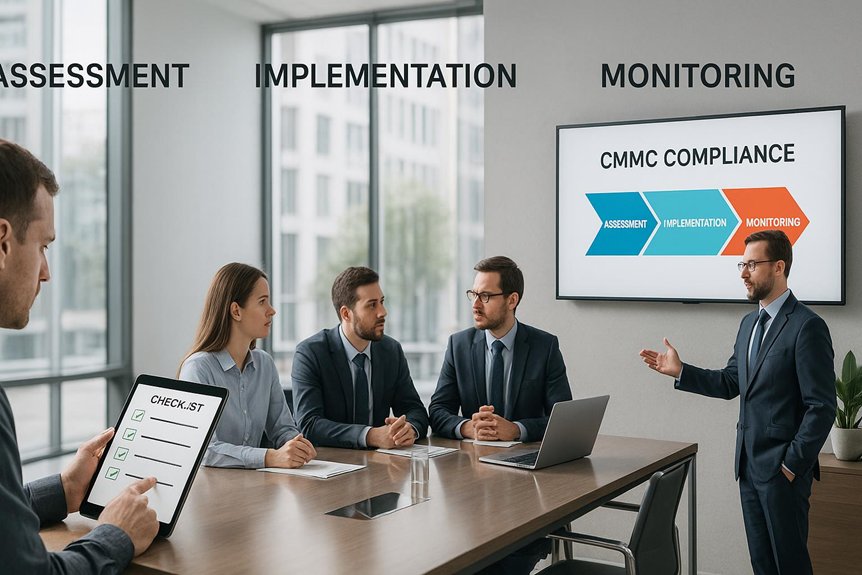
You’ll achieve CMMC compliance through three essential steps: First, conduct a thorough security assessment and gap analysis by evaluating your current cybersecurity practices against CMMC requirements, identifying vulnerabilities affecting Controlled Unclassified Information, and mapping existing controls to NIST SP 800-171 standards. Second, develop required documentation including your System Security Plan and implement necessary security controls. Third, prepare for third-party assessment by engaging a C3PAO early and conducting internal audits—the complete roadmap awaits below.
Key Takeaways
- Conduct a comprehensive security assessment to evaluate current practices against CMMC requirements and identify compliance gaps.
- Establish clear system boundaries and develop required documentation including System Security Plans and compliance policies.
- Implement necessary security controls based on NIST SP 800-171 requirements to address identified vulnerabilities.
- Engage a CMMC Third Party Assessment Organization early to understand assessment methodology and requirements.
- Train key personnel on compliance roles and prepare staff for employee interviews during formal assessments.
Conduct a Comprehensive Security Assessment and Gap Analysis
 Before you can achieve CMMC compliance, you’ll need to conduct a thorough security assessment that evaluates your current cybersecurity practices against CMMC requirements. This assessment identifies vulnerabilities and non-compliance areas, particularly those affecting Controlled Unclassified Information (CUI).
Start with a detailed gap analysis to document deficiencies in your security controls. Map your existing controls to NIST SP 800-171 requirements and specific CMMC levels to establish a compliance baseline.
Map your existing security controls against NIST SP 800-171 requirements to establish a clear CMMC compliance baseline.
You’ll also need to create a detailed asset inventory that categorizes systems, devices, and applications based on their sensitivity and role.
Define clear system boundaries and document your entire system scope thoroughly. This documentation becomes essential for your System Security Plan (SSP) and guarantees accurate representation of your security posture throughout the compliance process.
Develop and Implement Required Documentation and Controls
Once you’ve identified gaps through your security assessment, you must develop thorough documentation that forms the foundation of your CMMC compliance framework.
Create a detailed System Security Plan that describes your information system and outlines security controls aligned with CMMC standards. Develop a Plan of Action and Milestones to address identified gaps, assign responsibilities, and establish timelines for achieving maximum self-assessment scores.
You’ll need to document all policies and procedures reflecting NIST 800-171 requirements for protecting Controlled Unclassified Information.
Conduct regular self-assessment evaluations using DoD’s methodology to monitor your compliance process effectiveness. Keep your documentation current by updating records as you implement enhancements, ensuring accurate evidence for external assessments and maintaining ongoing CMMC compliance.
Prepare for Third-Party Assessment and Certification

After establishing your documentation framework, you’ll need to engage a CMMC Third Party Assessment Organization (C3PAO) early in your compliance journey to understand the specific assessment methodology and requirements that apply to your organization.
Prepare thorough documentation of all implemented security controls, ensuring they align with CMMC requirements for assessment review.
Comprehensive documentation of security controls must demonstrate clear alignment with CMMC standards to ensure successful assessment outcomes.
Conduct internal audits and mock assessments to identify potential issues before your official evaluation. This proactive approach greatly enhances your readiness.
Schedule your C3PAO assessment through an accredited provider listed on The Cyber AB Marketplace to secure timely evaluation.
Ensure key personnel receive proper training sessions and understand their roles during the assessment process. They’ll need preparation for employee interviews and artifact checks that assessors will conduct.
Frequently Asked Questions
How to Achieve CMMC Compliance?
You’ll achieve CMMC compliance by first understanding the CMMC framework overview and conducting detailed compliance assessment processes.
Implement cybersecurity best practices and robust risk management strategies while meeting all documentation requirements.
Establish extensive employee training programs and prepare for third party audits through continuous monitoring techniques.
Develop solid incident response planning to address implementation challenges.
You’ll need to maintain ongoing vigilance, regularly update your security posture, and guarantee all controls remain effective throughout your compliance journey.
What Are the Stages of CMMC?
Think of CMMC stages as stepping stones across a river toward cybersecurity success.
You’ll start with a readiness assessment to gauge your current position, then develop implementation plans addressing gaps.
Next, you’ll document security controls and prepare for audit preparation through self-assessment tips.
The assessment process involves C3PAO evaluation across certification levels.
Finally, you’ll establish continuous monitoring as part of your ongoing compliance roadmap to maintain your CMMC certification.
How to Get CMMC Level 1 Certified?
To get CMMC Level 1 certified, you’ll start with a CMMC requirements overview, then create a compliance checklist covering 17 basic controls.
Focus on security controls implementation like access management and system protection.
Follow documentation best practices when developing your System Security Plan. Include incident response planning and basic risk management strategies.
Develop training programs for staff awareness. Establish continuous monitoring techniques, use assessment preparation tips for your annual self-assessment, and plan your certification process timeline accordingly.
How to Get CMMC 2.0 Certification?
Studies show 75% of organizations underestimate their CMMC readiness timeline.
You’ll need to master the cybersecurity maturity model requirements, starting with a thorough CMMC requirements overview. Develop robust compliance assessment strategies and establish a solid risk management framework.
Focus on documentation best practices while implementing training and awareness programs. Engage certified assessors early, establish continuous monitoring techniques, and prepare for implementation challenges.
The certification process timeline typically spans 12-18 months depending on your current security posture.
Conclusion
You’ve mapped your path to CMMC compliance through assessment, implementation, and certification preparation. Coincidentally, as you’re reading this, cyber threats are evolving at breakneck speed, making your compliance journey more critical than ever. You can’t afford to delay—every moment you hesitate, you’re potentially exposing your organization to devastating breaches. The three steps aren’t just regulatory requirements; they’re your shield against an increasingly dangerous digital landscape that’s targeting businesses just like yours.