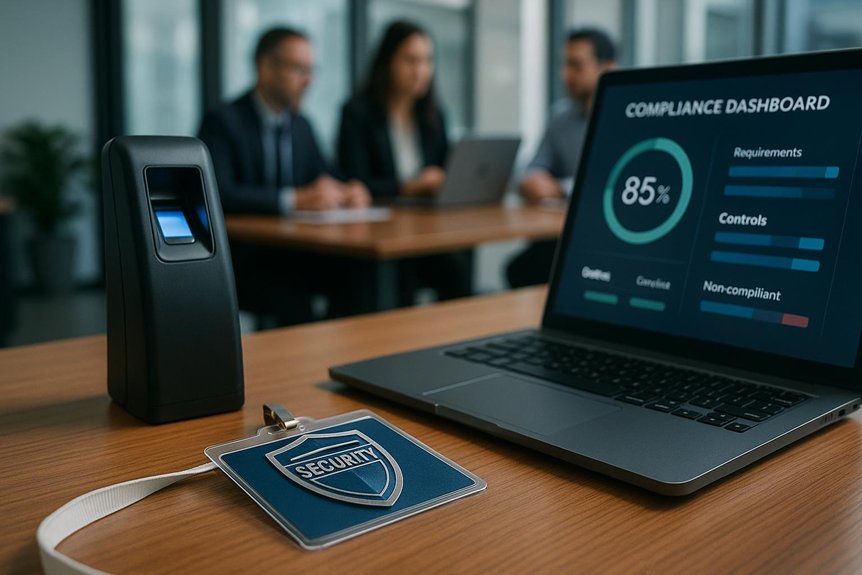
You’ll need to implement 22 specific Access Control requirements from NIST SP 800-171 to achieve CMMC Level 2 compliance when handling CUI or FCI. Focus on establishing role-based access controls, multi-factor authentication, and least privilege principles while maintaining detailed audit logs for at least 90 days. You must conduct regular security assessments, provide employee training on access protocols, and integrate continuous monitoring systems to detect unauthorized access attempts. The thorough strategies below will guide your complete implementation.
Key Takeaways
- Implement Role-Based Access Control (RBAC) with documented role definitions and permissions aligned to job functions for CMMC Level 2.
- Deploy multi-factor authentication (MFA) integrated with access controls to verify user identities before granting system access.
- Maintain comprehensive audit logs recording all CUI interactions with user IDs, timestamps, and actions for 90+ days minimum.
- Establish least privilege principles ensuring users only access information necessary for their specific job responsibilities and duties.
- Conduct regular access reviews and security assessments to verify control effectiveness and maintain continuous NIST 800-171 compliance.
Understanding CMMC Access Control Domain Requirements
When organizations handle federal contracts involving Controlled Unclassified Information (CUI) or Federal Contract Information (FCI), they must implement robust access control measures under the CMMC framework.
CMMC Level 2 compliance requires you to address 22 specific Access Control requirements derived from NIST SP 800-171, establishing thorough security protocols for your systems.
You’ll need to focus on essential practices including user identification protocols, implementing the principle of least privilege, and controlling remote access to sensitive data.
Your organization must maintain detailed audit logs to track all access activities and demonstrate accountability during assessments.
Comprehensive audit logs serve as your digital paper trail, proving compliance and enabling accountability when assessors review your access control practices.
Regular security assessments verify your access controls remain effective and compliant.
These evaluations help you identify vulnerabilities and confirm that your implemented controls adequately protect CUI throughout your organization’s infrastructure and processes.
Additionally, implement multi-factor authentication and document it in your System Security Plan (SSP) to strengthen defenses and demonstrate compliance during audits.
Role-Based Access Control Implementation for Defense Contractors
Effective access control implementation hinges on establishing a well-structured Role-Based Access Control (RBAC) system that aligns user permissions with specific job functions and organizational responsibilities.
For defense contractors pursuing CMMC compliance, you’ll need to implement access control policies that enforce the least privilege principle while protecting sensitive information through strategic user access management.
Your RBAC implementation should follow these essential steps:
- Define organizational roles based on specific job responsibilities and create corresponding access permissions that limit exposure to sensitive information.
- Document role definitions and access rights to meet CMMC Level 2 requirements and support ongoing audits.
- Deploy Identity and Access Management (IAM) systems to automate monitoring, reporting, and role assignment processes.
- Conduct regular access reviews to guarantee user permissions remain aligned with current job functions and organizational changes.
Additionally, align RBAC with NIST 800-171 practices and include access controls in your System Security Plan (SSP) to support CMMC Level 2 readiness.
Multi-Factor Authentication and Identity Verification Strategies
Beyond traditional password-based authentication, multi-factor authentication (MFA) serves as your organization’s critical defense layer for meeting CMMC Level 2 requirements and protecting Controlled Unclassified Information (CUI).
You’ll need to implement identity verification through multiple factors—combining passwords with biometric scans or one-time mobile codes—to prevent unauthorized access to sensitive systems.
Integrating MFA with Role-Based Access Control ensures only cleared personnel access appropriate data levels. Your cybersecurity posture strengthens through continuous monitoring of MFA logs, enabling rapid detection of suspicious access patterns.
Effective access control requires thorough employee training on identity verification protocols and phishing recognition.
You’ll maintain compliance by regularly auditing authentication logs and updating verification strategies to address evolving threats targeting defense contractor environments.
To align with CMMC 2.0 expectations, conduct periodic risk assessments using frameworks like NIST SP 800-30 and document updates to authentication controls as new threats emerge.
Centralized Access Management Systems and Least Privilege Principles
While multi-factor authentication provides robust identity verification, centralized access management systems form the backbone of your organization’s extensive security framework by consolidating user permissions and enforcing least privilege principles across all systems.
These systems strengthen your security posture through role-based access control (RBAC), ensuring users can’t exceed their designated responsibilities. You’ll reduce unauthorized access risks while maintaining CMMC Level 2 requirements compliance for Controlled Unclassified Information (CUI) protection.
RBAC systems prevent privilege escalation while ensuring your organization meets stringent CMMC Level 2 compliance standards for sensitive data protection.
Key implementation strategies include:
- Unified Permission Management – Streamline user account oversight through single-platform control
- Role-Based Restrictions – Align access rights with specific job functions and responsibilities
- Privileged Account Monitoring – Deploy Privileged Identity Management tools for enhanced oversight
- Compliance Auditing – Conduct regular audits to identify permission discrepancies and maintain standards
Integrating these controls supports adherence to NIST SP 800-171 requirements and strengthens operational resilience mandated by CMMC for defense contractors.
Audit Logging and Continuous Monitoring of Access Activities
Once you’ve established centralized access management, thorough audit logging becomes your organization’s digital watchdog, meticulously recording every interaction with Controlled Unclassified Information (CUI) to create an unbreakable chain of accountability.
Each access attempt gets documented with user IDs, timestamps, and specific actions taken, ensuring complete traceability of access activities.
Continuous monitoring transforms these logs into actionable intelligence, detecting unusual behavior and unauthorized access attempts in real-time. This enables swift incident response and strengthens your security measures against potential breaches.
CMMC Level 2 compliance mandates retaining audit logs for 90 days minimum, supporting thorough assessments.
Implementing SIEM tools automates log analysis and correlation, enhancing threat detection efficiency.
Regular audits verify adherence to access control policies, identifying compliance gaps and driving continuous improvement.
To reinforce compliance and security, integrate real-time SIEM monitoring with regular vulnerability assessments as part of a continuous monitoring framework.
Employee Training and Security Awareness Programs
Even the most sophisticated technical controls fail when employees inadvertently compromise security through human error or lack of awareness.
Employee training on access control policies forms the foundation of your CMMC compliance strategy, ensuring staff understand their critical role in protecting Controlled Unclassified Information.
Your security awareness programs should encompass:
- Core Principles Training – Educate employees on least privilege concepts and multi-factor authentication requirements
- Periodic Training Sessions – Conduct regular updates on emerging threats and access control protocols
- Interactive Training Methods – Implement simulations and quizzes to enhance engagement and knowledge retention
- Assessment and Improvement – Use employee evaluations and feedback mechanisms for continuous improvement
These thorough training initiatives create a security-conscious workforce that actively supports your access control objectives while maintaining CMMC compliance standards.
Organizations should reinforce training with ongoing continuous monitoring and regular internal assessments to validate adherence to CMMC controls and quickly address gaps.
Regular Security Assessments and Compliance Validation
Although implementing robust access controls marks an essential milestone in CMMC compliance, you can’t simply set these systems and forget them. Regular security assessments guarantee your access control systems remain effective against evolving vulnerabilities while maintaining CMMC requirements adherence.
You’ll need to conduct penetration tests and vulnerability scans that verify compliance with NIST 800-171 guidelines. These assessments strengthen your cybersecurity posture by identifying weaknesses before attackers exploit them.
Internal audits must evaluate your access control policies regularly, documenting gaps and implementing corrective measures. This compliance validation process creates essential documentation for third-party assessments by C3PAOs.
Your security assessments also establish a digital paper trail that supports incident response investigations, demonstrating your commitment to maintaining robust access controls throughout your CMMC journey.
To support ongoing compliance, maintain up-to-date System Security Plan documentation and record all remediation actions, ensuring auditors can verify changes against CMMC and NIST SP 800-171 requirements.
Frequently Asked Questions
What Are the Typical Costs for Implementing CMMC Access Control Solutions?
You’ll face varied costs depending on your organization’s size and complexity.
Your budget considerations should include software licensing ($10,000-$100,000+), hardware expenses for authentication systems, training programs for staff, and ongoing maintenance fees.
Consultation services typically range $150-$300 hourly, while implementation timelines span 6-18 months.
Factor in risk assessment costs, compliance audits, and your specific cost breakdown will depend on current infrastructure gaps and required security controls.
How Long Does It Take to Achieve Full CMMC Access Control Compliance?
Achieving full compliance isn’t lightning-fast – you’re looking at 12-18 months typically.
Your implementation timeline depends on current infrastructure and compliance phases you’ll navigate. You’ll need strategic resource allocation for staff training, documentation processes, and technology upgrades.
Assessment procedures and risk management frameworks require thorough planning. Factor in audit frequency requirements and ongoing maintenance responsibilities.
Don’t rush – proper preparation guarantees sustainable compliance rather than scrambling later.
Which Third-Party Vendors Are Recommended for CMMC Access Control Tools?
You’ll find strong vendor partnerships with Microsoft (Azure AD), Okta, and CyberArk for access control tools.
These providers offer compliance certifications and proven tool effectiveness for CMMC requirements. You should conduct third party evaluations comparing security features, software scalability, and cost comparisons before selecting.
Consider integration challenges with existing systems, available support services, and thorough user training programs. Each vendor provides different strengths in meeting your specific CMMC access control needs.
What Happens if We Fail Our Initial CMMC Access Control Assessment?
While failing isn’t ideal, you’ll receive detailed remediation strategies outlining specific corrective actions needed.
Your assessment timeline extends, delaying compliance implications and contract eligibility.
You’ll need thorough stakeholder engagement to address gaps through enhanced training programs and updated documentation requirements.
Strong risk management becomes essential during this period.
The audit processes help identify exact deficiencies, and your assessor guides preparation for future assessments.
Don’t panic—most organizations succeed after implementing recommended improvements.
Can Existing Legacy Systems Be Integrated With New CMMC Access Controls?
Yes, you can integrate legacy systems with new CMMC access controls, but you’ll face legacy integration challenges and access control compatibility issues.
You’ll need system modernization strategies to address data migration issues and conduct thorough cybersecurity risk assessments.
Don’t overlook user training requirements, vendor support options, and compliance documentation needs.
Consider regulatory update impacts and develop long-term maintenance planning to guarantee sustained compliance and security effectiveness.
Conclusion
You’ve mastered the technical complexities of CMMC access controls, yet your greatest challenge isn’t configuring systems—it’s maintaining human vigilance. While you’ll implement sophisticated multi-factor authentication and centralized management, don’t forget that your employees remain both your strongest asset and weakest link. You can design perfect audit trails and least privilege frameworks, but without consistent training and awareness, you’re building digital fortresses with open doors. Balance technology with humanity.