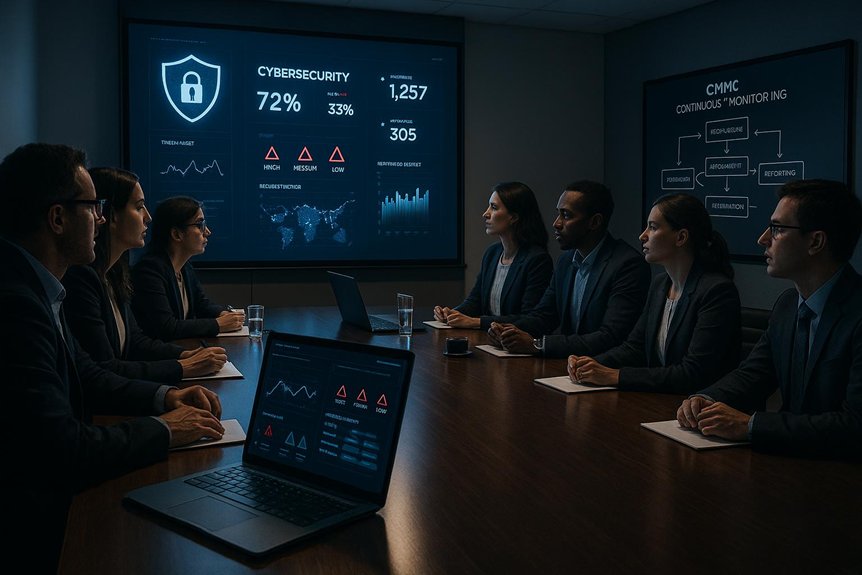
You’ll need to implement CMMC continuous monitoring through real-time threat detection using SIEM systems, regular vulnerability assessments, and thorough audit log reviews to maintain compliance with control CA.L2-3.12.3. You must establish automated tools for anomaly detection, centralized log aggregation, and multi-factor authentication while training your staff to recognize security threats. You should develop extensive monitoring plans, invest in advanced detection technologies, and schedule regular policy reviews to prevent audit failures and strengthen your cybersecurity posture through proactive measures.
Key Takeaways
- Implement real-time SIEM systems and automated monitoring tools to detect security incidents and maintain continuous oversight of CUI access.
- Conduct regular vulnerability assessments and configuration management reviews to identify weaknesses before they compromise CMMC compliance standards.
- Establish comprehensive audit logging systems that document all user interactions with CUI, including identities, timestamps, and specific actions taken.
- Develop robust staff training programs that build a security-conscious culture and ensure all employees understand continuous monitoring requirements.
- Create documented monitoring procedures with regular compliance assessments and metrics to demonstrate ongoing adherence to CMMC requirements.
Understanding CMMC Continuous Monitoring Requirements and Framework
As cyber threats evolve at an unprecedented pace, CMMC Continuous Monitoring serves as your organization’s vigilant sentinel, ensuring security controls remain effective against emerging risks.
Under Control CA.L2-3.12.3, you’re required to implement ongoing monitoring that proactively safeguards Controlled Unclassified Information (CUI) within your systems.
Your continuous monitoring framework must integrate real-time threat detection capabilities through Security Information and Event Management (SIEM) systems, enabling swift identification and response to security incidents.
Regular vulnerability assessments form the backbone of this strategy, allowing you to discover and remediate weaknesses before exploitation occurs.
This proactive approach prevents compliance drift and maintains your robust security posture over time.
Key Components of an Effective Continuous Monitoring Strategy for CMMC Compliance
When building your CMMC continuous monitoring strategy, you’ll need to integrate five critical components that work together to create a thorough security framework.
These elements strengthen your security posture through a proactive approach that addresses vulnerabilities before they become costly breaches.
Your continuous monitoring foundation requires:
- Real-time threat detection using Security Information and Event Management (SIEM) systems that instantly identify suspicious activities threatening your CUI
- Regular vulnerability assessments that uncover hidden weaknesses before attackers exploit them
- Comprehensive audit log reviews that catch unauthorized activities and maintain accountability across your systems
- Rigorous configuration management that prevents dangerous deviations from security baselines
- Robust incident response planning that minimizes breach impact and guarantees CMMC compliance
These components work synergistically to maintain continuous CMMC compliance and protect your organization’s sensitive information.
Automated Tools and Technologies for Real-Time CMMC Monitoring
While manual monitoring processes can’t keep pace with today’s sophisticated cyber threats, automated tools transform your CMMC compliance efforts by delivering the speed and accuracy necessary to protect Controlled Unclassified Information in real-time.
Security Information and Event Management (SIEM) systems anchor your continuous monitoring strategy by collecting and analyzing data instantaneously to detect security incidents and compliance deviations.
Anomaly detection technologies automatically flag unusual user activities, identifying potential unauthorized access before damage occurs. Log aggregation solutions centralize audit logs from multiple sources, providing thorough visibility into system activities required for CMMC compliance.
Automated anomaly detection and centralized log aggregation deliver the comprehensive visibility essential for maintaining continuous CMMC compliance across all systems.
Vulnerability assessment tools continuously scan your infrastructure, enabling proactive remediation of security weaknesses before auditors discover them.
Multi-factor authentication (MFA) integrated into monitoring systems guarantees only authorized personnel access sensitive information, strengthening your real-time data analysis capabilities while supporting strict CMMC standards.
Establishing Comprehensive Logging and Audit Trail Systems
Building thorough logging and audit trail systems requires you to capture every interaction with Controlled Unclassified Information, creating an unbreakable chain of accountability that meets CMMC’s stringent Audit and Accountability requirements.
Your all-encompassing logging strategy must document user identities, access times, and specific actions taken with CUI. You’ll need robust access controls and security measures like multi-factor authentication to protect audit logs from tampering.
Regular analysis helps identify unusual activities and guarantees regulatory requirements compliance.
- Sleep peacefully knowing every CUI interaction is meticulously tracked and protected
- Breathe easier with automated tools handling complex log collection and anomaly detection
- Feel confident during audits with detailed records spanning minimum one-year retention
- Stay ahead of threats through real-time monitoring of suspicious access patterns
- Build trust with stakeholders through transparent, tamper-proof audit trails
Automated tools streamline this process while enhancing your organization’s CMMC compliance posture.
Risk Assessment Integration and Vulnerability Management Processes
Your thorough logging foundation sets the stage for implementing integrated risk assessment and vulnerability management processes that transform raw audit data into actionable security intelligence.
Risk assessment integration guarantees you can identify, evaluate, and prioritize risks associated with Controlled Unclassified Information (CUI) within your continuous monitoring framework. You’ll need automated scanning tools conducting quarterly vulnerability assessments, aligning with NIST recommendations for proactive security measures.
Establishing robust vulnerability management processes involves timely patching and remediation of identified weaknesses. Your automated systems should continuously assess vulnerabilities, enabling swift threat response while maintaining CMMC compliance.
Staff Training and Organizational Culture for Continuous Monitoring
Since technology alone can’t guarantee CMMC compliance, your organization’s human element becomes the cornerstone of effective continuous monitoring implementation. You must invest in thorough staff training that transforms employees into vigilant defenders of your security posture.
Your training programs should emphasize how continuous monitoring directly supports CMMC requirements and protects sensitive data.
Building a culture of cybersecurity requires proactive engagement from every team member. You’ll need regular refresher courses covering emerging threats and monitoring techniques. When employees understand their critical role in identifying unusual activities, they become active participants in your compliance strategy.
Consider these emotional impacts of inadequate training:
- • Your organization’s reputation destroyed by preventable security breaches
- • Customer trust shattered through compromised sensitive information
- • Employee guilt from unknowingly enabling cyber attacks
- • Financial devastation from compliance failures and penalties
- • Career consequences affecting your entire team’s future
Cultivating strong organizational culture guarantees sustainable monitoring success.
Measuring Success and Maintaining Long-Term CMMC Compliance

Although implementing continuous monitoring establishes your foundation for CMMC compliance, you must establish quantifiable metrics that demonstrate ongoing adherence to CMMC 2.0 requirements.
You’ll measure success through tracked vulnerabilities resolved, threats detected, and security controls effectiveness rates. Your audit process becomes streamlined when you integrate SIEM systems and automation tools that provide real-time visibility into your security posture.
You should conduct regular reviews of your monitoring processes, incorporating lessons learned from previous assessments to identify gaps proactively.
This approach transforms your organization from reactive to implementing proactive measures that prevent audit failures. By establishing clear benchmarks for threat detection capabilities and continuous monitoring performance, you’ll maintain long-term CMMC compliance while fostering a culture of security vigilance throughout your organization.
Frequently Asked Questions
What Happens if Continuous Monitoring Detects a Compliance Violation During Contract Performance?
When you detect a compliance violation during contract performance, you’ll face immediate contract ramifications requiring swift violation reporting to stakeholders.
You must implement remediation strategies and corrective actions while following established notification protocols.
Conduct thorough risk assessment to gauge severity, then execute communication plans with your team.
Provide targeted compliance training to prevent recurrence and maintain audit readiness.
Delayed response risks compliance penalties and potential contract termination.
How Does Continuous Monitoring Impact Existing Incident Response Procedures and Timelines?
You’ll need to integrate monitoring tools with your existing incident response procedures to guarantee compliance alignment.
Automated alerts from continuous monitoring will trigger faster threat detection, requiring timeline adjustments to your current response protocols.
Your staff training must cover how monitoring data enhances risk assessment capabilities.
You’ll also need to update incident documentation procedures to capture monitoring insights, ultimately improving response efficiency while maintaining CMMC compliance requirements throughout the incident lifecycle.
Can Continuous Monitoring Data Be Used as Evidence During Formal Audits?
You’ll find that continuous monitoring data serves as powerful evidence during formal audits when properly collected and maintained.
Your monitoring tools create thorough audit trails that demonstrate ongoing compliance efforts and data integrity.
Through systematic evidence collection and presentation, you’ll show auditors your commitment to continuous improvement.
However, you must guarantee your compliance documentation meets audit readiness standards and your team receives proper compliance training for effective evidence presentation during risk assessment reviews.
What Are the Insurance Implications of Implementing CMMC Continuous Monitoring Systems?
Picture sleepless nights worrying about cyber incidents draining your bank account.
You’ll find insurance coverage often improves when you implement continuous monitoring systems. Risk assessment becomes more accurate, potentially leading to premium impacts and favorable policy adjustments.
However, liability concerns and compliance costs require careful evaluation. Cybersecurity insurance providers appreciate proactive monitoring for claim processes and breach notifications.
You’ll need to weigh financial implications against enhanced protection benefits.
How Should Organizations Handle Continuous Monitoring During System Migrations or Upgrades?
You’ll face significant compliance challenges during system migrations requiring strategic upgrade strategies and thorough risk assessment.
Maintain data integrity by selecting compatible monitoring tools that won’t disrupt operations.
Engage stakeholders early, addressing training requirements for new systems.
Consider budget considerations for dual-system operations during changes.
Establish performance metrics to track migration success while preserving continuous monitoring capabilities.
Don’t let system alterations create security gaps—plan meticulously to guarantee seamless monitoring throughout the entire upgrade process.
Conclusion
Think of CMMC continuous monitoring as tending a digital garden—you can’t just plant seeds and walk away. You’re the gardener who must water, weed, and watch for threats daily. Your automated tools become your irrigation system, your staff training transforms into fertile soil, and your audit trails form the protective fence. Without this constant cultivation, your cybersecurity garden will wither, leaving you vulnerable when assessors arrive to inspect your harvest.