
You’ll need to complete eight essential steps for CMMC compliance: determine your required maturity level based on the data you handle, establish compliance boundaries and documentation including a System Security Plan, conduct thorough self-assessments against 110 practices for Level 2, create Plans of Action and Milestones for gaps, implement technology solutions like encryption and multi-factor authentication, and prepare for mandatory third-party C3PAO assessment. The detailed guide below outlines each critical phase.
Key Takeaways
- Determine your required CMMC level based on data type: Level 1 for FCI or Level 2 for CUI handling.
- Define compliance boundaries, map CUI data flows, and develop a comprehensive System Security Plan documenting current controls.
- Conduct thorough self-assessment against 110 Level 2 practices and submit scores to DoD’s SPRS system regularly.
- Implement technology solutions including encryption, multi-factor authentication, secure cloud services, and regular system patching for CUI protection.
- Create Plans of Action and Milestones for unmet controls while preparing for mandatory third-party compliance assessments.
Understanding CMMC Framework and Compliance Levels
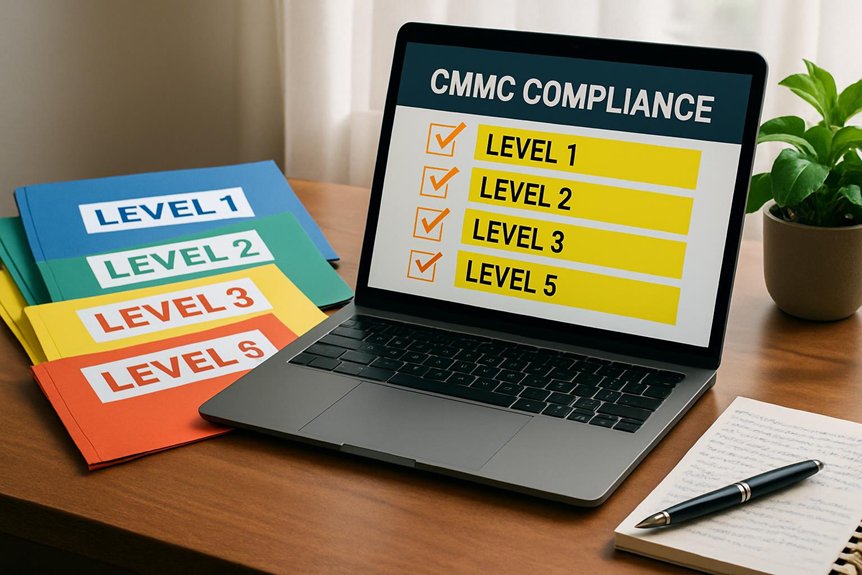
Before you can develop an effective compliance strategy, you must understand that the Cybersecurity Maturity Model Certification (CMMC) framework establishes mandatory cybersecurity standards for all Defense Industrial Base contractors.
The framework includes three distinct compliance levels that determine your certification requirements.
Level 1 addresses basic cybersecurity practices for protecting Federal Contract Information through fundamental cyber hygiene measures.
Level 2 aligns with NIST SP 800-171 requirements and applies when you handle Controlled Unclassified Information (CUI).
Level 3 incorporates advanced cybersecurity practices for the most sensitive contracts.
You’ll need independent third-party assessments to verify your compliance with the appropriate CMMC level.
Most contractors must achieve Level 2 certification since CUI handling is common across Defense Industrial Base contracts, making this your likely compliance target.
Determining Your Required CMMC Maturity Level
How do you determine which CMMC maturity level applies to your organization? Your required CMMC maturity level depends entirely on the type of information you handle.
Your CMMC maturity level requirement is determined solely by the type of sensitive information your organization processes and handles.
If you process only Federal Contract Information (FCI), you’ll need Level 1 compliance, which focuses on basic cybersecurity hygiene and allows annual self-assessments. However, if you handle Controlled Unclassified Information (CUI), you must meet Level 2 standards aligned with NIST SP 800-171, requiring third-party assessments.
Under CMMC 2.0, all DoD contractors and subcontractors must achieve compliance readiness based on their information processing requirements.
Prime contractors must also guarantee their entire supply chain meets necessary CMMC requirements. Start your assessment early, as achieving compliance typically takes 6-18 months before CMMC rollout in DoD contracts.
Establishing Compliance Boundaries and Documentation

Once you’ve determined your CMMC maturity level, you’ll need to establish clear compliance boundaries that define exactly which systems, networks, and data fall under CMMC requirements.
Start by identifying where Controlled Unclassified Information (CUI) flows through your organization and limit access to authorized personnel only. This boundary definition directly impacts your security requirements and determines which NIST 800-171 security controls apply to your environment.
- Develop a thorough System Security Plan (SSP) early to document existing security controls and create a living document for ongoing updates.
- Create a Customer Responsibility Matrix (CRM) with Cloud Service Providers to clarify shared responsibilities for protecting sensitive data.
- Implement policy and procedure documents for each applicable security control.
- Maintain regular documentation updates throughout your CMMC compliance journey.
Conducting Self-Assessment and Scoring Controls
With your compliance boundaries clearly defined and documentation framework in place, you’ll need to evaluate how well your current security measures align with CMMC requirements.
This self-assessment involves systematically reviewing your organization against NIST 800-171 security controls. For Level 2 CMMC compliance, you’ll assess 110 specific practices, assigning each control a score between +110 and -203 based on implementation effectiveness.
You must submit your self-assessment score to the DoD’s Supplier Performance Risk System (SPRS) for tracking compliance efforts.
For any unmet controls, create Plans of Action and Milestones detailing remediation technologies and timelines. Regularly update your scores and POA&Ms to close security gaps before your C3PAO assessment.
This ongoing evaluation guarantees you’re progressing toward full compliance.
Creating Plans of Action and Milestones for Security Gaps
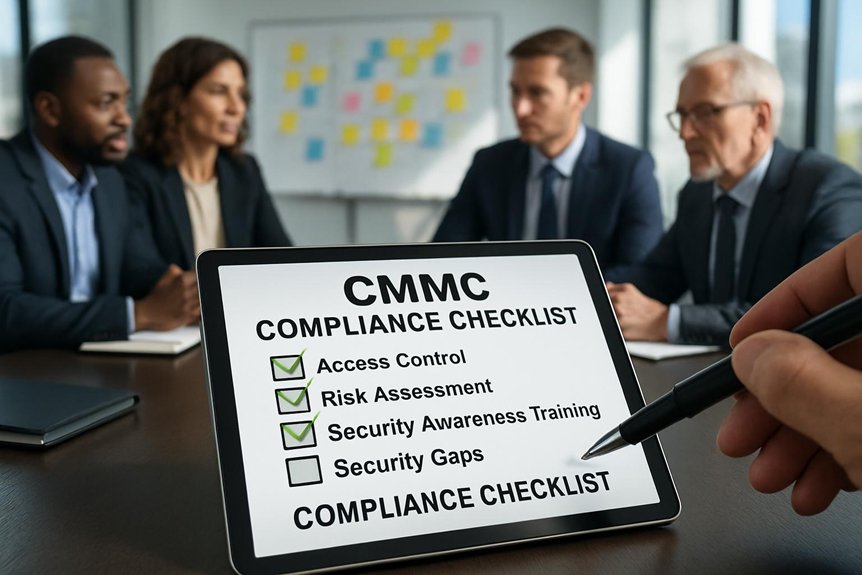
When your self-assessment reveals security gaps, you’ll need to create thorough Plans of Action and Milestones (POA&Ms) that outline specific remediation steps and realistic timelines.
These remediation plans are essential for CMMC compliance, as they demonstrate your commitment to addressing unmet security controls and achieving cybersecurity requirements.
For contractors pursuing CMMC certification, POA&Ms are only permitted for one-point controls at Levels 2 and 3.
You must prioritize closing these security gaps to maintain compliance timelines and avoid potential delays in certification.
- Document specific technologies and resources needed to implement missing security controls
- Establish realistic milestones with measurable progress indicators for organizational improvements
- Regularly update POA&Ms to reflect changing compliance requirements and implementation progress
- Align remediation efforts with overall cybersecurity strategy to maximize effectiveness
Implementing Technology Solutions for CUI Protection
After establishing your remediation roadmap through POA&Ms, you’ll need robust technology solutions to protect Controlled Unclassified Information (CUI) and meet CMMC requirements.
Start by implementing encryption and access controls across all systems handling CUI. These secure technology solutions form the foundation of your cybersecurity framework.
Choose cloud services that provide Customer Responsibility Matrix documentation, clearly defining security responsibilities between you and your provider.
Deploy secure file-sharing platforms with end-to-end encryption for CUI transmission and storage.
Implement multi-factor authentication (MFA) across all CUI-accessing systems to strengthen your security posture.
Regular patching and updates address vulnerabilities while maintaining system integrity.
These technology implementations directly support your incident response capabilities and enhance overall risk management strategies, ensuring thorough CUI protection throughout your organization.
Preparing for Third-Party C3PAO Assessment

Once your technology solutions are operational, preparing for your third-party Cybersecurity Maturity Model Certification Accredited Third Party Assessment Organization (C3PAO) assessment becomes your next critical milestone.
Your CMMC compliance checklist must include developing a thorough System Security Plan (SSP) that details your security controls and practices. You’ll need to conduct extensive self-assessments using NIST 800-171A guidelines to identify and address security gaps before the formal evaluation.
Essential preparation steps include:
- Gathering all documentation, policies, procedures, and evidence of compliance for required security controls
- Conducting internal assessments to verify compliance readiness and address any identified deficiencies
- Engaging consultants for final documentation review to guarantee all requirements are properly addressed
- Scheduling your C3PAO assessment through The Cyber AB Marketplace with an accredited assessment organization
Timeline and Resource Allocation for CMMC Certification
Since CMMC requirements will begin appearing in DoD contracts by mid-2025, you’ll need to start your certification journey immediately to avoid supply chain disruptions.
CMMC compliance typically requires 6-18 months for preparation, with small and midsize contractors needing approximately 12 months for Level 2 certification readiness.
Effective resource allocation starts with assigning a dedicated compliance point person to oversee your entire certification timeline. This individual will coordinate NIST 800-171 implementation and guide your team through complex requirements.
Begin early preparation by familiarizing yourself with the CMMC framework and developing your System Security Plan (SSP).
These foundational steps streamline the certification process and optimize resource allocation. For contractors targeting Level 2 certification, immediate action guarantees you’ll meet DoD contracts’ compliance deadlines without operational disruptions.
Frequently Asked Questions
What Is the CMMC Compliance Plan?
You’ll develop a CMMC compliance plan as your systematic roadmap for meeting cybersecurity maturity levels and contractor responsibilities outlined in federal requirements.
Your plan encompasses the compliance certification process, security controls implementation, and risk management framework adoption.
You’ll establish assessment preparation strategies, continuous monitoring techniques, and training program essentials.
The plan includes documentation best practices for your System Security Plan while ensuring you’re prepared for external assessments and maintaining ongoing CMMC requirements overview compliance.
Do Subcontractors Need to Be CMMC Certified?
Like knights protecting castle gates, you’ll find that subcontractor requirements mandate CMMC certifications when they handle federal contract information.
Your contractor obligations extend throughout the supply chain, making compliance implications critical for cybersecurity measures.
You’re responsible for ensuring subcontractors meet security standards through proper assessment processes.
Without adequate risk management and implementation strategies, you’ll jeopardize your federal contracts.
Don’t let uncertified subcontractors become your weakest link in the defense industrial base.
How Much Does a CMMC Assessment Cost?
CMMC assessment pricing varies greatly based on your certification level and organizational complexity.
You’ll face costs ranging from $10,000-$50,000, with certification cost factors including assessment duration impact and provider selection.
Level 1 self-assessments cost less than Levels 2-3 requiring third-party evaluators.
Your budget planning strategies should include preparation expenses, consultant fees, and technology investments.
Consider funding options available and ROI on compliance when evaluating financial implications overview for your industry specific pricing needs.
How to Get CMMC Compliant?
To achieve CMMC compliance, you’ll need to complete CMMC training programs and develop detailed compliance documentation aligned with cybersecurity frameworks.
Implement robust risk management and follow proper assessment procedures to meet contractor responsibilities. Conduct thorough security audits using effective implementation strategies, establish continuous monitoring systems, and understand your certification timeline.
You must assess your current security posture, identify gaps, create remediation plans, and engage certified assessors for external validation of your cybersecurity controls.
Conclusion
You’ll achieve CMMC compliance by understanding requirements, determining your level, establishing boundaries, conducting assessments, creating action plans, implementing solutions, preparing for certification, and allocating resources. You can’t skip steps, you can’t rush timelines, and you can’t ignore documentation. Success demands you systematically address each checklist item, you consistently maintain security controls, and you continuously monitor your compliance posture throughout the certification process.