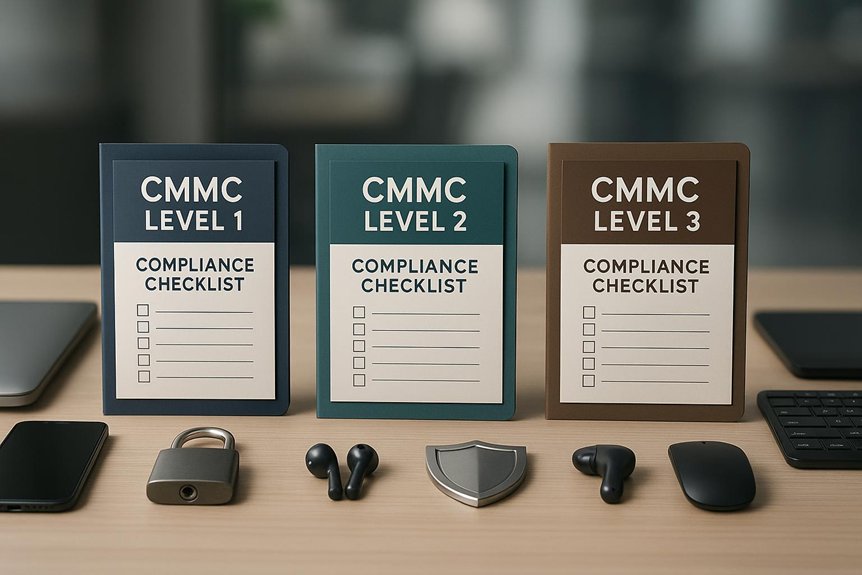
CMMC 2.0 features three compliance levels for DoD contractors. Level 1 requires 17 basic security practices for Federal Contract Information through annual self-assessments. Level 2 mandates 110 NIST SP 800-171 controls for Controlled Unclassified Information, typically requiring third-party validation. Level 3 combines 134 controls from NIST frameworks for critical national security data, demanding government-led assessments every three years. Each level builds upon the previous one’s requirements, with increasing complexity and oversight. Understanding these distinctions will help you navigate implementation challenges and develop effective compliance strategies.
Key Takeaways
- CMMC uses a three-tier framework with Level 1 for basic cyber hygiene, Level 2 for advanced controls, and Level 3 for expert cybersecurity.
- Level 1 requires 17 fundamental security practices for Federal Contract Information protection through annual self-assessment without third-party certification.
- Level 2 demands 110 security controls following NIST SP 800-171 standards for Controlled Unclassified Information, typically requiring third-party assessments.
- Level 3 involves 134 security controls combining NIST frameworks for critical CUI, mandating Zero Trust Architecture and government-led assessments.
- Compliance complexity increases across levels, from basic safeguards and self-reporting to advanced monitoring and mandatory third-party verification requirements.
Understanding the CMMC 2.0 Framework and Its Purpose
Cybersecurity breaches targeting defense contractors have prompted the Department of Defense to implement the Cybersecurity Maturity Model Certification (CMMC) 2.0 framework, a mandatory compliance system that guarantees organizations in the DoD supply chain maintain adequate protection for sensitive federal information.
You’ll find CMMC 2.0 streamlines the previous five-tier model into three focused levels.
Level 1 addresses Basic Cyber Hygiene for Federal Contract Information (FCI), requiring 17 fundamental practices.
Level 1 establishes foundational cybersecurity requirements through 17 essential practices for protecting Federal Contract Information in defense supply chains.
Level 2 demands Advanced Cybersecurity Controls for Controlled Unclassified Information (CUI), implementing 110 NIST SP 800-171 controls.
Level 3 mandates Expert Cybersecurity Framework for critical CUI, incorporating 134 thorough controls.
This cybersecurity framework guarantees you’re protecting sensitive data while maintaining competitive advantage in defense contracting opportunities.
Starting in fiscal year 2025, contractors without proper certification will be ineligible to bid on DoD contracts, a key milestone in the rollout of CMMC 2.0.
CMMC Level 1: Basic Cyber Hygiene Requirements
Seventeen fundamental security practices form the foundation of CMMC Level 1, designed to establish basic cyber hygiene for organizations handling Federal Contract Information (FCI).
These security practices include essential measures like physical access limitations, antivirus usage, and strong password management protocols.
You’ll find Level 1 compliance relatively straightforward since it doesn’t require third-party certification. Instead, you can complete an annual self-assessment to demonstrate your adherence to these Basic Cyber Hygiene requirements.
After completing your assessment, you must submit your scores to the Supplier Performance Risk System (SPRS) to verify compliance.
Unlike higher CMMC levels, Level 1 doesn’t mandate documentation of your practices, considerably simplifying the compliance process.
This streamlined approach helps contractors focus on implementing essential cybersecurity measures without overwhelming administrative burdens.
Additionally, organizations must obtain a formal affirmation by a senior company official under the False Claims Act and submit their annual self-assessment to the SPRS as part of maintaining Level 1 compliance.
CMMC Level 2: Advanced Cybersecurity Controls
When you’re ready to move beyond basic cyber hygiene, CMMC Level 2 demands a significantly more extensive approach with 110 security controls that align with NIST SP 800-171 standards.
You’ll need to safeguard Controlled Unclassified Information (CUI) while documenting your processes to demonstrate compliance maturity within your cybersecurity program.
You can pursue assessment through self-assessment or third-party evaluation, depending on your CUI’s sensitivity level.
Prime contractors must guarantee their subcontractors meet these requirements, as contractual obligations shift based on data sensitivity.
To achieve full compliance, you’ll implement all 320 NIST SP 800-171A objectives, providing thorough CUI protection throughout your operations.
This level establishes robust cybersecurity foundations essential for handling sensitive government information.
For organizations processing CUI, Level 2 typically requires a third-party assessment by an accredited C3PAO to verify compliance.
CMMC Level 3: Expert Cybersecurity Framework
Moving beyond Level 2’s thorough controls, CMMC Level 3 represents the pinnacle of cybersecurity requirements with 134 security controls that combine NIST SP 800-171 and NIST SP 800-172 frameworks.
You’ll need this expert-level certification when handling Controlled Unclassified Information (CUI) critical to national security and high-priority DoD projects.
Your cybersecurity compliance strategy must include advanced detection and response capabilities alongside continuous monitoring systems.
Advanced threat detection and continuous monitoring aren’t optional—they’re essential pillars of your CMMC Level 3 compliance framework.
You can’t self-assess at this level—government-led assessments occur every three years to verify your implementation.
You’ll establish a detailed cybersecurity management plan documenting your organization’s practices and maturity levels.
These stringent assessment requirements guarantee you’re protecting the most sensitive information.
Failing to meet CMMC Level 3 standards results in significant penalties and contract losses.
A key requirement is implementing a Zero Trust Architecture and continuous security monitoring, which are mandatory for Level 3 compliance.
Common Implementation Challenges and Practical Solutions
Despite understanding CMMC requirements, you’ll likely encounter considerable implementation challenges that can derail your compliance efforts. Many organizations struggle with unclear guidance on DoD security controls, leading to compliance misunderstandings.
Conducting readiness assessments helps clarify these expectations and streamlines your CMMC compliance journey.
If you’re a smaller business lacking expertise for advanced cybersecurity practices, consider utilizing compliant cloud solutions like Microsoft 365 GCC High. This approach simplifies NIST SP 800-171 implementation requirements greatly.
Third-party assessments present cost and complexity hurdles, making collaboration with CMMC Registered Provider Organizations essential.
Perform a thorough gap analysis using NIST SP 800-171 self-assessment tools to identify security practice discrepancies.
Finally, implement regular employee training programs and enforce strong password policies to mitigate implementation challenges and maintain compliance standards effectively.
Additionally, schedule your C3PAO assessment well in advance to ensure adequate preparation and documentation for a smoother path to certification, leveraging the benefits of early scheduling.
Best Practices for Achieving CMMC Compliance
Successfully maneuvering implementation challenges requires adopting proven strategies that streamline your path to CMMC compliance.
Start by conducting a thorough gap analysis using NIST SP 800-171 self-assessment tools to identify discrepancies between your current practices and requirements. Implement security automation tools like Microsoft Defender for Cloud to establish continuous security monitoring and reduce manual oversight burdens.
You’ll need regular cybersecurity training for employees handling Controlled Unclassified Information (CUI), focusing on password policies and multi-factor authentication.
Partner with a CMMC Registered Provider Organization (RPO) to navigate assessment complexities effectively. For Level 3 certification, develop a detailed System Security Plan (SSP) that documents your advanced security measures implementation.
These practices guarantee you’re meeting compliance standards while maintaining operational efficiency throughout your certification journey.
Additionally, ensure you understand the three levels of CMMC 2.0, including that Level 2 aligns with NIST SP 800-171 and typically requires third-party assessments.
Frequently Asked Questions
What Is the Difference Between Level 2 and Level 3 CMMC?
CMMC Level 2 requires 110 security practices for basic CUI protection with self-assessment options, while Level 3 demands 134 controls for nationally critical information through mandatory government assessments.
You’ll face higher cost implications and extended implementation strategies for Level 3’s advanced risk management requirements.
Level 3 necessitates more rigorous training programs, extensive documentation requirements, and shifts your organizational culture toward proactive threat detection, making CMMC compliance considerably more complex than Level 2’s foundational assessment processes.
What Are the Levels 1 3 of CMMC?
You’ll find three CMMC levels overview:
Level 1 requires 17 basic security practices for Federal Contract Information with annual self-assessments.
Level 2 demands 110 NIST SP 800-171 controls for Controlled Unclassified Information, involving either self or third-party assessments.
Level 3 criteria adds 24 enhanced controls from NIST SP 800-172 for critical national security data, requiring government-led assessments.
Your compliance journey escalates in complexity and certification process rigor across levels.
What Is the Breakdown of CMMC?
CMMC’s cybersecurity framework breaks down into three progressive levels based on your data protection needs.
You’ll face different contractor obligations: Level 1 requires basic practices through self-assessment, Level 2 demands thorough risk management with third-party certification process, and Level 3 involves government-led audit procedures.
Your compliance timeline starts Q1 2025, requiring organizational culture shifts, training programs, and structured CMMC assessment preparation to meet these escalating requirements.
What Are the Requirements for Level 2 CMMC?
You’ll implement 110 security controls, complete Level 2 documentation, and undergo compliance assessment processes.
Your risk management framework must align with NIST SP 800-171, while security control implementation covers all 320 objectives.
You’ll need CMMC training programs, incident response planning, and continuous monitoring techniques.
Audit preparation strategies guarantee contractor readiness evaluation success.
You’ll maintain cybersecurity best practices through annual self-assessments or C3PAO evaluations every three years, plus develop POAMs for non-compliance issues.
Conclusion
You’ve got the roadmap to CMMC compliance, but implementation requires dedication and strategic planning. Like building a fortress, you can’t skip foundational levels and expect lasting protection. Start with Level 1’s basic hygiene, then progressively strengthen your defenses. Don’t tackle everything at once—you’ll overwhelm your team and compromise quality. Focus on one level at a time, document everything thoroughly, and invest in proper training. Your organization’s cybersecurity maturity depends on methodical execution.