
To achieve CMMC compliance, you’ll first determine your required certification level based on whether you handle Federal Contract Information (Level 1) or Controlled Unclassified Information (Level 2). Next, conduct a gap assessment against NIST SP 800-171 standards, develop a System Security Plan, and implement the necessary security controls. You’ll then complete self-assessments, select an accredited third-party assessor, and undergo the official evaluation. The following detailed guide outlines each critical step.
Key Takeaways
- Determine your required CMMC level based on data types: Level 1 for FCI or Level 2 for CUI processing.
- Conduct a comprehensive gap assessment against NIST SP 800-171 standards to identify security deficiencies and compliance gaps.
- Develop a System Security Plan documenting security controls, system boundaries, and information protection measures for your environment.
- Implement all required security controls with documented policies and establish continuous monitoring systems for ongoing effectiveness.
- Schedule formal assessment with an accredited C3PAO and maintain compliance through annual self-assessments and regular updates.
Understanding CMMC Certification Levels and Their Security Requirements
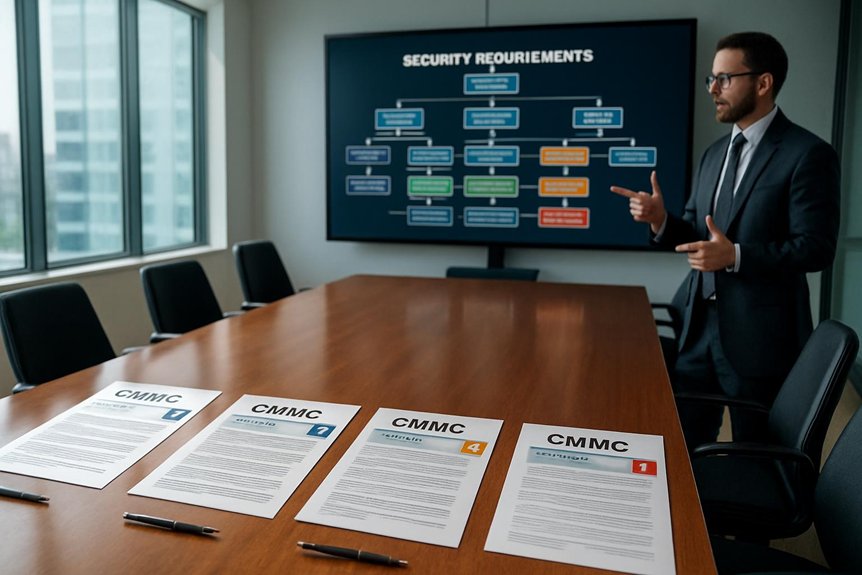
When traversing the complex landscape of defense contracting, you’ll encounter the Cybersecurity Maturity Model Certification (CMMC) framework, which establishes three distinct certification levels that align with the sensitivity of information your organization handles.
Level 1 targets basic Federal Contract Information protection through 17 fundamental security controls and self-assessments.
CMMC Level 1 establishes foundational cybersecurity through 17 essential controls, allowing organizations to self-assess their Federal Contract Information protection capabilities.
Level 2 addresses Controlled Unclassified Information (CUI) handling, requiring compliance with 110 security practices based on NIST SP 800-171 standards. You’ll need third-party assessments to verify this compliance across domains like access control and incident response.
Level 3 demands advanced threat detection capabilities beyond Level 2 requirements.
Each certification level serves the Defense Industrial Base (DIB) by ensuring appropriate security measures match your contract’s information sensitivity requirements.
Determining Your Organization’s Required CMMC Level Based on Data Types
After establishing which certification level applies to your organization, you must accurately classify the types of data your systems process and store.
If you’re handling only Federal Contract Information (FCI), you’ll need CMMC Level 1, which requires basic cybersecurity practices for data protection. However, if your organization processes Controlled Unclassified Information (CUI), you must achieve CMMC Level 2 compliance, implementing extensive cybersecurity measures based on NIST SP 800-171 requirements.
The distinction between FCI and CUI determines your entire CMMC compliance strategy. While Level 1 allows self-assessment, Level 2 requires third-party assessments to verify your cybersecurity practices.
Organizations handling the most sensitive information need Level 3 certification. You’ll need to conduct thorough data inventory assessments to identify all information types flowing through your systems and determine appropriate protection requirements.
Conducting a Comprehensive Gap Assessment Against NIST Standards
Once you’ve determined your required CMMC level, you’ll need to conduct a thorough gap assessment to evaluate your organization’s current cybersecurity practices against NIST SP 800-171 standards.
A comprehensive gap assessment against NIST SP 800-171 standards reveals critical cybersecurity deficiencies that must be remediated for CMMC compliance.
This extensive gap assessment identifies security gaps that must be addressed for CMMC compliance.
Here’s your roadmap for conducting an effective assessment:
- Define your scope – Determine whether controlled unclassified information affects your entire enterprise, specific unit, or program enclave.
- Schedule with a C3PAO – Partner with an accredited third-party assessment organization to identify specific deficiencies and receive expert guidance.
- Address identified findings – Implement necessary changes through targeted remediation to meet compliance requirements.
- Create your POA&M – Develop a detailed plan of actions and milestones to document progress and track improvements against NIST standards.
Developing a System Security Plan for Your CMMC Scope
Following your thorough gap assessment, you’ll need to develop a System Security Plan (SSP) that serves as the cornerstone document for your CMMC compliance efforts.
Your SSP must extensively outline security requirements and detail how you’re implementing security controls according to NIST SP 800-171 standards. Include clear system boundaries, types of information processed, and protection measures for Controlled Unclassified Information (CUI).
Document the implementation status of each control and any Plans of Action and Milestones (POA&Ms) for addressing deficiencies.
You’ll conduct a self-assessment against your SSP to verify effective control implementation before submitting scores to the Supplier Performance Risk System (SPRS).
Remember to regularly update your SSP as your environment changes, ensuring it remains an accurate compliance roadmap for ongoing CMMC requirements.
Implementing Required Security Controls and Technical Safeguards
With your System Security Plan serving as your implementation roadmap, you’ll now focus on putting the actual security controls and technical safeguards into practice.
CMMC compliance requires translating your documented policies into actionable cybersecurity practices that protect Controlled Unclassified Information (CUI) and Federal Contract Information (FCI).
Your implementation strategy should include:
A comprehensive CMMC implementation strategy encompasses technical controls deployment, continuous monitoring, policy documentation, and assessment preparation to ensure regulatory compliance.
- Deploy NIST SP 800-171 controls – Install 110 security practices across domains like access control and incident response for Level 2 compliance.
- Establish continuous monitoring systems – Implement automated tools to track control effectiveness and detect security gaps.
- Create documented policies – Develop clear procedures that support each implemented security control throughout your organization.
- Prepare for third-party assessments – Confirm all technical safeguards function properly and demonstrate compliance readiness.
Creating a Plan of Action and Milestones to Address Deficiencies
When your security control implementation reveals gaps or deficiencies, you’ll need to create a thorough Plan of Action and Milestones (POA&M) that systematically addresses each identified weakness.
This document serves as your roadmap for enhancing cybersecurity practices and achieving compliance with NIST 800-171 standards.
Your POA&M must detail specific corrective actions, assign responsible parties, allocate necessary resources, and establish target completion dates to guarantee accountability.
Prioritize deficiencies based on risk assessment results, focusing first on vulnerabilities that threaten Controlled Unclassified Information (CUI) and Federal Contract Information (FCI).
Regular updates are essential for tracking progress and adapting to changing circumstances.
When you submit your POA&M during the self-assessment process, you’re demonstrating commitment to addressing cybersecurity gaps—crucial for maximizing your compliance score.
Performing Self-Assessments and Documentation Preparation
Before you can develop effective POA&Ms, you must first complete a thorough self-assessment to identify where your organization stands against NIST SP 800-171 requirements.
This critical evaluation forms your foundation for CMMC Level 2 compliance and reveals gaps in compliance that need immediate attention.
Your self-assessment process involves several key steps:
- Develop your System Security Plan (SSP) to document current security controls and practices across your organization.
- Score your implementation based on the 110-point maximum scale reflecting NIST SP 800-171 requirements.
- Submit scores into SPRS to demonstrate your compliance status to the DoD.
- Create extensive documentation including POA&Ms to address deficiencies and prepare for third-party assessments.
Proper documentation guarantees you’re ready for external validation.
Selecting an Accredited Third-Party Assessment Organization
Once you’ve completed your self-assessment and documentation preparation, choosing the right Accredited Third-Party Assessment Organization (C3PAO) becomes your next critical milestone toward CMMC certification.
Selecting the right C3PAO marks a pivotal step in your journey toward successful CMMC certification and compliance.
You’ll need to verify that your selected C3PAO appears in the Cyber-AB Marketplace and maintains proper accreditation status through stringent compliance requirements.
When evaluating potential organizations, prioritize those with proven experience conducting CMMC assessments for defense contractors similar to your business.
Review their testimonials and case studies to assess their effectiveness and reliability. Confirm they understand the specific requirements for your target CMMC level.
Establishing a clear communication plan with your chosen C3PAO streamlines the assessment process.
This alignment on expectations and timelines helps prevent delays and confirms a smoother path to achieving compliance with CMMC standards.
Scheduling and Completing the Official CMMC Assessment
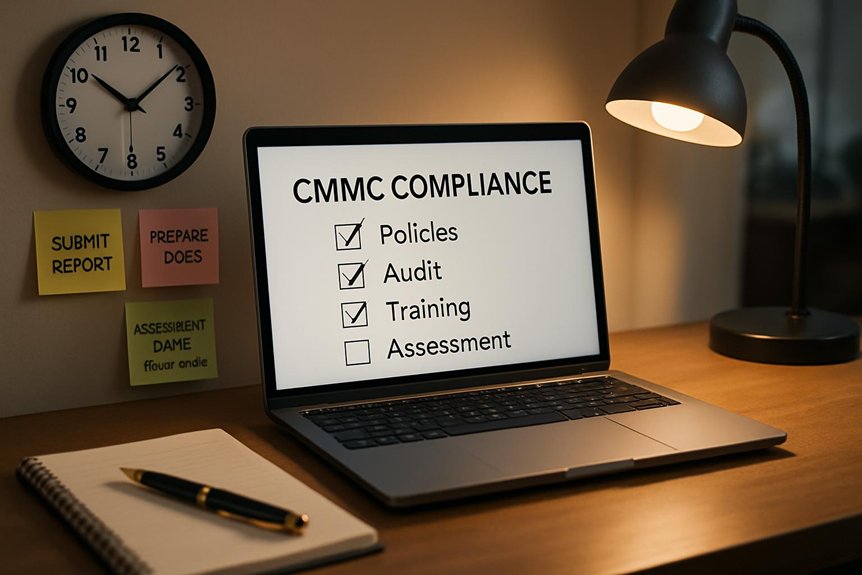
After establishing your partnership with a qualified C3PAO, you’ll move forward with scheduling your official CMMC assessment through a structured four-phase process.
The thorough assessment guarantees your organization meets compliance requirements for your designated performance level:
- Pre-assessment planning – You’ll coordinate with your C3PAO to schedule both a preliminary gap assessment and the official evaluation, guaranteeing all documentation and systems are ready for review.
- Official assessment execution – Your C3PAO conducts the formal CMMC assessment, reviewing your compliance with required practices, particularly NIST SP 800-171 standards for Level 2.
- Post-assessment reporting – Results are uploaded into the CMMC eMASS system, determining your certification status.
- Potential remediation – If needed, you’ll receive a 90-day remediation period to address gaps before achieving your CMMC Level 2 certification.
Maintaining Continuous Compliance and Preparing for Reassessments
While achieving CMMC certification marks a significant milestone, you’ll need to maintain continuous compliance throughout your three-year certification period to preserve your competitive advantage in DoD contracting.
CMMC certification is just the beginning—maintaining continuous compliance over three years is essential for retaining your DoD contracting edge.
You must conduct annual self-assessments to verify ongoing adherence to your certification level’s requirements. Implement and regularly update your System Security Plan (SSP) to reflect operational changes while actively monitoring your cybersecurity posture through regular risk assessments.
Address identified vulnerabilities promptly and conduct internal audits to guarantee documentation remains current. Provide thorough employee training on relevant cybersecurity practices to maintain organizational readiness.
Consider engaging certified consultants or Managed Service Providers (MSPs) for ongoing guidance and support. These professionals can help you navigate compliance challenges and effectively prepare for upcoming assessments, guaranteeing seamless certification renewal.
Frequently Asked Questions
What Are the CMMC Requirements?
You’ll need to understand CMMC framework basics across three levels with distinct security practices overview.
Level 1 requires basic safeguarding through self-assessment, while Levels 2-3 demand third-party compliance assessment process.
You must implement documentation essentials like System Security Plans, conduct gap assessments, and address implementation challenges.
Certification timeline varies by level complexity.
You’ll benefit from training resources and audit preparation tips while developing risk management strategies to maintain DoD contract eligibility.
What Are the Requirements for CMMC ESP?
You’ll need to implement 24 enhanced security practices beyond NIST SP 800-171’s 110 requirements for CMMC ESP certification.
Your CMMC implementation strategies must include continuous monitoring and advanced incident response capabilities.
You’ll undergo an extensive assessment by a certified C3PAO using specialized CMMC assessment tools.
Your CMMC risk management approach should address Critical CUI threats, while your CMMC documentation standards must demonstrate proactive threat detection and remediation capabilities throughout the certification process.
How to Get Certified in CMMC?
Like assembling a complex puzzle, you’ll start your CMMC certification process by developing documentation requirements and conducting self-assessments.
You’ll need proper CMMC training resources to understand security controls and implementation strategies.
The CMMC assessment timeline involves working with C3PAOs for the auditing process.
Consider CMMC compliance costs and certification renewals when planning.
Small businesses benefit from phased approaches, making CMMC for small businesses more manageable through structured preparation.
What Is CMMC Level 5 Requirements?
You’ll need to implement 110 advanced cybersecurity practices from NIST SP 800-172 for CMMC level 5.
Your organization must establish continuous monitoring, robust incident response capabilities, and thorough training programs.
You’re required to maintain detailed documentation standards and undergo government-led compliance assessments every three years.
Your security controls must demonstrate resilience against sophisticated threats, while your risk management processes and audit processes guarantee proactive, adaptive protection of critical CUI throughout operations.
Conclusion
You’ve now charted your course through CMMC’s labyrinthine requirements, from initial gap assessments to final certification. Like Odysseus maneuvering treacherous waters, you’ll face ongoing challenges maintaining compliance and preparing for reassessments. Remember, achieving CMMC isn’t a destination—it’s an ongoing voyage requiring constant vigilance. Your organization’s cybersecurity posture must remain battle-ready, adapting to evolving threats while preserving the trust you’ve earned with the Department of Defense through rigorous compliance efforts.