CMMC 2.0 establishes three cybersecurity levels for defense contractors based on information sensitivity. Level 1 requires 17 basic practices with self-assessment, Level 2 demands 110 NIST SP 800-171 controls with third-party evaluation, and Level 3 adds advanced requirements with independent audits. You’ll determine your needed level based on contract requirements and the type of federal information you’ll handle. Understanding these distinctions helps you prepare for compliance deadlines and positions your organization for DoD contracting opportunities ahead.
Key Takeaways
- CMMC has three certification levels that correspond to the sensitivity of information handled in defense contracts.
- Level 1 requires 17 basic cybersecurity practices and allows annual self-assessments for foundational protection.
- Level 2 demands compliance with 110 NIST SP 800-171 controls and independent third-party assessments.
- Level 3 includes all Level 2 requirements plus advanced practices for highly sensitive information protection.
- Higher levels require more documentation, stricter audits, and comprehensive System Security Plans.
What Is the Cybersecurity Maturity Model Certification (CMMC)?
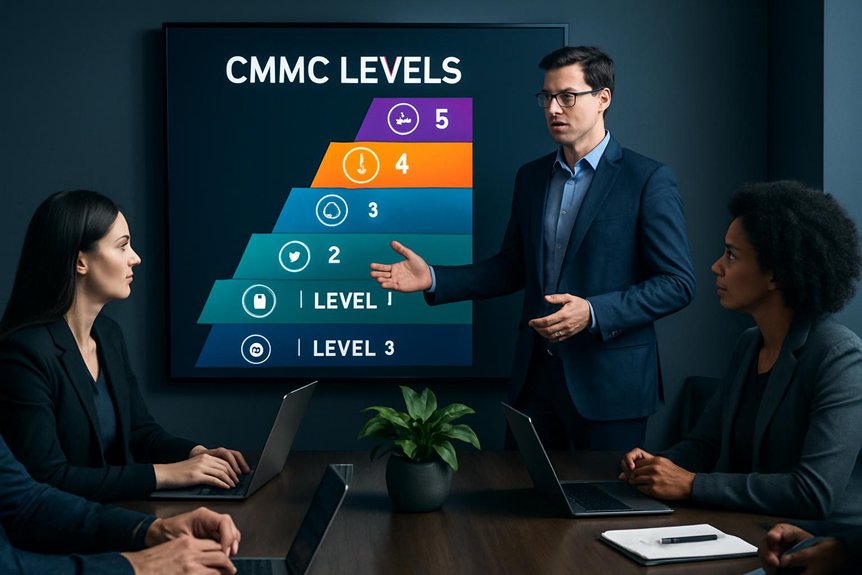
The Cybersecurity Maturity Model Certification (CMMC) is a thorough framework that the U.S. Department of Defense developed to strengthen cybersecurity across its contractor network.
You’ll encounter this unified standard designed to protect Federal Contract Information and controlled unclassified information from cyber threats.
CMMC establishes three distinct certification levels that defense contractors must meet based on their contract requirements.
Level 1 covers foundational cybersecurity practices, while Level 2 requires compliance with 110 NIST SP 800-171 controls for handling sensitive data.
Level 3 implements the most stringent cybersecurity requirements for organizations managing highly sensitive information.
How Many CMMC Levels Are There in CMMC 2.0?
CMMC 2.0 streamlines the original framework into three clearly defined levels that align with the sensitivity of information you’ll handle as a defense contractor.
CMMC 2.0 creates three distinct security levels that correspond directly to the classified nature of defense contract information.
Here’s how the CMMC levels break down:
- Level 1 (Foundational) – You’ll implement 17 basic cybersecurity practices to protect Federal Contract Information through annual self-assessments.
- Level 2 (Advanced) – You must comply with 110 security controls from NIST SP 800-171 to safeguard Controlled Unclassified Information, requiring documented processes.
- Level 3 (Expert) – You’ll meet all Level 2 requirements plus additional advanced practices for the most sensitive CUI, with mandatory independent audits.
CMMC Level 1: Foundational Cybersecurity Practices
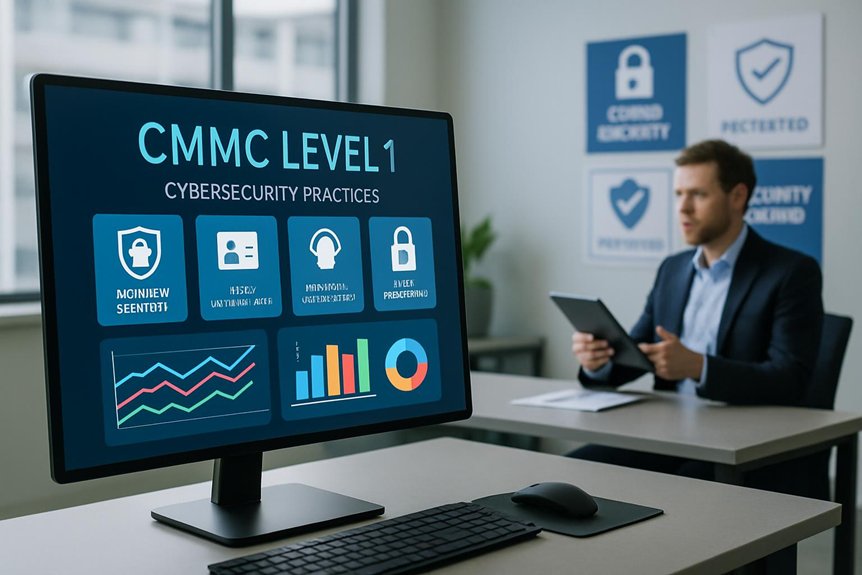
At CMMC Level 1, you’ll implement 17 foundational cybersecurity practices designed to protect Federal Contract Information (FCI) – data that isn’t intended for public release but doesn’t require the stringent protections of classified material.
This foundational level focuses on basic cyber hygiene measures like deploying antivirus software and maintaining regular password updates.
Organizations handling FCI can achieve compliance through an annual self-assessment, making Level 1 the most accessible CMMC certification. You won’t need external assessors for this level, allowing you to evaluate your cybersecurity framework internally.
These 17 basic practices establish essential protections that mitigate risks associated with less sensitive data handling.
Level 1 creates your foundational cybersecurity framework, preparing organizations handling FCI for potential advancement to higher CMMC levels.
CMMC Level 2: Advanced Cybersecurity Requirements
When your organization handles Controlled Unclassified Information (CUI), you’ll need to advance to CMMC Level 2, which requires implementing 110 security controls derived from NIST SP 800-171.
This advanced cyber hygiene level bridges foundational practices with more rigorous cybersecurity requirements.
Level 2 compliance involves four critical components:
CMMC Level 2 demands comprehensive implementation, thorough documentation, independent assessment, and demonstrated maturity across all cybersecurity controls.
- Implementation – Deploy all required security controls across your infrastructure
- Documentation – Maintain detailed processes and procedures for each control
- Assessment – Undergo evaluation by a Certified Third-Party Assessment Organization (C3PAO)
- Maturity – Demonstrate sustained cybersecurity practices beyond basic implementation
Unlike Level 1’s self-assessments, you’ll face independent audits conducted by certified assessors.
CMMC Level 3: Expert Cybersecurity Controls

Beyond Level 2’s advanced requirements, organizations handling the most sensitive Controlled Unclassified Information for high-priority Department of Defense programs must achieve CMMC Level 3 certification.
You’ll need to implement all 110 cybersecurity controls from NIST SP 800-171, plus 20 additional CMMC-specific practices designed to protect against advanced threats. Your organization must develop a thorough System Security Plan (SSP) that documents implementation processes and maintains ongoing compliance.
Unlike lower levels, CMMC Level 3 requires independent assessments conducted by Certified Third-Party Assessment Organizations (C3PAOs).
These rigorous evaluations guarantee you’re meeting the strict cybersecurity standards necessary for handling Controlled Unclassified Information (CUI) in critical Department of Defense (DoD) programs.
This expert-level certification demonstrates your capability to safeguard the most sensitive defense-related information.
Key Differences Between CMMC 2.0 and NIST SP 800-171
While NIST SP 800-171 provides the foundational security controls for protecting Controlled Unclassified Information, CMMC 2.0 transforms these requirements into a thorough certification framework specifically designed for Department of Defense contractors.
Understanding these key differences helps Defense Industrial Base (DIB) organizations prepare for evolving cybersecurity compliance requirements.
Here are the primary distinctions between these frameworks:
- Assessment Structure: CMMC 2.0 requires independent assessment for certification levels 2 and 3, while NIST SP 800-171 allows self-assessments without third-party verification.
- Documentation Requirements: You must develop a System Security Plan (SSP) for CMMC 2.0 Level 2 and 3, whereas NIST SP 800-171 doesn’t explicitly mandate documentation.
- Control Scope: CMMC 2.0 expands beyond 110 NIST controls, incorporating 130 total security controls across three certification levels.
- Compliance Timeline: You can’t use Plans of Action and Milestones under CMMC 2.0’s stricter requirements.
Which CMMC Level Does Your Organization Need?

Determining your organization’s required CMMC level depends on the type of sensitive information you handle and process within your systems.
If you only manage Federal Contract Information (FCI), you’ll need CMMC Level 1 certification, which involves 17 basic cybersecurity practices. Organizations handling Controlled Unclassified Information (CUI) must achieve CMMC Level 2, requiring compliance with all 110 NIST SP 800-171 practices.
For the most sensitive CUI, CMMC Level 3 certification demands additional security controls beyond the standard requirements.
Your DoD contracts will specify the required CMMC levels based on data sensitivity. Conducting a gap analysis helps identify which CMMC certification your organization needs and reveals compliance gaps.
Steps to Achieve CMMC Compliance
Achieving CMMC compliance requires a systematic approach that begins with scoping your organization’s operations to identify which systems and processes handle Federal Contract Information (FCI) or Controlled Unclassified Information (CUI).
Here’s your path to meeting CMMC Compliance Requirements:
- Conduct a NIST SP 800-171 Basic Assessment to evaluate current cybersecurity practices and submit your score to the supply chain risk system.
- Determine your required CMMC levels based on contract specifications—Level 1 CMMC demands 17 basic practices, while Level 2 CMMC requires all 110 NIST SP 800-171 controls.
- Engage a Certified Third-Party Assessment Organization (C3PAO) for formal audits if you’re pursuing Level 2 or higher certification.
- Implement continuous monitoring to maintain compliance and adapt your cybersecurity practices to evolving threats post-assessment.
CMMC Implementation Timeline and Assessment Requirements
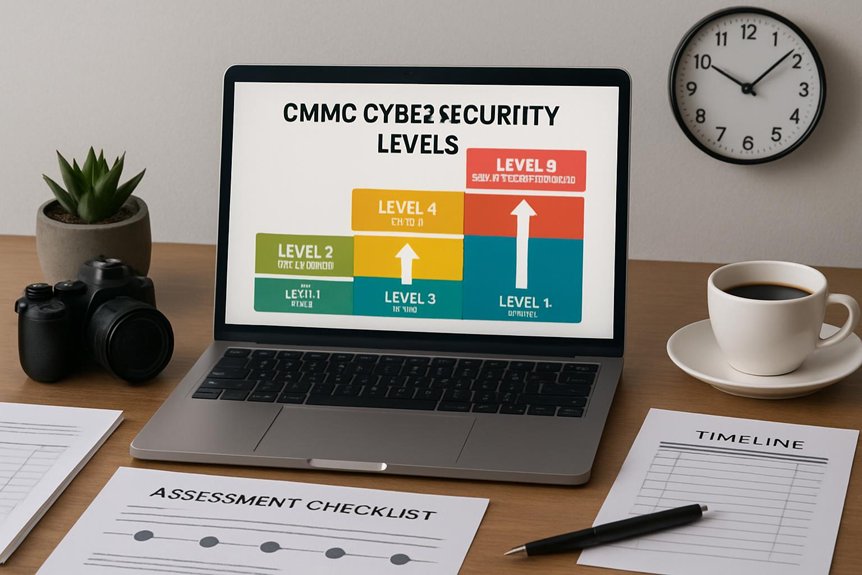
Once you’ve mapped out your compliance strategy, you’ll need to align your efforts with the official CMMC implementation timeline. The timeline begins with Level 1 certification self-assessments due by December 14, 2024, requiring compliance with 17 basic cybersecurity practices.
Level 2 controls become mandatory by June 2025, demanding adherence to 110 NIST SP 800-171 requirements with proper documentation.
Assessment requirements vary greatly by level. While Level 1 allows self-assessment, Level 2 and Level 3 mandate independent assessments conducted by Certified Third-Party Assessment Organizations (C3PAOs).
Benefits of CMMC Certification for Defense Contractors
Beyond meeting mandatory compliance requirements, CMMC certification delivers substantial strategic advantages that can transform your defense contracting business. This certification positions you among 300,000+ contractors eligible for DoD contracts while demonstrating unwavering commitment to cybersecurity standards.
CMMC certification transforms defense contractors by providing strategic advantages that extend far beyond basic compliance requirements.
Here are four key benefits you’ll gain:
- Enhanced Market Position – You’ll secure a competitive edge by proving adherence to industry-recognized cybersecurity standards that influence contract awards.
- Trust Building – You’ll foster stronger client relationships by ensuring protection of Federal Contract Information and Controlled Unclassified Information.
- Risk Reduction – You’ll mitigate cyber threats and protect intellectual property from unauthorized access.
- Cost Optimization – You’ll achieve long-term savings by reducing security incidents while streamlining compliance processes and operational efficiencies.
Frequently Asked Questions
What Are the Levels 1 2 and 3 of CMMC?
You’ll encounter three CMMC definitions for cybersecurity frameworks.
Level 1 requires 17 basic security controls protecting Federal Contract Information, allowing self-assessments.
Level 2 demands 110 NIST SP 800-171 controls for Controlled Unclassified Information, requiring certification bodies for independent assessment process.
Level 3 adds NIST SP 800-172 controls for high-priority data.
Your contractor responsibilities include meeting compliance requirements, implementing risk management strategies, and maintaining continuous monitoring based on your contract’s specified level.
What Is a Level 2 CMMC Compliance?
Level 2 affects 80% of defense contractors handling CUI.
You’ll need to implement 110 NIST SP 800-171 security controls through thorough compliance documentation tips and risk management strategies.
This CMMC requirements breakdown includes developing incident response planning, establishing continuous monitoring importance, and creating training and awareness programs.
Your Level 2 assessment requires C3PAO verification of cyber hygiene practices.
Defense contractor obligations mandate this compliance for DoD contracts, making security controls overview essential for maintaining eligibility.
How to Get CMMC Level 1?
To get CMMC Level 1, you’ll start by reviewing the 17 basic cybersecurity best practices required.
Document your current security measures and identify gaps through compliance assessment steps. Implement necessary software tools like antivirus and access controls.
Create documentation needs showing adherence to Level 1 requirements. Conduct your self-assessment following the CMMC certification process.
Consider training resources for staff and establish implementation timelines with cost considerations for risk management strategies.
What Is Level 3 Compliant CMMC?
CMMC Level 3 compliance means you’ll implement all 110 NIST SP 800-171 controls plus 20 additional CMMC-specific practices.
You’ll face significant compliance challenges requiring detailed implementation strategies and substantial cost considerations.
The assessment process involves C3PAO certification with extensive documentation needs.
You’ll need thorough training resources and expect a lengthy certification timeline.
Level 3 benefits include eligibility for high-priority DoD contracts handling sensitive CUI, integrating advanced cybersecurity frameworks for enhanced protection.
Conclusion
You’ve spent months mastering CMMC levels, implementing advanced controls, and preparing for rigorous assessments. Ironically, the very systems designed to protect you from cyber threats now require you to jump through hoops that’d make a circus performer dizzy. You’re building digital fortresses while drowning in paperwork castles. But here’s the twist: once you’ve achieved compliance, you’ll sleep soundly knowing your cybersecurity house isn’t built on sand—it’s reinforced concrete against tomorrow’s storms.