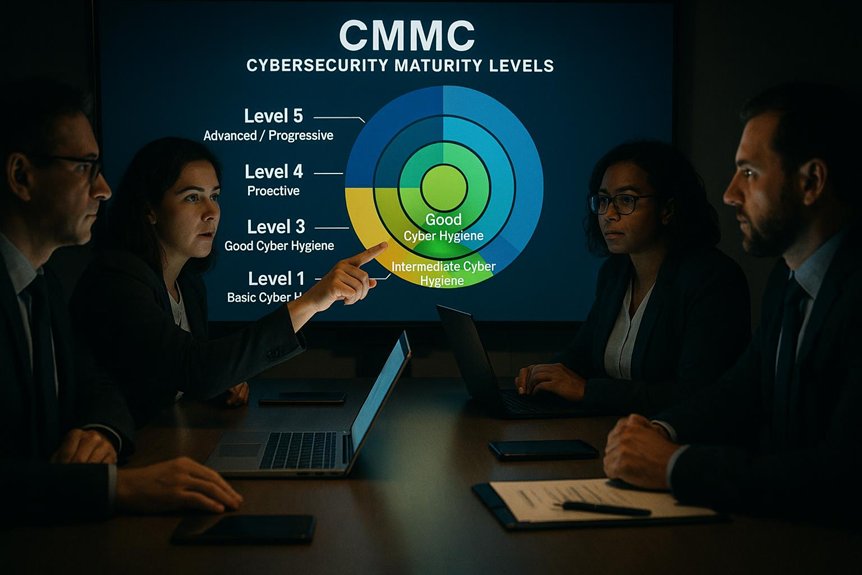
Understanding CMMC cybersecurity levels is essential because they determine which defense contracts you’re eligible to bid on and what security investments you’ll need to make. Each level—from basic Level 1 self-assessments to expert Level 3 government evaluations—requires specific controls and assessment processes that directly impact your competitive position. You’ll optimize resources by targeting the right certification level while positioning yourself ahead of competitors who aren’t prepared for these requirements.
Key Takeaways
- Understanding CMMC levels enables precise allocation of cybersecurity investments and optimizes resource distribution across organizational security needs.
- Knowledge of certification requirements establishes competitive advantage by improving bidding position for DoD contracts and defense opportunities.
- Comprehending level distinctions facilitates informed decision-making regarding which cybersecurity requirements apply to your specific contract types.
- Early preparation for appropriate CMMC compliance ensures organizational readiness ahead of competitors in the defense contracting market.
- Understanding levels helps determine eligibility for critical defense contracts, particularly high-value opportunities requiring advanced security certifications.
What Are CMMC Cybersecurity Levels and How Do They Work?

The CMMC cybersecurity framework operates through three distinct levels that determine your organization’s security requirements based on the sensitivity of federal information you handle.
Level 1 (Foundational) protects Federal Contract Information (FCI) through basic cybersecurity practices and requires annual self-assessments.
Level 1 provides foundational cybersecurity protection for Federal Contract Information through basic practices and annual self-assessments.
Level 2 (Advanced) safeguards Controlled Unclassified Information (CUI) using 110 security controls aligned with NIST standards, requiring third-party CMMC assessment every three years.
Level 3 (Expert) implements the most stringent protections for highly sensitive CUI through advanced practices and government-led assessments.
Each level builds progressively, ensuring DoD contractors meet appropriate security thresholds.
CMMC 2.0 streamlines compliance by integrating NIST SP 800-171 and 800-172 controls.
You’ll need to evaluate your organizational needs and data sensitivity to determine which level applies to your contracts and operations.
CMMC 2.0 Level 1: Foundational Cybersecurity Requirements
Seventeen fundamental cybersecurity practices form the backbone of CMMC 2.0 Level 1, designed specifically for organizations that handle Federal Contract Information (FCI) in their DoD contracts.
You’ll achieve certification through an annual self-assessment rather than third-party evaluation, making it the most accessible entry point into CMMC compliance.
These foundational cybersecurity requirements emphasize basic cyber hygiene through essential controls like password policies, physical access controls, and regular system updates.
You won’t need this level if you’re processing Controlled Unclassified Information (CUI), as Level 1 specifically targets organizations handling minimal FCI.
Successfully implementing these cybersecurity practices establishes your foundation for advancing to higher CMMC levels.
Organizations handling FCI benefit from this structured approach to building robust cybersecurity frameworks.
CMMC 2.0 Level 2: Advanced Protection for Controlled Unclassified Information

While Level 1 addresses basic Federal Contract Information protection, organizations handling Controlled Unclassified Information (CUI) must meet CMMC 2.0 Level 2‘s considerably more rigorous standards.
You’ll need to implement 110 advanced security practices based on NIST SP 800-171 framework, demonstrating cybersecurity maturity through documented processes and enhanced controls.
Level 2 requires you to establish robust access management, incident response capabilities, and continuous monitoring systems to protect sensitive information effectively.
Robust access controls, incident response protocols, and continuous monitoring form the security foundation for effective CUI protection under Level 2 requirements.
Unlike lower levels, you can’t rely on self-assessments—you must undergo mandatory third-party assessment every three years to verify compliance.
If you’re pursuing high-priority DoD projects, achieving Level 2 compliance becomes critical.
This certification validates your organization’s ability to safeguard against sophisticated cyber threats while handling classified government information.
CMMC 2.0 Level 3: Expert-Level Security for High-Risk Defense Contractors
Beyond Level 2’s advanced protections, CMMC 2.0 Level 3 represents the pinnacle of cybersecurity requirements for defense contractors handling the most sensitive Controlled Unclassified Information.
You’ll need expert-level security measures to protect against advanced threats targeting high-priority Department of Defense (DoD) programs.
To achieve compliance, you must implement:
- All 110 NIST SP 800-171 controls plus 20 additional practices from NIST SP 800-172
- A thorough System Security Plan (SSP) demonstrating your cybersecurity framework
- Proactive threat detection and incident response capabilities for real-time protection
You’ll undergo government-led assessments every three years, ensuring your organization maintains the highest security standards.
CMMC 2.0 Level 3 certification directly impacts your eligibility for critical defense contracts, making it essential for contractors pursuing high-value DoD opportunities.
How CMMC Levels Determine Your Compliance Requirements and Assessment Process
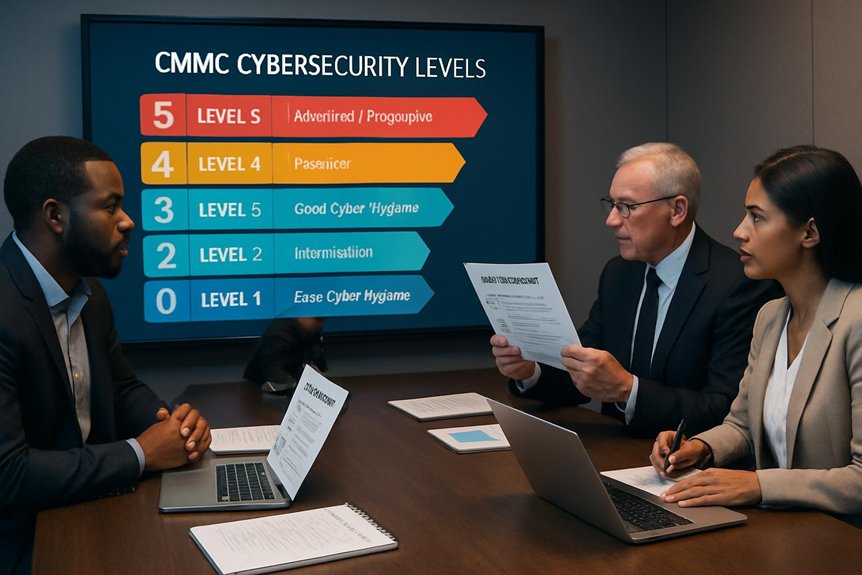
Your CMMC level directly determines both the cybersecurity controls you’ll implement and the assessment process you’ll undergo to prove compliance.
Level 1 requires basic cybersecurity practices for Federal Contract Information (FCI) with annual self-assessments. Level 2 demands 110 practices protecting Controlled Unclassified Information (CUI) and may require third-party assessments. Level 3 mandates all NIST SP 800-171 controls plus additional practices, requiring government-led assessments every three years.
Your compliance requirements scale with your cybersecurity maturity level and the sensitivity of data you handle.
The Department of Defense (DoD) uses these CMMC levels to determine contract eligibility, making proper assessment vital. Understanding your required level helps you plan implementation timelines, budget for necessary cybersecurity practices, and select appropriate assessment processes to maintain compliance.
Strategic Benefits of Understanding CMMC Levels for Defense Contractors
Although CMMC compliance might seem like just another regulatory hurdle, understanding these cybersecurity levels actually delivers significant strategic advantages that can transform your defense contracting business.
Grasping CMMC levels enables defense contractors to make informed decisions about cybersecurity requirements and strategic resources allocation. Whether you’re handling Federal Contract Information (FCI) or Controlled Unclassified Information (CUI), this knowledge positions you for success.
Here are three key strategic benefits:
- Resource Optimization – You’ll allocate cybersecurity investments precisely where needed, avoiding unnecessary expenditures while meeting compliance standards.
- Competitive Advantage – Prime contractors increasingly prefer subcontractors with established certifications, improving your bidding position.
- Market Positioning – Early preparation for the Q1 2025 rollout guarantees you’re ready for lucrative DoD contracts while competitors scramble to achieve compliance.
Steps to Identify and Achieve Your Required CMMC Certification Level
Since steering CMMC certification requires a systematic approach, you’ll need to follow specific steps that align with your organization’s security requirements and contract obligations.
First, determine your required CMMC level by evaluating whether you handle Federal Contract Information or Controlled Unclassified Information (CUI).
Next, conduct a gap analysis comparing your current cybersecurity practices against NIST SP 800-171 requirements—17 practices for Level 1 or 110 for Level 2.
Develop an all-encompassing System Security Plan (SSP) documenting your policies, controls, and remediation strategies.
Partner with Third-Party Assessment Organizations (C3PAOs) to navigate compliance requirements and prepare for evaluations.
Finally, establish continuous monitoring and training programs to maintain readiness, as DoD contractors must meet CMMC certification process requirements by Fall 2026.
Frequently Asked Questions
Why Is CMMC Certification Important?
CMMC certification is essential because you’ll gain access to lucrative defense contracts while strengthening your security posture.
The certification process guarantees you meet strict compliance requirements, reducing cybersecurity risks through an all-encompassing framework. You’ll demonstrate contractor responsibilities effectively, improving incident response capabilities and establishing continuous improvement practices.
These CMMC benefits position your organization competitively within the defense industrial base, protecting sensitive information while building client trust and maintaining eligibility for government opportunities.
What CMMC Level Do I Need?
Maneuvering CMMC requirements is like choosing the right armor for battle—you’ll need Level 1 for basic Federal Contract Information, Level 2 for most Controlled Unclassified Information, or Level 3 for highly sensitive data.
The compliance assessment process and contractor obligations explained depend on your data sensitivity. A thorough self assessment using available tools will clarify level distinctions and help you understand cost implications, preparation strategies, and continuous monitoring importance for maintaining certification.
What Is the Difference Between CMMC 2.0 Level 2 and Level 3?
CMMC levels differ greatly in compliance requirements and organizational impact.
Level 2 implements 110 NIST SP 800-171 controls through self-assessment or third-party evaluation, while Level 3 adds 20 advanced practices requiring government-led assessment.
You’ll face higher cost implications and extended certification timelines for Level 3.
The cybersecurity framework intensifies with Level 3’s focus on APT protection.
Your implementation strategies must include thorough training programs and enhanced risk management for Level 3’s stringent assessment process.
What Is the Cyber Security Maturity Model CMMC?
The CMMC framework overview establishes mandatory cybersecurity best practices for defense contractors handling sensitive government data.
You’ll undergo a compliance assessment process through certified third-party organizations to verify your implementation.
The framework aligns with NIST standards while addressing implementation challenges through continuous monitoring techniques and thorough training programs.
You’re building organizational readiness against evolving threats, incorporating risk management strategies that reflect future cybersecurity trends in defense contracting requirements.
Conclusion
You’re standing at the crossroads of defense contracting success. Each CMMC level you master opens the door to higher-value contracts, but one misstep in understanding requirements could cost you everything. The clock’s ticking—competitors are already advancing through certification levels while you’re still figuring out the basics. Your next move determines whether you’ll secure lucrative DoD contracts or watch them slip away. Don’t let confusion about CMMC levels become your biggest strategic mistake.