You’ll best understand CMMC cybersecurity levels by first reviewing each tier’s specific requirements—from Level 1’s 17 basic practices for Federal Contract Information to Level 3’s 130+ advanced controls for sensitive defense data. Next, conduct thorough self-assessments using CMMC checklists to identify compliance gaps in your current security practices. Finally, engage with cybersecurity experts and utilize training resources like webinars and workshops to gain practical implementation insights. These foundational steps will prepare you for deeper compliance strategies.
Key Takeaways
- Study the three-tier structure: Level 1 protects FCI, Level 2 handles CUI, Level 3 adds advanced threat detection.
- Conduct thorough self-assessments using CMMC checklists to identify compliance gaps in your current cybersecurity practices.
- Engage cybersecurity experts and Third-Party Assessment Organizations for tailored insights into specific CMMC requirements and processes.
- Access training resources like webinars, workshops, and NIST SP 800-171 courses to build foundational compliance knowledge.
- Align cybersecurity practices with your operational role in the defense supply chain and information sensitivity levels.
Review Core Requirements and Security Practices for Each CMMC Level
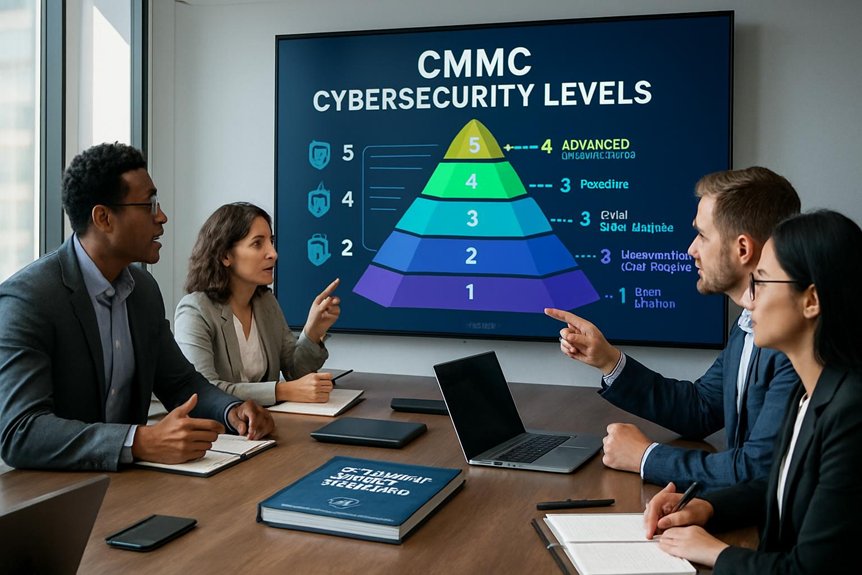
Since your organization’s position in the defense supply chain determines which CMMC level you’ll need to achieve, understanding each level’s specific requirements becomes essential for compliance planning.
CMMC Level 1 requires 17 basic cybersecurity practices to protect Federal Contract Information (FCI). You’ll conduct annual self-assessments without documenting processes, making it the most accessible tier.
Level 2 demands 110 security practices aligned with NIST SP 800-171 for handling Controlled Unclassified Information (CUI). You must document your processes and demonstrate maturity in implementation.
CMMC Level 2 requires comprehensive documentation and mature implementation of 110 NIST-aligned security practices for CUI handling.
Level 3 incorporates all previous practices plus 20 additional requirements. You’ll need thorough cybersecurity practices management, focusing on advanced threat detection and incident response capabilities for CUI protection.
Each level reflects information sensitivity, ensuring appropriate defense supply chain compliance measures match your operational responsibilities.
Conduct Self-Assessment Against CMMC Standards to Identify Gaps
Before pursuing formal CMMC certification, you’ll need to conduct a thorough self-assessment against the relevant standards to identify compliance gaps in your current cybersecurity practices. This evaluation focuses on the 110 security controls outlined in NIST SP 800-171 for Level 2 and Level 3 certifications.
Use an extensive checklist to evaluate your organization’s cybersecurity practices against specific CMMC requirements for your target level. Document all findings carefully, as these results form the foundation for creating a Plan of Actions and Milestones (POAM) to address identified deficiencies.
Regular self-assessments prepare you for future independent assessments while fostering continuous cybersecurity improvement.
Consider working with cybersecurity consultants who provide structured frameworks and tools, ensuring extensive coverage of all CMMC standards and enhancing your assessment’s effectiveness.
Engage With Cybersecurity Experts and Training Resources

After completing your self-assessment, you’ll benefit greatly from engaging with cybersecurity experts who can provide tailored insights into your specific CMMC levels requirements.
These professionals understand how data sensitivity and operational roles align with appropriate compliance scenarios. You should utilize training resources like webinars and workshops that offer practical implementation knowledge for real-world situations.
Consider consulting with Third-Party Assessment Organizations (C3PAOs) to clarify assessment processes and prepare for independent audits required at higher levels.
Online courses focusing on NIST SP 800-171 controls will enhance your understanding of foundational requirements for cybersecurity compliance.
Stay current with government publications and industry guidelines that provide updated best practices.
These resources guarantee you’re informed about evolving CMMC standards and maintain effective compliance strategies.
Frequently Asked Questions
How Are CMMC Levels Determined?
CMMC levels are determined through thorough CMMC assessment criteria that evaluate your organization’s cybersecurity maturity and compliance requirements.
You’ll undergo a certification process where assessors examine your organizational practices against specific security controls and industry standards.
The scoring methodology considers your risk management capabilities and implementation strategies for protecting Federal Contract Information or Controlled Unclassified Information.
Your required level depends on the data sensitivity you’ll handle in DoD contracts.
What Is the Difference Between CMMC 2.0 Level 2 and Level 3?
You’ll find Level 2 requirements include 110 security controls with self-assessment options, while Level 3 assessments demand 130 controls requiring independent C3PAO evaluation.
Your compliance documentation shifts from basic process documentation to thorough System Security Plans.
Level 3 emphasizes advanced cybersecurity best practices including proactive incident response plans and continuous monitoring strategies.
The CMMC certification process becomes more rigorous, with enhanced contractor obligations for risk management framework implementation and thorough security controls evaluation.
What Is the Difference Between CMMC L1 and L2?
Need to understand CMMC compliance differences?
L1 requirements focus on cybersecurity basics with 17 controls for Federal Contract Information, allowing self-assessment.
L2 controls advance to 110 practices protecting Controlled Unclassified Information, requiring documented processes and Third-Party Assessment Organization certification.
Your contractor obligations escalate from foundational cyber hygiene to advanced risk management.
These security frameworks demand different implementation strategies – L1 emphasizes basic data protection while L2 involves thorough assessment processes and mature cybersecurity practices.
Which Level of CMMC Is Most Closely Aligned With NIST 800-171?
CMMC Level 2 is most closely aligned with NIST 800-171, requiring you to implement all 110 security controls for protecting CUI.
You’ll find the compliance requirements mirror NIST’s framework exactly, making your implementation strategies straightforward. The certification process involves demonstrating organizational readiness through documented risk management practices.
Your assessment process can include self-evaluations or third-party audits, with audit frequency varying based on contract requirements and documentation practices.
Conclusion
You’ll master CMMC levels by systematically reviewing requirements, conducting honest self-assessments, and leveraging expert guidance. Don’t underestimate the complexity—when Lockheed Martin faced CMMC compliance challenges in 2021, they discovered gaps across multiple domains despite their robust security posture. You can’t afford similar oversights. Start your assessment today, because CMMC compliance isn’t just regulatory—it’s your gateway to lucrative defense contracts and operational resilience.