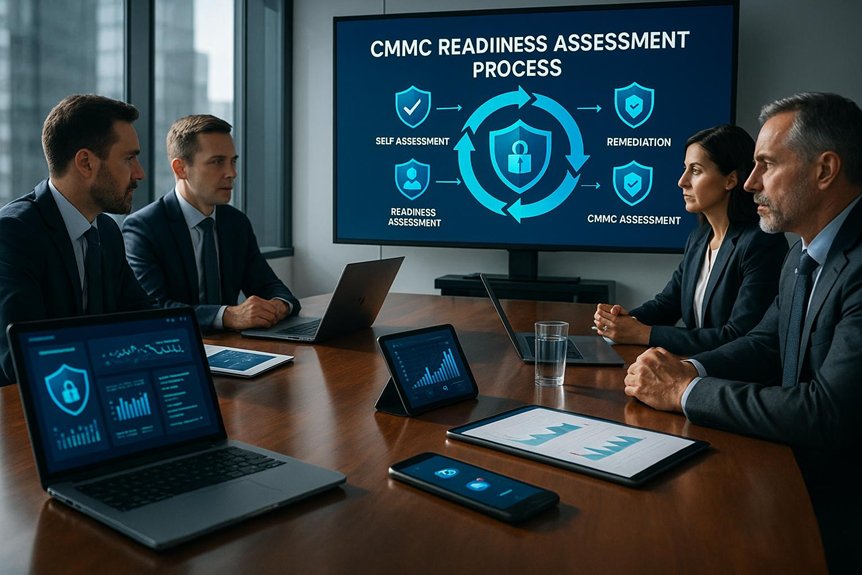
You’ll need to evaluate your cybersecurity posture against CMMC’s three compliance levels, starting with a thorough gap analysis of your current security controls versus the required 17 Level 1 or 110 Level 2 standards. Assemble a readiness assessment team including IT professionals and compliance officers, then document your System Security Plan while implementing essential practices like access controls, continuous monitoring, and risk management strategies. Prepare for third-party validation through mock audits and detailed documentation to confirm you’re ready for mandatory compliance.
Key Takeaways
- Conduct a comprehensive gap analysis comparing current security practices against CMMC’s 17 Level 1 or 110 Level 2 controls.
- Assemble a readiness team including IT professionals, compliance officers, and leadership to oversee assessment and documentation efforts.
- Evaluate technical controls, policies, procedures, and employee training programs to identify compliance gaps across all security domains.
- Develop a System Security Plan documenting current security measures, identified gaps, and remediation priorities for assessor review.
- Perform regular self-assessments and mock audits using CMMC Assessment Guides to validate readiness before formal third-party evaluation.
Understanding CMMC Framework Requirements and Compliance Levels
Three distinct compliance levels form the backbone of the CMMC framework, each designed to protect different types of sensitive information based on your organization’s role in the defense supply chain.
Level 1 requires 17 security controls to safeguard Federal Contract Information (FCI) and allows self-assessment of your cybersecurity posture.
Level 1 CMMC establishes baseline cybersecurity with 17 essential controls and self-assessment capabilities for federal contract information protection.
Level 2 demands 110 controls from NIST SP 800-171 for handling Controlled Unclassified Information (CUI) and mandates third-party evaluations to assess compliance.
Level 3 incorporates advanced protections from NIST SP 800-172 for highly sensitive CUI, also requiring formal external assessment.
Understanding these compliance levels and their specific requirements is essential, as meeting the appropriate CMMC framework standards becomes mandatory for DoD contracts starting in 2025.
CMMC 2.0 aligns with NIST standards by integrating SP 800-171 and 800-172 controls, streamlining compliance across levels.
Conducting a Comprehensive Gap Analysis of Current Security Controls
Once you’ve identified your required compliance level, the next step involves systematically evaluating where your organization currently stands against those specific requirements.
Your gap analysis should map existing cybersecurity practices against CMMC’s 17 Level 1 requirements or NIST SP 800-171’s 110 controls for Level 2 compliance. This process helps you identify gaps between current security controls and mandated standards.
Don’t limit your assessment to technical controls alone. You’ll need a holistic approach that examines policies, procedures, and employee training programs.
Utilizing CMMC Assessment Guides and risk assessment frameworks streamlines this evaluation process. Incorporate robust documentation such as an SSP aligned with NIST 800-171A and POA&Ms to correlate findings with remediation plans and support assessment success.
Your gap analysis results will prioritize remediation efforts by highlighting high-risk areas requiring immediate attention.
This strategic approach guarantees you’re addressing the most critical vulnerabilities first, strengthening your overall cybersecurity posture efficiently.
Building Your CMMC Readiness Assessment Team and Documentation
After completing your gap analysis, assembling the right team becomes essential for your CMMC readiness assessment‘s success.
Your CMMC readiness assessment team should include senior leadership, IT professionals, compliance officers, and external consultants to guarantee thorough coverage of cybersecurity practices.
Clearly define roles and responsibilities within your team, focusing on documentation updates and assessor communication.
Develop a System Security Plan that outlines current security measures, compliance gaps, and improvement timelines. This document must reflect ongoing changes in your cybersecurity practices.
Gather essential policies and procedures that align with CMMC requirements, using assessment guides and NIST SP 800-171A for compliance mapping.
Conduct regular self-assessments to identify gaps and maintain accurate documentation. This structured approach supports continuous improvement while guaranteeing your organization stays aligned with evolving standards.
Add a dedicated process to maintain your SSP, POA&M, and evidence artifacts between audits, as triennial assessments require sustained compliance and up-to-date documentation.
Implementing Essential Security Practices and Risk Management Strategies
With your team assembled and documentation framework established, you must now focus on implementing the fundamental security practices that form the backbone of CMMC compliance.
Your CMMC readiness begins with establishing robust access controls and user authentication protocols, ensuring only authorized personnel access sensitive information per Level 1 standards.
You’ll need continuous monitoring systems and regular maintenance schedules to address vulnerabilities promptly, meeting Levels 2 and 3 compliance requirements.
Physical security measures complement your cybersecurity posture by preventing unauthorized facility access, essential for CUI safeguarding.
Implement thorough audit logging and reporting mechanisms to track system activity and support incident response procedures.
Develop a strategic risk management approach that identifies vulnerabilities and establishes mitigation practices, maintaining alignment with essential security practices while strengthening your overall cybersecurity posture against evolving threats. Add routine user access reviews and enforce least privilege to remediate common CMMC access control failures and demonstrate compliance during audits.
Preparing for Third-Party Validation and Continuous Monitoring
As your security practices mature, you must shift focus toward preparing for the rigorous third-party validation process that determines your CMMC certification level.
Building CMMC readiness requires extensive documentation of your cybersecurity practices, ensuring assessors have clear evidence of compliance with CMMC standards.
Conduct thorough self-assessments and mock audits to identify gaps in your cybersecurity posture before formal validation. These evaluations increase your chances of successful certification while strengthening your overall security framework.
Engage external consultants familiar with CMMC standards to provide insights and best practices during preparation.
Leverage DoD resources like the CMMC Assessment Guide and NIST SP 800-171A to streamline validation processes.
Implement continuous monitoring through regular evaluations and updates to your cybersecurity controls.
This ongoing approach maintains compliance and adapts to evolving threats.
Integrate automated monitoring tools such as SIEM and EDR and maintain detailed compliance documentation to provide essential evidence during audits and ensure continuous alignment with CMMC requirements.
Frequently Asked Questions
What Is the CMMC Framework for Cybersecurity Maturity Model Certification?
The CMMC framework establishes three levels of cybersecurity maturity for Defense Industrial Base contractors.
You’ll need Level 1 for basic safeguarding, Level 2 for enhanced CUI protection with all 110 NIST SP 800-171 controls, and Level 3 for expert protections.
Compliance importance can’t be overstated—you must meet requirements to bid on DoD contracts.
Assessment methodologies involve third-party evaluations, requiring continuous monitoring and risk management best practices for successful implementation strategies.
How to Conduct a CMMC Assessment?
You’ll conduct a CMMC assessment by following the CMMC evaluation process with your assessment team roles clearly defined.
Start with a CMMC assessment checklist mapping your current cybersecurity best practices against required security controls assessment.
Implement CMMC implementation strategies through proper compliance documentation requirements and CMMC training programs.
Use continuous monitoring techniques within your risk management framework to identify gaps and maintain ongoing compliance readiness.
How Much Does the CMMC Readiness Assessment Cost?
Ironically, you’ll spend money to potentially save millions. CMMC costs range from $5,000-$25,000+ for thorough assessment fees, depending on your organization’s complexity.
Budget considerations include additional remediation expenses and ongoing support. Pricing structures vary among providers, with some offering package deals.
Despite these financial implications and cost breakdown seeming steep, consider funding options and assessment value against industry standards. The cost benefits become clear when you avoid losing lucrative contracts due to non-compliance.
How to Determine CMMC Level?
You’ll determine your CMMC level by first identifying whether you handle FCI or CUI data.
Review assessment criteria against your current cybersecurity controls and organizational policies.
Use a compliance checklist to evaluate security requirements, documentation processes, and training programs.
Conduct risk management analysis comparing your posture to required CMMC levels.
Consider continuous monitoring capabilities and existing controls to identify gaps between Level 1’s basic practices and Level 2’s thorough requirements.
Conclusion
You’ve laid the groundwork for CMMC success by understanding requirements, analyzing gaps, assembling your team, implementing controls, and preparing for validation. Don’t let this momentum slip through your fingers—cybersecurity isn’t a destination, it’s an ongoing journey. Stay vigilant with continuous monitoring and regular assessments. You’re not just checking compliance boxes; you’re building a fortress that’ll protect your organization’s future. Keep your security posture sharp and you’ll thrive in today’s threat landscape.