
You’ll need CMMC certification to secure defense contracts as a small business, with requirements ranging from 17 basic cybersecurity practices at Level 1 to 171 advanced controls at Level 5. You must document policies, procedures, and employee training while implementing specific security controls based on your target maturity level. Level 1 allows self-assessment, but higher levels require certified third-party assessors to validate your compliance through thorough evaluations and on-site visits. Ongoing monitoring guarantees you’ll maintain certification standards effectively.
Key Takeaways
- Small defense contractors must achieve CMMC Level 1 certification requiring implementation of 17 basic cybersecurity practices.
- Level 1 certification allows self-assessment, while higher levels require costly third-party assessor validation and evaluation.
- Essential documentation includes security policies, employee training records, risk assessments, and complete hardware/software asset inventories.
- Businesses must establish continuous monitoring systems and incident response plans to maintain certification after initial assessment.
- Approximately 50% of defense contractors are small businesses, making CMMC compliance critical for contract eligibility.
Understanding CMMC Framework Levels and Small Business Requirements

While traversing the complex landscape of defense contracting, you’ll encounter the CMMC framework‘s five-tiered structure that scales from basic cyber hygiene at Level 1 to advanced cybersecurity measures at Level 5.
Each certification level demands increasingly rigorous cybersecurity practices, with Level 1 requiring 17 fundamental security practices to protect Controlled Unclassified Information (CUI).
CMMC Level 1 establishes the foundation with 17 essential cybersecurity practices designed to safeguard Controlled Unclassified Information in defense contracting.
As a small business in the defense supply chain, you’ll face specific compliance requirements that align with your desired CMMC certification level.
The framework recognizes that approximately 50% of defense contractors are small businesses, making your cybersecurity posture critical to national security.
You’ll need ongoing training to maintain compliance and prepare for mandatory third-party assessments.
These evaluations validate your adherence to prescribed security practices, ensuring you can effectively safeguard sensitive information while participating in defense contracts.
Essential Documentation and Evidence Collection for CMMC Compliance
Once you’ve identified your target CMMC level, you’ll need to systematically collect and organize documentation that proves your cybersecurity practices meet the framework’s requirements.
Essential documentation for CMMC compliance includes thorough policies and procedures covering information security, risk management, and incident response protocols. Small businesses must maintain detailed records of employee training programs that demonstrate your organization’s commitment to cybersecurity awareness.
You’ll also need to document regular assessments and audits of your security controls, providing evidence of ongoing compliance and continuous improvement efforts.
Additionally, compile a complete inventory of your hardware and software assets, including their security configurations. This systematic approach to documentation collection guarantees certification evaluators can verify that your small business meets all required CMMC standards effectively.
Cybersecurity Controls Implementation for Different CMMC Maturity Levels

Understanding which cybersecurity controls to implement depends heavily on your target CMMC maturity levels, as each tier introduces progressively more sophisticated security requirements. At Level 1, you’ll focus on basic cybersecurity hygiene with 17 fundamental practices like antivirus software and access controls.
Higher maturity levels demand increasingly complex implementation strategies, with Level 5 requiring 171 exhaustive practices including advanced threat hunting capabilities.
Your controls implementation must address access management, risk assessment, and continuous monitoring to achieve compliance. Remember that Level 1 allows self-assessment, while Levels 2-5 require third-party assessment validation.
Strategic implementation of these cybersecurity controls protects sensitive data and positions your business competitively for federal contracts, as DoD mandates CMMC compliance for defense contractors.
Third-Party Assessment Process and Certified Assessor Selection
When your business requires CMMC Level 2 or higher certification, you’ll need to engage a certified third-party assessor who possesses deep expertise in cybersecurity frameworks and DoD requirements.
The third-party assessment process involves thorough evaluation of your compliance with specific certification criteria through documentation reviews and interviews.
Your certified assessors conduct objective evaluations using these key methods:
- On-site visits to verify operations and review security records
- Ownership requirements verification to confirm proper operational control
- Performance assessments to validate your cybersecurity implementation
Organizations like the National Minority Supplier Development Council maintain trained assessors to preserve program integrity.
This evaluation confirms businesses genuinely represent their claimed populations, promoting diversity in contracting opportunities.
The assessment process guarantees certification authenticity while supporting fair access to government contracts.
Maintaining CMMC Certification Through Continuous Monitoring and Updates
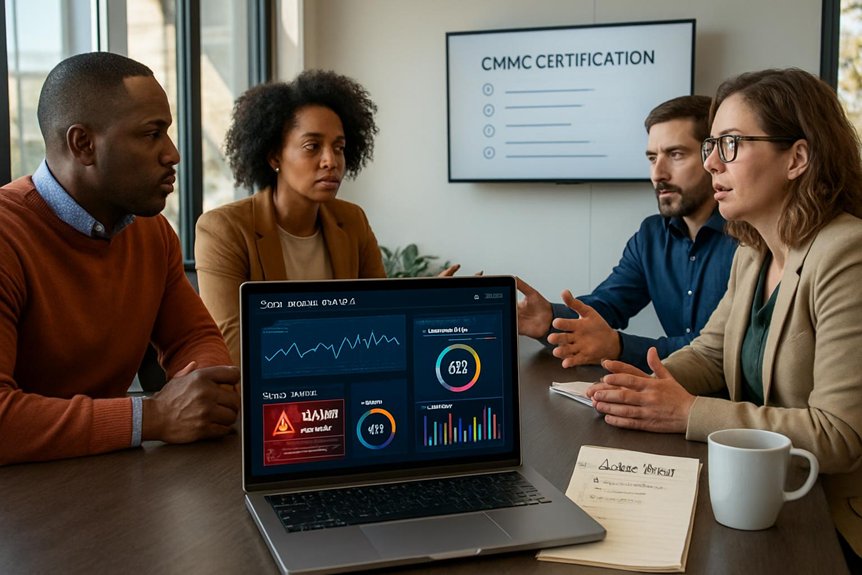
After completing your third-party assessment and achieving CMMC certification, you’ll face the ongoing challenge of maintaining that status through systematic monitoring and regular updates.
Small business certifications require continuous monitoring of security controls and regular assessments to guarantee compliance. You must establish robust updates and patching schedules to address vulnerabilities promptly.
Maintaining thorough documentation of policies and procedures proves essential during ongoing audits. Employee training programs keep your team current on security practices and compliance requirements.
Additionally, you’ll need a tested incident response plan that’s regularly updated to handle security events effectively. This systematic approach to CMMC certification maintenance protects your organization from non-compliance risks while preserving your ability to work with Department of Defense contracts.
Frequently Asked Questions
What Are the 5 SBA Requirements of a Small Business?
You’ll need to meet five key SBA eligibility criteria for your small business.
First, you must satisfy specific business size standards based on employee count and revenue limitations for your industry classifications.
Second, your ownership requirements include being independently owned and operated.
Third, you’ll face personal net worth thresholds.
Fourth, management criteria require you to control daily operations.
Finally, you must organize for profit and operate primarily within the United States while following affiliation rules.
What Are Good Certifications for Business?
Who doesn’t love collecting certificates like business merit badges?
You’ll gain massive certification benefits including competitive advantage through quality assurance and industry standards compliance.
These credentials boost customer trust, open market access, and release lucrative government contracts.
Focus on employee training certifications for professional development while pursuing sector-specific credentials that drive business growth.
Whether it’s ISO standards, safety certifications, or professional licenses, you’re fundamentally buying credibility that pays dividends.
What Certificate Do You Need to Start a Business?
You’ll need several certificates to start your business legally. First, obtain business licenses and complete tax registration with local and federal authorities.
Depending on your industry, you’ll require specific industry certifications, health permits, and occupation permits.
Don’t forget zoning approvals for your location and safety certifications for compliance.
Consider quality management standards, environmental compliance requirements, and professional memberships that enhance credibility and guarantee you’re operating within all regulatory frameworks.
What Are the Requirements for a Small Business?
You’ll need business registration in your state and a tax identification number from the IRS.
Develop a thorough business plan with financial projections to guide operations and secure funding.
Research industry regulations and obtain necessary licensing requirements and operational permits.
You’ll also need insurance policies to protect your business, employee contracts if hiring staff, and effective marketing strategies to reach customers and grow your venture successfully.
Conclusion
You’ve navigated the CMMC labyrinth like Theseus with his golden thread, mapping each compliance level and assembling your documentation arsenal. You’ve built cybersecurity fortresses, selected your assessment guides, and established vigilant monitoring systems. Now you’re equipped to cross the certification bridge that separates you from lucrative DoD contracts. Remember, CMMC isn’t a destination—it’s your passport to the federal marketplace, where prepared small businesses can compete alongside industry giants.