
You’ll find the most extensive cybersecurity maturity model certification courses through specialized CMMC training programs. The PECB Certified CMMC Professional offers a focused 4-day curriculum with 29 NASBA CPE credits, while CMMC 2.0 Compliance Training prepares defense contractors for government contract requirements. Advanced CMMC Assessor Certification develops practical evaluation skills across all five maturity levels. These programs integrate NIST standards and focus on protecting Controlled Unclassified Information. The following sections reveal specific course details and certification pathways.
Key Takeaways
- PECB Certified CMMC Professional Training offers a comprehensive 4-day program with 29 NASBA CPE Credits and hands-on cybersecurity controls experience.
- CMMC 2.0 Compliance Training specializes in defense contractor requirements, focusing on CUI protection and NIST SP 800-171 guidelines.
- Advanced CMMC Assessor Certification Training prepares candidates for the Certified CMMC Assessor role with practical evaluation skills development.
- CMMC Boot Camp provides four-day intensive training covering assessment scope, federal acquisition regulations, and CUI protection fundamentals.
- All CMMC training programs integrate NIST cybersecurity standards and prepare participants for third-party auditor assessments across five maturity levels.
Understanding CMMC Framework and Its Five Maturity Levels

As organizations increasingly handle sensitive government information, the Cybersecurity Maturity Model Certification (CMMC) framework establishes five progressive maturity levels that systematically build upon each other to strengthen cybersecurity defenses.
Each level within the CMMC Framework incorporates specific domains, capabilities, and cybersecurity practices that you’ll need to implement based on your contract requirements with the Department of Defense.
Level 1 focuses on basic cybersecurity hygiene, while Level 5 targets advanced, proactive measures.
As DoD contractors, you must achieve certification corresponding to your contract obligations, making compliance mandatory across the Defense Industrial Base.
The framework directly addresses risks associated with Controlled Unclassified Information compromise.
You’ll undergo assessments by accredited third-party auditors who verify that your organization meets the necessary controls and practices defined by each maturity level.
PECB Certified CMMC Professional Training Program
The PECB Certified CMMC Professional Training Program delivers thorough preparation through a focused 4-day curriculum that equips you with essential knowledge and skills for CMMC assessments.
This extensive CMMC Training Course prepares you for the Certified CMMC Professional (CCP) certification while earning 29 NASBA CPE Credits through live instruction.
You’ll gain hands-on experience with cybersecurity controls and CMMC assessment processes, supported by ongoing instructor coaching.
The training emphasizes practical application within the DoD supply chain environment, ensuring you understand real-world implementation challenges.
To enroll, you need foundational cybersecurity education or experience, plus Cyber AB approval and a $200 registration fee.
Upon successful completion, you’ll qualify as an Assessment Team Member under Lead Assessor supervision, positioning yourself for advancement to Certified CMMC Assessor certification.
CMMC 2.0 Compliance Training for Defense Contractors
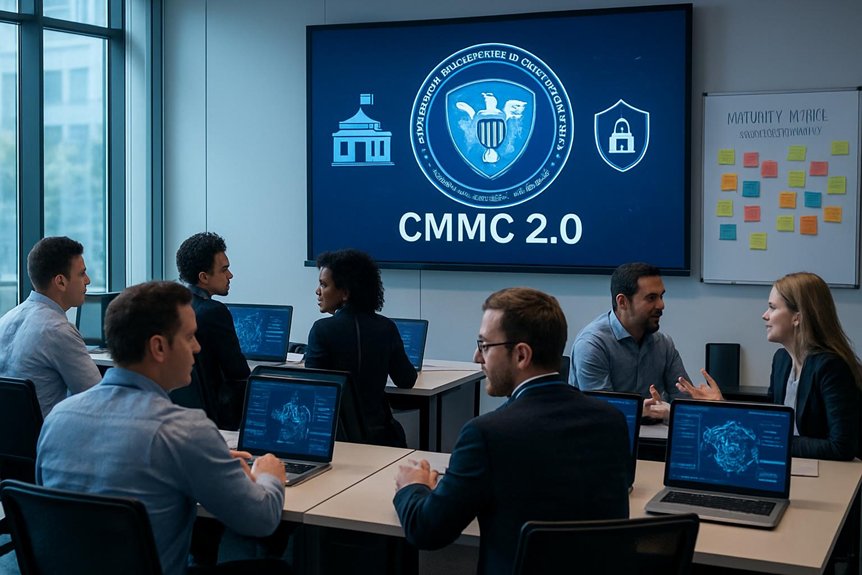
When defense contractors face the challenge of securing government contracts, CMMC 2.0 Compliance Training provides the critical foundation you need to meet stringent cybersecurity regulations.
This specialized CMMC Certification Training focuses specifically on protecting Controlled Unclassified Information (CUI) within the Defense Industrial Base (DIB).
You’ll master essential guidelines from the CMMC model, NIST standards, and SP 800-171 through this extensive four-day program.
The flexible delivery options include both online and in-class formats, accommodating your schedule preferences while ensuring thorough cybersecurity knowledge acquisition.
Through hands-on experience with the CMMC assessment process, you’ll develop practical skills for managing sensitive information protection.
Upon completion, you’ll possess the expertise necessary to guide your organization toward full compliance with updated CMMC requirements, positioning you competitively for government contract opportunities.
Certified CMMC Professional (CCP) Certification Path
Beyond basic compliance training, pursuing the Certified CMMC Professional (CCP) certification establishes your credentials as a qualified cybersecurity professional within the CMMC assessment ecosystem.
This extensive CMMC Certification Training Course spans four days and awards 29 NASBA CPE Credits upon completion.
You’ll need foundational cybersecurity education or experience plus a $200 registration fee for your CPN number from Cyber AB.
The program combines theoretical knowledge with hands-on experience in CMMC assessments, preparing you to serve as an Assessment Team Member under Lead Assessor supervision.
As a DoD contractor or cybersecurity professional, earning your Certified CMMC Professional credential positions you strategically within the Cybersecurity Maturity Model Certification framework.
Additionally, CCP certification serves as your stepping stone toward the advanced Certified CMMC Assessor qualification.
NIST Cybersecurity Framework Integration With CMMC

Since CMMC builds upon established cybersecurity standards, you’ll find that NIST Cybersecurity Framework (CSF) integration forms the backbone of effective compliance strategies. The framework’s structured approach directly aligns with CMMC’s mission to protect Controlled Unclassified Information (CUI) within defense contractors.
NIST Cybersecurity Framework integration serves as the foundation for achieving CMMC compliance and protecting defense contractor CUI effectively.
You’ll discover that NIST guidelines, particularly SP 800-171, are embedded throughout CMMC’s five maturity levels. This integration guarantees you’re implementing robust controls against unauthorized access and data breaches.
Both frameworks emphasize risk management, enabling you to identify, assess, and mitigate cybersecurity threats systematically.
When you pursue CMMC training that incorporates NIST cybersecurity standards, you’re equipping yourself with essential tools for compliance achievement. This all-encompassing approach strengthens your organization’s cybersecurity posture while meeting national security requirements for protecting critical defense information.
CMMC Assessment Methodology and Process Training
While understanding NIST integration provides the foundation for CMMC compliance, mastering the assessment methodology becomes your next priority for certification success.
CMMC Assessment Methodology training equips you with thorough evaluation skills across all five maturity levels, covering both self-assessments and third-party evaluations essential for cybersecurity standards compliance.
You’ll learn to define assessment scope, identify Controlled Unclassified Information (CUI), and establish protection boundaries within your organization. The course provides hands-on experience as Assessment Team Members under Lead Assessor supervision, preparing you for real-world scenarios.
This training proves critical for Organizations Seeking Certification (OSC) preparing for mandatory DoD contractor audits. You’ll master documentation requirements and assessment procedures, ensuring your organization meets certification standards for continued defense contracting eligibility.
Defense Industrial Base Security Requirements
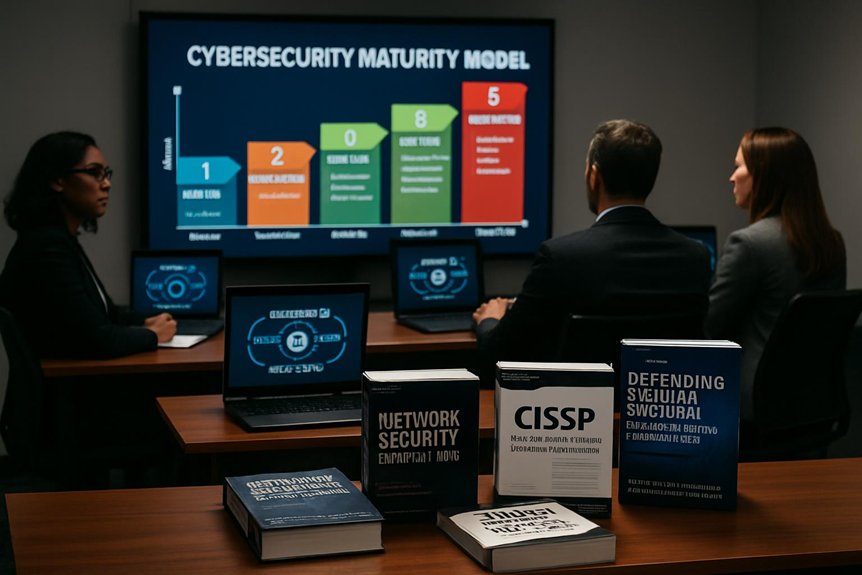
As cybersecurity threats intensify against defense contractors, you’ll need thorough understanding of Defense Industrial Base (DIB) security requirements to protect your organization’s role in national security.
The DIB encompasses companies providing research, engineering, and support services to the DoD, making cybersecurity paramount for protecting intellectual property and sensitive data.
CMMC mandates specific security controls for contractors handling Controlled Unclassified Information (CUI) and Federal Contract Information.
You must implement these cybersecurity requirements across five maturity levels, each demanding increasingly sophisticated practices and processes.
Your compliance directly impacts your ability to bid on government contracts and participate in the defense supply chain.
Understanding DIB security requirements isn’t optional—it’s essential for maintaining your competitive position while safeguarding national security interests.
Controlled Unclassified Information (CUI) Protection Strategies
Building on your foundation of DIB security requirements, you must now focus on implementing robust strategies to protect Controlled Unclassified Information (CUI).
CMMC mandates specific security measures that contractors within the Defense Industrial Base must adopt to safeguard this sensitive but unclassified information.
Your CUI protection strategy should include:
- Clear identification policies – Establish procedures to properly classify and mark CUI across all organizational systems.
- Access controls – Implement role-based permissions guaranteeing only authorized personnel handle CUI.
- Regular risk assessments – Conduct ongoing audits to identify vulnerabilities in your cybersecurity posture.
- Data governance frameworks – Create thorough handling procedures for CUI storage, transmission, and disposal.
Effective CUI protection strategies guarantee compliance with federal regulations while strengthening your organization’s overall cybersecurity resilience and data management practices.
CMMC Boot Camp for Organizational Readiness

The CMMC Boot Camp provides a thorough four-day training program that transforms your organization’s readiness for Cybersecurity Maturity Model Certification requirements.
You’ll earn 29 NASBA CPE credits while gaining hands-on experience with assessment processes and preparing for the Certified CMMC Professional certification.
The extensive curriculum covers assessment scope boundaries, federal acquisition regulation compliance, and Controlled Unclassified Information (CUI) protection within the Defense Industrial Base (DIB).
Experienced instructors, including provisional Certified CMMC Assessors, guide you through threat identification, security control establishment, and assessment preparation strategies.
You’ll develop essential cybersecurity skills to prepare Organizations Seeking Certification for evaluations.
Prior cybersecurity experience or education is recommended to maximize your participation effectiveness and guarantee you’re ready to protect sensitive information throughout the defense supply chain.
Advanced CMMC Assessor Certification Training
When you’re ready to advance beyond foundational CMMC knowledge, the Advanced CMMC Assessor Certification Training prepares you for the rigorous demands of becoming a Certified CMMC Assessor (CCA).
This thorough program equips you with essential skills for conducting extensive Maturity Model Certification (CMMC) evaluations within the Defense Industrial Base (DIB).
The training covers four critical areas:
The comprehensive curriculum addresses four essential domains crucial for successful CMMC assessment certification and professional development.
- Five maturity levels – Master each level’s specific practices and processes
- Controlled Unclassified Information (CUI) – Learn identification and protection requirements
- Risk management regulations – Understand compliance complexities and assessment methodologies
- Hands-on assessment experience – Develop practical evaluation skills
Upon completion, you’ll qualify as an Assessment Team Member under Lead Assessor supervision.
This certification greatly advances your cybersecurity career by providing expertise in cybersecurity standards implementation and CMMC compliance management.
Frequently Asked Questions
What Is the Best Maturity Model for Cybersecurity?
You’ll find CMMC stands out as the best cybersecurity maturity model due to its thorough maturity assessment techniques and rigorous compliance evaluation methods.
It’s superior in cybersecurity framework comparison because it integrates multiple standards like NIST SP 800-171.
You’ll benefit from its structured risk management strategies across five progressive levels that systematically enhance your organizational security posture.
CMMC’s third-party verification guarantees you’re meeting DoD requirements while strengthening your overall cybersecurity defenses effectively.
What Is the Most Prestigious Cybersecurity Certification?
While some argue certification value depends on your specialization, the CISSP stands as cybersecurity’s most prestigious credential with unmatched industry recognition.
You’ll need five years’ experience and must pass a demanding 250-question exam, making certification requirements rigorous. However, this difficulty enhances its reputation among employers.
Your career advancement opportunities multiply greatly with CISSP certification, as it’s often mandatory for senior roles.
Proper exam preparation is essential given the extensive eight-domain coverage required.
What Is the Cybersecurity Maturity Model Certification?
The Cybersecurity Maturity Model Certification (CMMC) is a thorough framework you’ll need if you’re working with the Department of Defense.
It establishes cybersecurity frameworks across five maturity levels, integrating risk management and compliance standards to protect sensitive information.
You’ll implement security policies and conduct threat assessments to meet requirements.
CMMC guarantees you’re properly safeguarding Controlled Unclassified Information and Federal Contract Information through verified cybersecurity practices and third-party assessments.
What Is Level 3 Certified Cybersecurity Maturity Model?
Think of Level 3 as your organization’s cybersecurity fortress – it’s the advanced tier requiring you to master 130 security practices protecting Controlled Unclassified Information.
You’ll need thorough Level 3 requirements including proactive risk management and continuous monitoring. The assessment criteria demand documented policies, regular training, and established procedures.
Certification benefits include mandatory compliance for defense contracts, while implementation strategies focus on organizational impact through systematic cybersecurity program development and maintenance.
Conclusion
You can’t afford to ignore CMMC certification when 83% of defense contractors report they’re unprepared for compliance requirements. These training programs aren’t just educational investments—they’re survival tools for your business. Without proper certification, you’ll lose access to lucrative government contracts worth billions annually. Don’t let your competitors gain the advantage while you’re scrambling to meet deadlines. Start your CMMC journey today and secure your organization’s future in defense contracting.