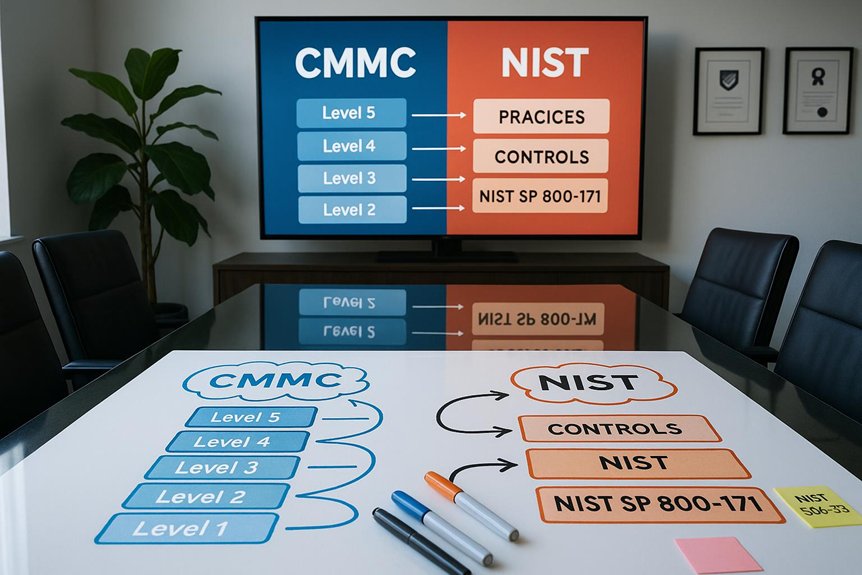
You’ll find CMMC uses three maturity levels (Foundational, Advanced, Expert) while NIST 800-171 operates as a single extensive framework. CMMC requires mandatory third-party assessments every three years for higher levels, whereas NIST allows flexible self-assessment. CMMC demands all Plan of Action items resolved before certification, while NIST permits ongoing documentation. CMMC also aligns security controls with information sensitivity, creating more targeted protection requirements that’ll become clearer as you explore each framework’s specific implementation details.
Key Takeaways
- CMMC uses three maturity levels (Foundational, Advanced, Expert) while NIST 800-171 operates as a single comprehensive framework.
- CMMC requires mandatory third-party assessments every three years for higher levels, unlike NIST’s flexible self-assessment approach.
- CMMC demands all Plan of Action items be resolved before assessment, while NIST allows ongoing remediation plans.
- CMMC certification requires extensive documentation and evidence collection, whereas NIST emphasizes control implementation with less rigorous documentation.
- CMMC Level 1 protects Federal Contract Information with 17 practices, while Level 2 handles Controlled Unclassified Information requiring all 110 NIST controls.
Understanding Cmmc’s Three-Tiered Structure Vs Nist’s Single Framework Approach
When you’re evaluating cybersecurity compliance frameworks, you’ll immediately notice a fundamental structural difference between CMMC and NIST standards. CMMC operates through three distinct maturity levels—Foundational, Advanced, and Expert—each escalating in cybersecurity requirements and complexity. This tiered approach allows you to align your security controls with the sensitivity of Controlled Unclassified Information (CUI) you handle.
In contrast, NIST 800-171 functions as a single, all-encompassing framework that applies uniformly across all organizations managing CUI. While NIST provides consistent guidelines for risk management, CMMC’s graduated structure offers more granular compliance pathways.
You’ll also find that CMMC requires mandatory third-party assessments at higher levels, whereas NIST 800-171 permits self-assessment, fundamentally changing how you approach cybersecurity validation and ongoing compliance monitoring.
Assessment Requirements: Self-Evaluation Vs Third-Party Certification Mandates
Beyond the structural differences in framework design, the assessment methodologies between CMMC and NIST 800-171 create distinctly different compliance experiences for your organization.
CMMC certification demands rigorous third-party assessments every three years for Levels 2 and 3, while Level 1 requires annual self-assessment. NIST 800-171 allows flexible self-assessment without external verification requirements.
Key assessment distinctions include:
- Plan of Action and Milestones handling: CMMC requires all PoA&M items resolved before assessment, while NIST 800-171 permits active plans during evaluation.
- Certification process: CMMC provides formal certification through C3PAOs, whereas NIST 800-171 offers no certification upon completion.
- Federal contracts compliance: CMMC mandates certification for DoD contractors, while NIST 800-171 requires compliance without formal certification.
These cybersecurity standards create fundamentally different compliance requirements for your organization’s certification process.
Compliance Documentation Standards and Plan of Action Limitations
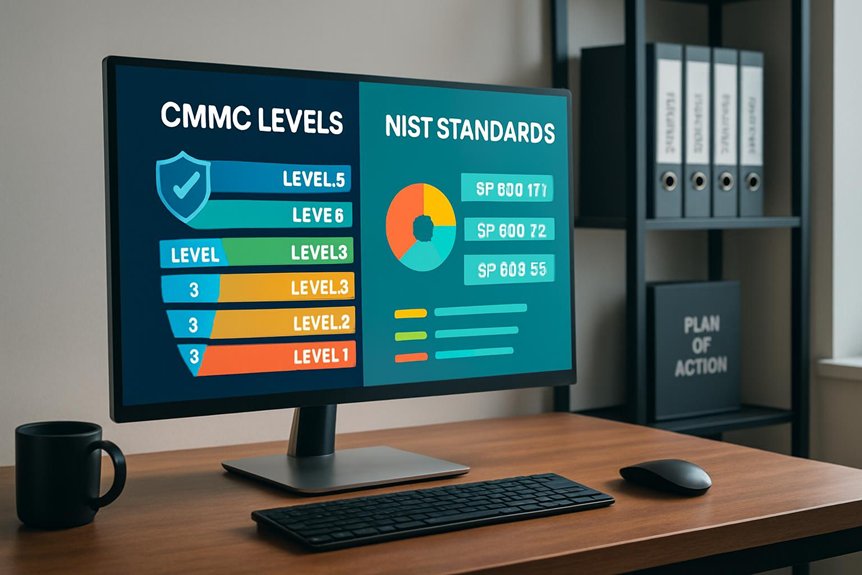
The documentation requirements and Plan of Action & Milestones (PoA&M) handling reveal stark differences between CMMC and NIST 800-171 frameworks that directly impact your compliance strategy.
CMMC demands you resolve all open PoA&M items before third-party assessment, while NIST 800-171 permits ongoing PoA&M documentation during self-assessment processes.
You’ll find CMMC restricts which practices can appear in your PoA&M, whereas NIST 800-171 allows broader inclusion of security controls without such limitations.
CMMC’s maturity levels require extensive detailed documentation and evidence collection for certification purposes.
In contrast, NIST 800-171 emphasizes implementing specific security controls with less rigorous documentation standards.
This means you’ll invest considerably more time preparing compliance documentation for CMMC’s certification process compared to NIST 800-171’s self-assessment approach.
Federal Contract Information Protection Vs Controlled Unclassified Information Handling
Understanding which type of sensitive information you’re handling determines your compliance pathway and security requirements.
Federal Contract Information (FCI) requires CMMC Level 1 certification with 17 basic cybersecurity practices, while Controlled Unclassified Information (CUI) demands CMMC Level 2 alignment with all 110 NIST 800-171 requirements.
Your information security approach differs notably:
- FCI Protection: Focuses on government-provided contract data with fundamental safeguards
- CUI Handling: Requires extensive controls for broader sensitive data categories
- Risk Assessment: CUI demands more rigorous evaluation than FCI protection measures
DoD contractors must identify which sensitive data they’re processing to meet proper compliance requirements.
Misclassifying information types can lead to inadequate security controls, resulting in contract penalties and eligibility loss for future opportunities.
Cloud Service Requirements and FedRAMP Moderate Baseline Considerations

How do cloud service requirements impact your CMMC compliance strategy? When you’re handling Controlled Unclassified Information through cloud services, you must guarantee your providers meet FedRAMP Moderate baseline standards, which include 325 security controls.
Your cybersecurity compliance approach requires implementing all 110 NIST 800-171 controls for internal cloud systems processing CUI.
You’ll need extensive documentation proving adherence to both CMMC and NIST 800-171 standards to maintain eligibility for DoD contracts.
Critical requirements include continuous monitoring and strict incident reporting within 72 hours of any cyber incidents affecting CUI.
Your cloud integration strategy must address these mandatory reporting timelines while maintaining robust security controls.
Proper documentation and compliance verification guarantee you’re protecting sensitive information while meeting federal contracting requirements effectively.
Implementation Timelines and Ongoing Monitoring Obligations
While CMMC and NIST Standards share similar security objectives, their implementation timelines and monitoring requirements differ considerably in scope and verification methods.
CMMC Levels dictate specific assessment frequencies – Level 1 requires annual self-assessment, while Levels 2 and 3 mandate third-party assessments every three years.
NIST Standards allow organizations to conduct self-assessments without third-party verification.
Key differences in ongoing monitoring include:
- Assessment verification: CMMC requires external validation for higher levels, while NIST permits self-conducted evaluations
- PoA&M requirements: You must resolve all open items before CMMC assessment, whereas NIST allows existing PoA&Ms during evaluation
- Documentation standards: CMMC Level 2 demands thorough documentation of all 110 practices with continuous compliance monitoring
Both frameworks emphasize maintaining your cybersecurity posture through regular vulnerability assessments and addressing emerging threats promptly.
Frequently Asked Questions
What Is the Difference Between NIST and CMMC Compliance?
You’ll find NIST frameworks allow self-assessment for federal contractors handling CUI, while CMMC requirements demand third-party cybersecurity audits for DoD work.
NIST focuses on data protection through 110 security controls, but CMMC creates tiered compliance challenges with maturity levels.
Your implementation strategies differ markedly – NIST emphasizes risk management practices, whereas CMMC’s assessment processes require formal certification.
You can’t bid on defense contracts without proper CMMC certification, unlike NIST’s self-reporting approach.
Which Level of CMMC Is Most Closely Aligned With NIST 800-171?
While other CMMC levels diverge considerably, CMMC Level 2 perfectly mirrors NIST 800-171‘s framework.
You’ll find identical security controls across both standards, making CMMC alignment seamless if you’re already NIST-compliant.
The key difference lies in assessment processes—you can self-assess NIST compliance, but CMMC Level 2 requires third-party certification every three years for federal contracts.
Your existing implementation strategies and risk management practices will directly transfer between frameworks.
What Are the Different Levels of CMMC?
You’ll encounter three CMMC levels with distinct compliance requirements and certification processes.
Level 1 involves 17 basic security practices through self-assessment, while Level 2 requires third-party evaluation of 110 controls.
Level 3 demands the most rigorous assessment methodology with additional advanced controls.
Each level’s distinctions affect your implementation strategies, cost implications, and training resources needs.
Understanding these industry impacts helps you determine which certification process aligns with your organization’s requirements.
What Is the Difference Between ISO 27001 and CMMC?
Think of ISO 27001 as a flexible toolkit while CMMC‘s a rigid rulebook.
You’ll find ISO benefits include global industry standards and risk management flexibility, letting you choose security controls based on your audit procedures.
CMMC requirements are non-negotiable for defense contractors, with specific compliance frameworks and certification processes.
You’ll face different implementation challenges: ISO’s self-assessment versus CMMC’s mandatory third-party evaluations for data protection compliance.
Conclusion
You’re maneuvering through two distinct cybersecurity landscapes that don’t always align like puzzle pieces. While NIST provides an extensive foundation, CMMC’s tiered approach demands specific compliance levels based on your contract requirements. You’ll need to balance self-assessments with mandatory third-party certifications, ensuring you’re protecting both FCI and CUI appropriately. Don’t let implementation timelines catch you off guard—start planning now to meet these evolving federal standards and maintain your competitive edge.