
You’ll need to establish a thorough risk assessment framework following ISO 31000 standards to systematically identify and prioritize threats. Implement continuous monitoring systems with automated tools and regular reporting to track risks in real-time. Foster cross-organizational communication through risk dashboards, training sessions, and stakeholder engagement to guarantee everyone understands potential vulnerabilities. These foundational practices create a robust defense system, though mastering the nuances of each approach will release even greater organizational resilience.
Key Takeaways
- Establish a systematic risk assessment framework following ISO 31000 standards to identify, analyze, and prioritize risks effectively.
- Implement continuous monitoring systems with automated tools and regular reporting to track emerging threats in real-time.
- Foster organization-wide risk awareness through training, communication channels, and transparent dashboards for all stakeholders.
- Engage diverse stakeholders throughout the risk management process to gather comprehensive perspectives and ensure shared responsibility.
- Maintain detailed documentation of risks, consequences, and mitigation strategies to support compliance and continuous improvement efforts.
Establish a Comprehensive Risk Assessment Framework
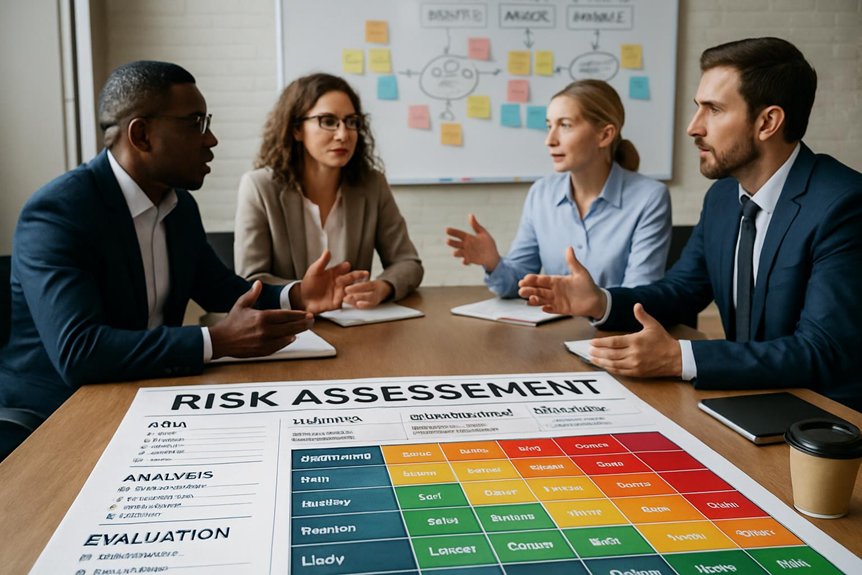
While risk management often feels overwhelming, establishing a thorough risk assessment framework provides the structured foundation you need to tackle uncertainty systematically.
Your risk management framework should follow established standards like ISO 31000 to identify risks, analyze their potential impacts, and develop prioritized risks based on organizational objectives.
Following ISO 31000 standards ensures your risk framework systematically identifies, analyzes, and prioritizes threats aligned with organizational goals.
You’ll want to incorporate stakeholder engagement throughout the process, as diverse perspectives enhance your ability to uncover hidden vulnerabilities.
Documentation becomes essential here—record identified threats, their potential consequences, and corresponding mitigation strategies to maintain compliance and support future evaluations.
Don’t forget that continuous monitoring forms the backbone of effective risk assessment.
Regular reassessment allows you to adapt quickly to emerging threats and changing operational conditions, keeping your framework current and actionable.
Implement Continuous Monitoring and Reporting Systems
Once you’ve established your risk assessment framework, implementing continuous monitoring and reporting systems becomes your next critical step for maintaining operational visibility.
You’ll need to integrate these systems directly into your risk management framework to enable real-time risk assessments and immediate identification of emerging risks.
Establish regular reporting mechanisms that keep stakeholders informed about current risk landscapes and mitigation effectiveness. This promotes transparency and accountability across your organization.
Deploy automated tools to enhance monitoring efficiency—they’ll provide alerts for emerging risks and facilitate timely risk register updates.
Create key performance indicators for your risk management activities to measure monitoring effectiveness and support data-driven decisions.
Schedule regular reviews to help you mitigate risks, adapt to evolving threats, and maintain compliance.
Foster Cross-Organizational Risk Awareness and Communication
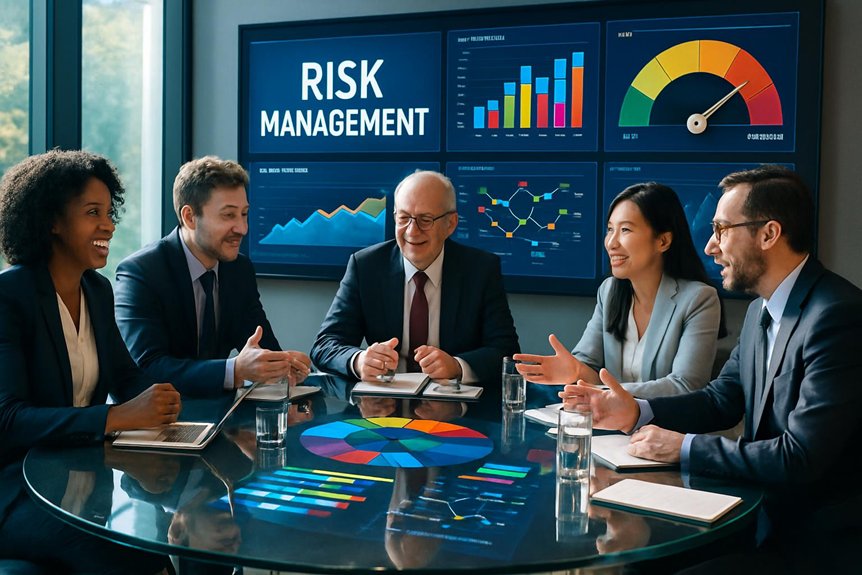
Your monitoring systems can only be as effective as the people who understand and act on the information they provide. Foster cross-organizational risk awareness by establishing regular communication channels that keep all stakeholders informed about high-impact risks.
Engage diverse departments in risk identification discussions to capture thorough insights and build shared responsibility across your organizational culture.
Implement risk dashboards and reports that provide transparent visibility into current threats, enabling departments to stay aligned and responsive.
Conduct training sessions focused on risk management strategies and best practices to enhance employees’ ability to recognize and communicate emerging risks effectively.
This proactive approach creates a unified understanding of potential threats, improves decision-making processes, and guarantees all team members contribute to your organization’s overall risk management success.
Frequently Asked Questions
How Do You Implement Risk Management Practices?
You’ll start by conducting thorough risk assessment techniques and applying systematic risk identification methods across your organization.
Next, you’ll develop risk prioritization strategies to focus on critical threats, then create extensive risk mitigation plans.
You’ll establish risk monitoring tools and clear risk communication processes while setting appropriate risk tolerance levels.
Finally, you’ll implement risk reporting standards, foster risk culture development through training, and conduct regular risk audit practices to guarantee continuous improvement.
What Are the 5 R’s of Risk Management?
The 5 R’s of risk management are Risk Avoidance, Risk Reduction, Risk Sharing, Risk Retention, and Risk Reassessment.
You’ll eliminate threats through avoidance, minimize impacts through reduction, transfer exposures through sharing, accept certain risks through retention, and continuously evaluate through reassessment.
Risk identification drives your initial assessment, while risk analysis supports prioritization decisions.
You’ll monitor outcomes, communicate findings across your organization, and align responses with your risk tolerance to build a strong risk culture throughout implementation.
What Are the 5 T’s of Risk Management?
You’ll find the 5 T’s of risk management are Transfer, Tolerate, Terminate, Treat, and Take.
Transfer involves shifting risks through insurance or risk transfer options.
Tolerate means accepting risks within your risk appetite definition.
Terminate eliminates risks entirely by stopping activities.
Treat reduces risks through risk mitigation plans and analysis methods.
Take means actively pursuing risks for potential gains.
These strategies work with risk prioritization frameworks and communication strategies to manage organizational exposures effectively.
What Are the Best Practices of Risk Management Framework?
You’ll excel at risk management by conducting thorough risk assessments and developing robust mitigation strategies.
Guarantee strong stakeholder involvement and establish continuous monitoring systems that align with compliance standards.
Create clear communication plans while fostering a positive risk culture through extensive training programs.
Integrate advanced technology for better tracking and establish meaningful performance metrics.
You’ll build resilience by engaging everyone, documenting processes clearly, and adapting strategies based on real-time monitoring and regular reviews.
Conclusion
You’re sitting on a goldmine of organizational protection when you master these three risk management pillars! Don’t let another day slip by without establishing your bulletproof assessment framework, launching your 24/7 monitoring systems, and transforming every employee into a risk-detecting superhero. Your company’s survival literally depends on turning risk management from a dusty afterthought into your organization’s most powerful shield against disaster. Start implementing these game-changing practices today!