
You’ll need to start with a thorough asset inventory and risk assessment using frameworks like NIST or ISO 27005 to identify vulnerabilities across your IT environment. Build a cross-functional team spanning IT, legal, and compliance departments to enhance threat detection and response coordination. Implement layered defense controls including firewalls, encryption, and intrusion detection systems while prioritizing employee training programs since human error causes 90% of security incidents. Continue exploring these proven methodologies to strengthen your organization’s cybersecurity resilience.
Key Takeaways
- Establish a comprehensive asset inventory and classify systems by criticality to prioritize security investments and resource allocation effectively.
- Assemble cross-functional teams with IT, legal, and compliance representatives to enhance threat identification and streamline cybersecurity decision-making processes.
- Implement layered defense controls including firewalls, encryption, and intrusion detection systems combined with regular penetration testing assessments.
- Develop robust incident response plans with defined roles, regular drills, and continuous monitoring to ensure swift threat mitigation.
- Foster organization-wide security culture through consistent employee training programs to reduce human error causing 90% of incidents.
Understanding CMMC Risk Management Requirements

How can your organization navigate the complex landscape of CMMC risk management requirements?
You’ll need to understand that CMMC establishes a tiered framework with five maturity levels, each demanding specific cybersecurity practices to protect sensitive information.
Your risk management approach must encompass thorough risk assessment procedures that identify threats and vulnerabilities across your infrastructure.
Comprehensive risk assessment procedures must systematically identify and evaluate threats and vulnerabilities throughout your entire organizational infrastructure.
You’re required to document all cybersecurity policies and procedures to demonstrate compliance during audits.
The framework’s 17 Capability Areas include critical components like incident response and access control that you must implement based on your maturity level.
Success demands you continuously monitor and adapt your cybersecurity measures to evolving threats, maintaining a proactive strategy that aligns with DoD standards and regulatory requirements.
Building a Cross-Functional Risk Management Team
While technical controls form the backbone of CMMC compliance, you’ll achieve the most robust cybersecurity posture by assembling a cross-functional risk management team that bridges organizational silos.
Your team should include representatives from IT, legal, HR, compliance, and business units to guarantee thorough risk assessments from diverse perspectives.
Effective collaboration enhances communication and enables crucial information sharing about emerging threats, promoting unified organizational responses.
You’ll want to implement regular training programs that foster cybersecurity awareness across all departments, keeping team members informed about latest threats and best practices.
- Define clear roles and responsibilities to streamline decision-making and enhance risk mitigation strategies
- Utilize analytics tools for root cause analysis and predictive threat assessments
- Establish regular cross-departmental meetings to maintain ongoing threat intelligence sharing
Conducting Comprehensive Asset Inventory and Classification

Once your cross-functional team is established, you’ll need to create a thorough inventory of all organizational assets to form the foundation of your risk management strategy.
Conducting extensive asset inventory involves cataloging all hardware, software, and data throughout your IT environment. You’ll then classify these assets based on their sensitivity and criticality, enabling you to develop appropriate security measures tailored to each asset’s risk profile.
Effective asset inventory requires comprehensive cataloging and classification to enable risk-appropriate security measures across your entire IT environment.
Automated asset discovery tools will enhance accuracy and efficiency, guaranteeing real-time visibility of all devices and applications. This process helps identify security vulnerabilities while supporting regulatory requirements compliance.
You must regularly update your asset inventory as new assets arrive or existing ones are decommissioned. Proper classification ensures sensitive data receives adequate protection, greatly improving your organization’s ability to meet compliance standards like GDPR or HIPAA.
Implementing Risk Assessment Methodologies
Three fundamental methodologies dominate modern cybersecurity risk assessment: the NIST Cybersecurity Framework, NIST Risk Management Framework, and ISO 27005.
These risk assessment methodologies systematically guide you through identifying cybersecurity risks, evaluating potential impact, and prioritizing threats based on your organization’s risk tolerance.
Your cybersecurity risk management process must begin with thorough asset inventory, then progress through threat identification and vulnerability analysis.
You’ll categorize risks into critical, high, medium, and low levels, enabling strategic resource allocation.
Key implementation considerations include:
- Stakeholder collaboration across IT, legal, and compliance teams for holistic risk identification
- Continuous assessment cycles addressing 2,000 monthly NIST database vulnerabilities
- Dynamic risk management strategy adaptation as your threat landscape evolves
Effective managing cybersecurity requires regular methodology updates reflecting emerging threats and organizational changes.
Developing Risk Mitigation Controls and Safeguards

After completing your risk assessment, you’ll transform identified vulnerabilities into actionable defense strategies through systematic control development.
Your cybersecurity risk management approach should prioritize technological safeguards like firewalls, intrusion detection systems, and encryption to create multiple defense layers against potential threats and data breaches.
You’ll need thorough employee training programs since human error causes 90% of security incidents. Regular awareness sessions build a cybersecurity-conscious culture that strengthens your overall defense posture.
Implement routine penetration testing and vulnerability assessments to identify security gaps and validate your risk mitigation controls’ effectiveness.
These evaluations guarantee your defenses evolve with emerging threats.
Finally, establish a robust incident response plan with clearly defined roles and responsibilities. This framework enables swift response to cyber incidents, minimizing damage and maintaining business continuity when threats materialize.
Establishing Continuous Monitoring Processes
Building on your established risk mitigation controls, you must implement continuous monitoring processes to maintain their effectiveness against rapidly evolving cyber threats.
With approximately 2,000 new vulnerabilities added monthly to the NIST database, your security posture requires real-time assessment through automated monitoring tools that detect deviations from established baselines.
Your cybersecurity strategy should include regularly scheduled audits ensuring compliance with regulations like GDPR and HIPAA.
Establish a centralized repository for risk assessments to enhance cross-departmental collaboration and analysis.
- Real-time vulnerability tracking against the continuously updated NIST database for immediate threat identification
- Third-party vendor evaluation to assess their security practices and prevent supply chain vulnerabilities
- Automated baseline monitoring to promptly identify and respond to security control deviations
This thorough approach strengthens your organization’s defensive capabilities against emerging risks.
Creating Incident Response and Recovery Plans

While monitoring systems detect threats, your organization’s survival during a cyber incident depends on having a well-structured incident response plan that mobilizes your team into immediate, coordinated action.
Your plan must clearly define roles and responsibilities, ensuring team members know exactly what to do when cyber incidents occur. Establish predefined procedures for identifying, containing, eradicating, and recovering from attacks to minimize damage quickly.
Clear roles and defined procedures enable swift action when cyber incidents strike, minimizing damage through coordinated team response.
Conduct regular testing to identify procedural gaps and adapt to evolving threats and attack vectors. Incorporate lessons learned from previous incidents to strengthen your security posture continuously.
Your recovery plan shouldn’t focus solely on technical restoration—develop thorough communication strategies to keep stakeholders informed and maintain transparency throughout the recovery process.
Training Employees on Security Awareness and Protocols
Everyone in your organization represents either your strongest defense or your weakest link against cyber threats. Since human error accounts for approximately 90% of data breaches, training employees on security awareness becomes absolutely critical.
You can reduce phishing attacks by up to 75% through regular education programs that address social engineering tactics and emerging cyber threats.
Continuous training guarantees your team stays current with evolving attack vectors while building a robust cybersecurity culture. When you encourage collective responsibility for protecting sensitive information, employees become active participants rather than passive targets.
- Implement simulated phishing exercises to identify vulnerable staff and reinforce vigilance
- Provide ongoing education about malware, social engineering, and new threat landscapes
- Foster an environment where reporting suspicious activities is encouraged and rewarded
Documenting Risk Management Procedures for CMMC Compliance
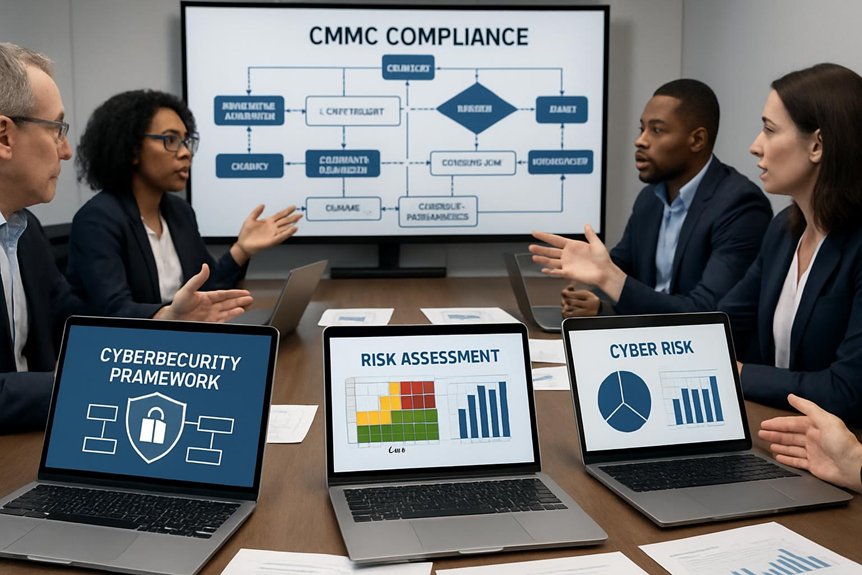
Although training strengthens your human firewall, you’ll need robust documentation to prove your cybersecurity efforts meet CMMC standards. Your risk management procedures must include a thorough system security plan (SSP) detailing implemented security controls and risk assessment processes.
Document identified threats, vulnerabilities, and prioritized mitigation strategies to demonstrate ongoing CMMC compliance.
You’ll require a defined incident response plan outlining procedures for identifying, responding to, and recovering from cybersecurity risks.
Maintain detailed training records and awareness program evidence to showcase your proactive security posture.
Regular documentation updates should reflect continuous monitoring efforts and vulnerability management activities.
This thorough documentation framework guarantees you can effectively demonstrate your organization’s ability to manage cybersecurity risks while maintaining CMMC compliance requirements.
Measuring and Improving Risk Management Effectiveness
How can you determine if your cybersecurity risk management efforts are actually working? Measuring effectiveness requires a multi-faceted approach that combines quantifiable assessments with proactive security practices.
You’ll need security ratings to evaluate your security posture and identify critical vulnerabilities requiring immediate attention. Regular penetration testing provides actionable insights into your cybersecurity framework’s weaknesses, while continuous monitoring guarantees you’re adapting to evolving threats—especially important given that 2,000 new vulnerabilities enter the NIST database monthly.
Essential measurement strategies include:
- Implementing thorough incident response plans with regular drills and updates
- Conducting employee training programs covering password security and phishing recognition
- Establishing ongoing vulnerability assessments and remediation tracking
Building a security-aware culture through consistent employee training strengthens your overall risk management strategy and creates measurable improvements in organizational cybersecurity resilience.
Frequently Asked Questions
What Are the 5 Risk Management Strategies?
You’ll implement five key risk management strategies to protect your organization.
First, you’ll avoid risks by eliminating vulnerable processes through threat modeling frameworks.
Second, you’ll mitigate risks using vulnerability management tools and security awareness training.
Third, you’ll transfer risks via third party risk evaluation and insurance.
Fourth, you’ll accept certain risks after risk assessment techniques show low impact.
Finally, you’ll exploit positive opportunities through data protection strategies and network segmentation practices for competitive advantage.
What Is Risk Management Strategy in Cybersecurity?
You’ll develop a cybersecurity risk management strategy by conducting thorough risk assessment and threat identification to understand your organization’s vulnerabilities.
You’ll perform vulnerability analysis, establish extensive security policies, and create incident response procedures.
Through risk prioritization, you’ll focus resources effectively while ensuring compliance standards are met.
Regular security audits help you monitor progress, while clear risk communication keeps stakeholders informed.
Your mitigation planning addresses identified threats systematically.
What Are the 5 C’s of Cyber Security?
You’d think cybersecurity was rocket science with all the fancy acronyms floating around!
The 5 C’s are actually straightforward: Confidentiality protects your data from unauthorized snoops, Integrity prevents tampering, Availability keeps systems running when you need them, Control manages access permissions, and Compliance guarantees you’re following regulations.
These principles guide your threat modeling, vulnerability assessments, security audits, incident response plans, employee training programs, and risk assessments against cyber threats and potential data breaches.
What Are the Four 4 Cybersecurity Risk Treatment Mitigation Methods?
You’ll use four key cybersecurity risk treatment methods to protect your organization.
Risk avoidance eliminates dangerous activities entirely.
Risk reduction implements security controls like data encryption, access management, and continuous monitoring to minimize threats.
Risk sharing transfers risk through insurance or outsourcing to specialized firms.
Risk acceptance acknowledges certain risks when mitigation costs exceed potential losses.
These methods work alongside threat modeling, vulnerability management, incident response, compliance requirements, and awareness training for thorough protection.
Conclusion
You’ve built your cybersecurity fortress brick by brick, transforming vulnerabilities into strongholds. Your cross-functional team stands as vigilant sentinels, while thorough documentation serves as your battle-tested blueprint. Each risk assessment becomes a lighthouse guiding you through digital storms, and employee training forges an unbreakable human firewall. Remember, cybersecurity isn’t a destination—it’s an evolving shield that grows stronger with every threat you face. Your organization’s digital kingdom now stands fortified against tomorrow’s challenges.