You’ll need to systematically analyze your CMMC audit findings to identify specific policy gaps, then prioritize updates based on risk assessments and compliance impact on CUI security. Focus on addressing critical control weaknesses through targeted policy development that includes clear roles, responsibilities, and detailed corrective procedures with timelines. Implement continuous monitoring processes, update documentation standards, and establish regular training programs to guarantee personnel understand the new policies. The following thorough approach will transform your audit findings into organizational strengths.
Key Takeaways
- Systematically analyze audit findings by severity and impact to identify critical policy gaps affecting CUI security.
- Prioritize policy updates using risk assessments, focusing on compliance-critical security measures and audit findings first.
- Develop targeted policies with clear roles, responsibilities, corrective action procedures, and specific timelines for implementation.
- Implement continuous monitoring processes and regular training programs to ensure ongoing adherence to updated security policies.
- Conduct regular internal assessments through documentation reviews, personnel interviews, and hands-on testing to validate policy effectiveness.
Understanding Common CMMC Audit Findings and Their Impact

When organizations undergo CMMC audits, they frequently encounter findings that can jeopardize their defense contracts and compliance status.
Common CMMC audit findings reveal inadequate documentation of security policies and procedures, leading to non-compliance issues that can cost you valuable DoD contracts. You’ll often face scrutiny for lacking continuous monitoring processes and failing to maintain historical evidence of security control adherence.
Inadequate documentation and missing continuous monitoring evidence are primary reasons organizations fail CMMC audits and lose DoD contract eligibility.
Auditors frequently identify gaps in incident response protocols and risk assessments, which can result in significant financial penalties.
Additionally, insufficient training programs expose weaknesses in your personnel’s understanding of cybersecurity practices.
These findings highlight critical areas where your organization must improve to meet CMMC requirements and maintain eligibility for defense sector opportunities.
Analyzing Your Audit Results to Identify Policy Gaps
Once you’ve received your CMMC audit results, you’ll need to systematically analyze each finding to pinpoint specific policy gaps that contributed to non-compliance.
Start by categorizing audit findings based on severity and impact, prioritizing high-risk gaps that could considerably weaken your cybersecurity posture. You’ll want to align each finding with relevant CMMC requirements, guaranteeing your updated policies directly address specific practices and controls outlined in the framework.
Take a thorough approach by engaging stakeholders across departments during analysis. This provides diverse insights and guarantees a complete understanding of existing policies.
Compliance experts recommend establishing continuous monitoring processes for your updated policies post-audit. This maintains ongoing compliance and adapts to evolving cybersecurity threats, preventing future CMMC audit deficiencies.
Prioritizing Policy Updates Based on Risk and Compliance Requirements

After identifying policy gaps through your audit analysis, you’ll need to establish a systematic approach for prioritizing updates based on risk severity and compliance urgency.
Start by conducting a thorough risk assessment to identify high-risk areas requiring immediate attention. Focus first on policy updates directly linked to audit findings that impact Controlled Unclassified Information (CUI) security, as these pose the greatest threat to your DoD contract eligibility.
CUI security gaps identified through audit findings present the most critical threat to maintaining DoD contract eligibility and require immediate prioritization.
Prioritize compliance-critical security measures that align with CMMC 2.0 requirements, ensuring your cybersecurity posture meets mandatory standards.
Implement a phased approach, addressing essential controls before secondary improvements. This systematic prioritization helps allocate resources effectively while maintaining CMMC compliance.
Developing Targeted Policies for Critical Control Weaknesses
Building on your prioritized list of policy updates, you’ll now create specific policies that directly address each critical control weakness identified in your CMMC audit.
Start by conducting a thorough gap analysis against your CMMC audit findings to pinpoint exactly where targeted policies are needed. Each policy must clearly define roles and responsibilities for addressing these control weaknesses, ensuring accountability throughout your organization.
Include detailed procedures for implementing corrective actions with specific timelines and designated personnel. Align these targeted policies with existing CMMC standards and industry requirements to guarantee extensive coverage of all critical areas.
Establish a regular review schedule to keep your policies current with evolving threats and maintain ongoing compliance with CMMC standards.
Aligning Policy Changes With CMMC Level Requirements
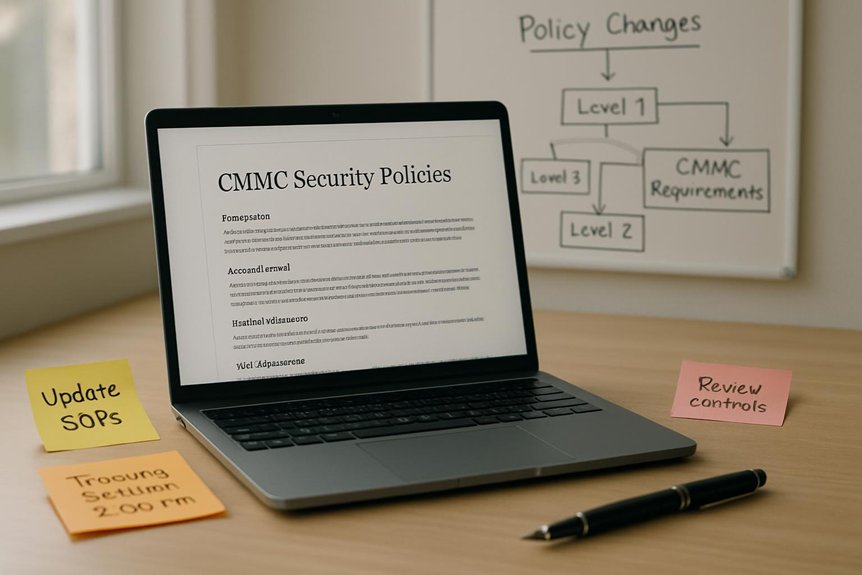
When implementing your targeted policy updates, you must guarantee each change directly corresponds to your organization’s specific CMMC level requirements.
For Cybersecurity Maturity Model Certification at CMMC Level 2, you’ll need thorough security policies covering all 14 control families, with at least one policy per domain to achieve CMMC compliance.
Your policy updates should directly address security controls mandated for your certification level, incorporating specific audit findings into revised documentation.
This systematic approach guarantees your cybersecurity posture aligns with required standards while addressing identified deficiencies.
Focus on integrating audit findings into existing policies rather than creating entirely new documents.
Each updated policy must demonstrate how you’ve addressed control weaknesses while maintaining compliance across all relevant control families, creating a cohesive framework that supports your organization’s CMMC certification goals.
Implementing Evidence Collection and Documentation Standards
Successfully updated policies require robust evidence collection systems to demonstrate ongoing compliance with your CMMC requirements.
You’ll need to establish clear documentation standards that capture user access, actions, and timestamps for all activities involving Controlled Unclassified Information (CUI). Each CMMC security control demands specific evidence types, particularly audit logs detailing user identities, access times, and action types.
Create a centralized repository for compiling evidence that supports your compliance claims during audits. This guarantees easy retrieval and alignment with CMMC retention policies.
Schedule regular reviews of your documentation practices to identify gaps and improve processes for ongoing compliance readiness.
Implement automated tools to enhance accuracy and efficiency in evidence collection. These tools reduce human error while maintaining robust documentation standards that meet CMMC requirements consistently.
Establishing Continuous Monitoring and Policy Review Processes
Since CMMC compliance isn’t a one-time achievement, you’ll need continuous monitoring processes that track security controls in real-time and detect potential violations before they escalate into breaches.
These systems must integrate with your incident response plans to enable immediate action when anomalies surface.
Establish structured policy review schedules—ideally annually—to update security policies based on evolving CMMC audits and NIST SP 800-171 requirements.
Your cybersecurity posture depends on incorporating audit findings into policy revisions, addressing identified gaps that could compromise compliance.
Create feedback loops between monitoring tools and policy updates, ensuring your security framework adapts to new threats and compliance requirements.
This systematic approach transforms audit findings into actionable improvements, maintaining robust defenses against unauthorized access while meeting CMMC’s accountability standards.
Training Personnel on Updated Security Policies and Procedures
The most sophisticated monitoring systems and policy frameworks won’t protect your organization if your personnel don’t understand and follow them consistently.
Training personnel on updated security policies is essential for maintaining CMMC compliance and strengthening your cybersecurity posture following audit findings.
Your training program should address:
- Proper handling procedures for Controlled Unclassified Information and Federal Contract Information
- Recognition of suspicious activities and unauthorized access attempts
- Accurate logging and monitoring practices for audit accountability
- Clear incident reporting procedures and escalation protocols
- Updated security policies and their practical implementation
Establish regular training sessions that incorporate feedback from audits and incident reviews.
This continuous improvement approach guarantees your team stays current with evolving cybersecurity threats while maintaining compliance with CMMC standards and organizational security requirements.
Validating Policy Effectiveness Through Internal Assessments
While training guarantees your personnel understand security policies, validating their effectiveness requires systematic internal assessments that measure real-world implementation and compliance.
These assessments provide structured approaches to evaluate how well your updated CMMC security policies align with Maturity Model Certification requirements and identify gaps in security controls protecting Controlled Unclassified Information.
Structured assessments evaluate CMMC policy alignment with certification requirements and identify security control gaps protecting Controlled Unclassified Information.
You’ll need to conduct regular internal assessments that include documentation reviews, personnel interviews, and hands-on testing of security controls.
This thorough approach validates that policies aren’t just documented but actively enforced. Using metrics and performance indicators helps you quantify policy effectiveness and make data-driven improvements.
Continuous monitoring through internal assessments creates accountability and audit preparation readiness, enabling you to address deficiencies before formal CMMC evaluations while ensuring ongoing compliance across all departments.
Frequently Asked Questions
How Long Does the Typical CMMC Policy Update Process Take?
The typical CMMC policy update process takes 3-6 months depending on your organization’s complexity.
You’ll need stakeholder involvement from IT, legal, and management teams.
Your compliance timeline includes policy review, risk assessment, and document management phases.
Resource allocation affects update frequency – larger teams complete updates faster.
Don’t forget training requirements for staff on new policies.
The approval process adds 2-4 weeks, so plan accordingly for implementation deadlines.
What Are the Estimated Costs for Implementing Comprehensive Policy Updates?
Coincidentally, you’re asking about costs just as many organizations face budget constraints.
You’ll need thorough cost analysis covering budget allocation for resource requirements, typically ranging $50,000-$500,000 depending on your organization’s size.
Factor in risk assessment expenses, compliance benchmarks development, training expenses for staff, technology investments for new systems, stakeholder engagement sessions, and policy enforcement mechanisms.
Consider phased implementation to spread costs over time and maximize your return on investment.
Can We Use Third-Party Consultants for Policy Development and Implementation?
You can definitely use third-party consultants for policy development.
Focus on consultant selection based on CMMC expertise and proven track records. They’ll handle policy customization, implementation strategy, and risk assessment while establishing realistic compliance timelines.
Make certain they provide thorough training requirements, clear communication plans, and ongoing support throughout the process.
Don’t forget to include performance evaluation metrics to measure their effectiveness and your organization’s progress toward full compliance.
How Do Policy Updates Affect Existing Vendor and Supplier Relationships?
Policy updates act like ripples in a pond, affecting all your business relationships.
You’ll need to reassess vendor compliance requirements and enhance supplier communication through targeted training programs.
Relationship management becomes essential as you navigate contract negotiations with updated security standards.
Trust building requires transparent risk assessment processes and consistent performance monitoring.
Success depends on achieving partnership alignment where your suppliers understand and embrace the new policy framework you’ve implemented.
What Happens if We Fail a Follow-Up Audit After Updating Policies?
If you fail a follow-up audit, you’ll face serious audit consequences including contract suspensions and reputation impact.
You must implement immediate corrective measures and develop thorough remediation strategies.
Stakeholder communication becomes critical as compliance failures affect business relationships.
Your risk management team should coordinate follow up actions while preparing for future audits.
Don’t underestimate how repeated failures compound problems—you’ll need robust processes to prevent ongoing issues.
Conclusion
You’ve built a fortress of compliance, brick by brick, transforming audit findings into strengthened defenses. Your policies now pulse with life, continuously monitored and refined like a well-tuned engine. Personnel march forward with clarity, armed with knowledge of their security mission. Each control flows seamlessly into the next, creating an unbreakable chain of protection. Your organization stands ready—no longer reactive to findings, but proactive in maintaining CMMC excellence through disciplined policy governance.