
After failing your CMMC assessment, you’ll need to complete extensive remediation and wait at least six months before re-assessment. Document all remediation actions thoroughly in your System Security Plan, addressing each “Not Met” control with specific steps, responsible personnel, and completion dates. Verify that corrected security controls function properly and align with NIST 800-171 requirements through mock assessments. Consider engaging third-party consultants for objective gap analysis and coordinate early with your C3PAO to discuss timelines and demonstrate sustained compliance readiness through continuous monitoring processes.
Key Takeaways
- Complete all remediation efforts and document changes at least six months before scheduling your re-assessment.
- Update your System Security Plan thoroughly with clear descriptions of remediation steps and compliance evidence.
- Conduct internal mock assessments to verify all security controls function properly and meet NIST 800-171 requirements.
- Engage third-party consultants for objective gap analysis and pre-assessment validation before official re-evaluation.
- Coordinate early with your C3PAO to discuss timelines and ensure all documentation is finalized before scheduling.
Understanding the Timeline Between Remediation and Re-Assessment
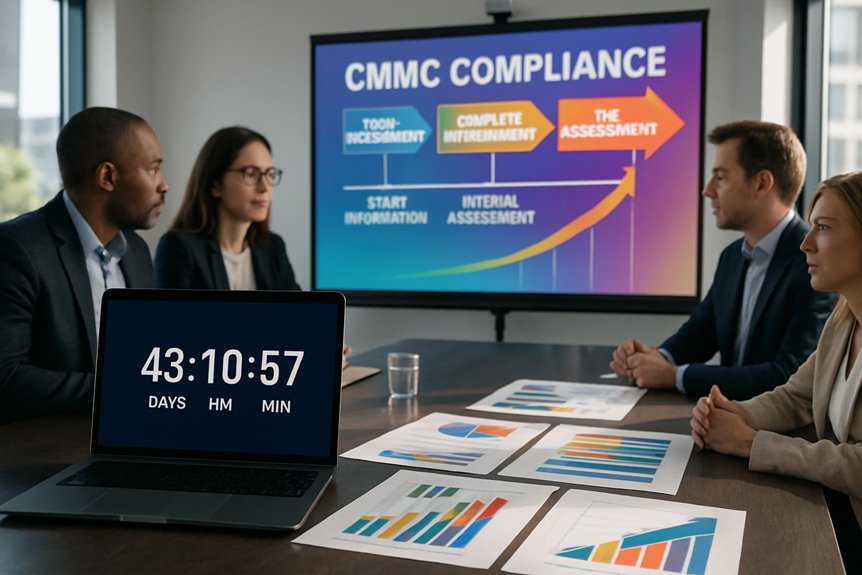
When your organization fails a CMMC assessment, you’ll need to understand that remediation isn’t a sprint—it’s a carefully planned process with specific timing requirements.
CMMC remediation requires strategic planning and patience—rushing through compliance fixes will only lead to repeated assessment failures.
You must complete all remediation efforts and document changes at least six months before scheduling your re-assessment to demonstrate compliance improvements.
Your timeline will vary greatly based on organization size. Smaller organizations might need just a few weeks, while larger ones may require 12-18 months to address all deficiencies.
You’ll need to develop a thorough remediation plan outlining specific actions, responsibilities, and completion dates.
All remediation must be documented in your System Security Plan (SSP) before re-assessment.
Conduct continuous internal reviews and mock assessments during this period to validate that all controls are effectively implemented.
Documenting Remediation Efforts in Your System Security Plan
After completing your remediation efforts, you’ll need to meticulously document every action taken in your System Security Plan (SSP) to demonstrate compliance with CMMC requirements.
Focus on addressing Not Met controls by providing clear descriptions of remediation steps, responsible personnel, and completion dates. This creates accountability and traceability throughout the process.
Update the SSP to reflect changes in cybersecurity practices, including new controls or modifications to existing ones. Include evidence of compliance such as screenshots, logs, and reports to substantiate your successful remediation claims.
This documentation facilitates the C3PAO’s re-assessment process.
Maintain documenting remediation efforts as an ongoing effort. Regularly review and update your SSP to guarantee it accurately reflects your current security posture and supports future compliance requirements.
Verifying Implementation of Corrected Security Controls
Once you’ve documented your remediation efforts, you must confirm that all corrected security controls function as intended and align with the 110 NIST 800-171 requirements for CMMC Level 2 compliance.
Start by conducting a thorough review of each implemented control to confirm proper functionality and risk mitigation for Controlled Unclassified Information.
Establish continuous monitoring processes to track control effectiveness over time. This ongoing verification prevents future compliance gaps and strengthens your security posture before re-assessment.
Consider conducting a mock assessment to identify any remaining implementation issues. This practice run allows you to address problems before the official evaluation.
Engaging a C3PAO for pre-assessment review enhances confidence in your remediation efforts. Their expertise helps validate that your security controls meet CMMC standards and your documentation adequately supports compliance claims.
Engaging Third-Party Consultants for Pre-Assessment Validation
While internal verification provides valuable insights into your remediation progress, bringing in third-party consultants adds an objective lens that can uncover blind spots your team might miss.
These experienced professionals conduct thorough gap analyses, evaluating your implementation of the 110 NIST 800-171 controls required for CMMC requirements compliance.
Expert consultants perform comprehensive gap analyses to evaluate your organization’s implementation of all 110 NIST 800-171 controls for CMMC compliance.
Third-party consultants streamline your documentation process by ensuring all necessary evidence and policies meet assessment standards. They’ll provide targeted training to prepare your internal teams for confident responses during the formal evaluation.
Most importantly, pre-assessment validation helps you prioritize remediation efforts effectively, developing robust plans of action for any identified deficiencies.
This expert guidance greatly reduces re-assessment failure risk, positioning your organization for successful CMMC certification by addressing vulnerabilities before the official audit begins.
Building a Culture of Continuous Compliance Improvement

Beyond conducting one-time assessments, successful CMMC compliance requires embedding cybersecurity practices into your organization’s DNA through continuous improvement initiatives.
Building a culture of continuous compliance starts with regular training sessions that enhance cybersecurity awareness across all departments. You’ll need to establish a feedback loop where employees can report compliance challenges and suggest improvements, promoting active participation in the compliance process.
Conducting periodic internal audits reinforces compliance importance while identifying potential gaps. These assessments shouldn’t feel punitive but rather supportive of your continuous improvement goals.
Recognize and reward teams demonstrating excellence in compliance efforts to motivate ongoing engagement. When you integrate these practices into daily operations, you’ll create sustainable compliance that extends beyond initial certification requirements.
Scheduling and Coordinating With Your C3PAO
After completing your remediation efforts, you’ll need to coordinate with your Certified Third-Party Assessment Organization (C3PAO) to schedule your re-assessment.
Begin this coordination early while your remediation is still underway to discuss timelines and C3PAO availability. You must demonstrate that all remediation actions are completed and documented in your System Security Plan before scheduling can proceed.
Prepare thorough documentation showing your implemented remediation strategies and evidence for each previously failed control.
Since C3PAOs often have limited availability, allow ample time for scheduling and anticipate potential delays due to high assessment demand.
Before finalizing your re-assessment date, conduct an internal review or mock assessment to identify any remaining gaps.
This guarantees you’re fully prepared for the C3PAO evaluation and demonstrates your commitment to achieving compliance.
Demonstrating Sustained Compliance Readiness

Since successful remediation marks only the beginning of your compliance journey, you must establish robust processes to demonstrate sustained readiness throughout your CMMC re-assessment.
Your documentation should include updated System Security Plans reflecting changes made at least six months prior to assessment, alongside current Plan of Action and Milestones tracking each control’s status.
Implement continuous monitoring and regular internal audits to guarantee security controls align with CMMC requirements and effectively protect CUI.
Continuous monitoring and internal audits ensure your security controls consistently meet CMMC standards and safeguard sensitive information.
Document all remediation efforts thoroughly, as assessors will scrutinize your compliance readiness meticulously.
Invest in ongoing staff training to reinforce cybersecurity practices and guarantee personnel understand their compliance roles.
Consider collaborating with cybersecurity consultants to proactively address deficiencies.
This systematic approach to demonstrating compliance creates a foundation for successful re-assessment outcomes.
Frequently Asked Questions
What Are the Typical Costs Associated With CMMC Re-Assessment Procedures?
You’ll face several CMMC re-assessment costs during your certification journey.
Assessment preparation expenses include auditor fees ranging from $50,000-$200,000 depending on your organization’s size.
Factor in remediation investment for technology upgrades, documentation expenses for policy updates, and employee training costs.
Don’t forget CMMC certification fees and compliance consulting charges.
Training costs vary based on staff size, while documentation expenses depend on your current compliance gaps requiring immediate attention.
How Do We Handle Employee Turnover During the Remediation Period?
Employee turnover can feel like a hurricane disrupting your security landscape.
You’ll need robust employee training and streamlined onboarding processes to maintain continuity. Implement extensive knowledge transfer sessions, update documentation regularly, and establish mentorship programs for new hires.
Focus on role reassignment strategies, conduct thorough risk assessments, and develop clear communication strategies.
Strong team collaboration and defined performance metrics guarantee you’re maintaining security standards despite personnel changes throughout your remediation efforts.
Can We Switch C3PAO Organizations Between Initial Assessment and Re-Assessment?
You can switch C3PAO organizations between assessments, though assessment continuity with the same vendor often provides consistency benefits.
Consider vendor reliability, contractual obligations, and assessment timeline when making C3PAO selection decisions. Regulatory changes might necessitate switching, but evaluate organizational impacts and risk management implications.
Different assessors may interpret requirements differently, affecting compliance consistency.
Develop communication strategies to guarantee your new C3PAO understands previous findings and remediation efforts for smoother changes.
What Happens if We Fail the Re-Assessment Again?
If you fail your re-assessment again, you’ll face serious certification impact and compliance timeline extensions.
You’ll need revised remediation strategies and thorough mitigation plans.
Re-assessment consequences include delayed contract eligibility and increased stakeholder communication requirements.
Focus on enhanced employee training, stricter documentation requirements, and improved audit readiness.
Strengthen your risk management approach before attempting another assessment.
Each failure compounds timeline delays and raises scrutiny from evaluators and clients.
Are There Penalties for Delaying Re-Assessment Beyond Recommended Timeframes?
While CMMC doesn’t impose direct financial penalties for delaying re-assessment beyond recommended timeframes, you’ll face significant compliance consequences.
Certification delays can jeopardize your contract eligibility and DoD opportunities. Your re-assessment timeline affects organizational readiness and risk management strategies.
Extended delays may trigger increased audit frequency and create legal repercussions regarding contract compliance. You should prioritize timely remediation strategy implementation to avoid these contract implications and maintain competitive positioning.
Conclusion
You’ve heard that CMMC re-assessment is just another checkbox exercise—but that’s dangerously wrong. The truth? It’s actually your chance to prove you’ve transformed from reactive compliance to proactive security leadership. Don’t just fix what broke; demonstrate you’ve built an unshakeable foundation. Your re-assessment isn’t about passing again—it’s about showing you’ve evolved into an organization that can’t fail. That’s what separates temporary fixes from lasting competitive advantage.