
After your CMMC audit, you’ll need to transform findings into actionable remediation plans through systematic gap analysis against NIST SP 800-171 standards. Prioritize critical vulnerabilities protecting CUI and FCI using risk-based approaches, while considering managed security service providers for cost-effective expertise. Develop thorough staff training programs addressing specific CMMC requirements and strengthen vendor management with embedded cybersecurity contractual obligations. The strategies ahead will guide your complete compliance transformation journey.
Key Takeaways
- Transform audit findings into actionable remediation plans using systematic gap analysis against NIST SP 800-171 standards.
- Prioritize remediation efforts through risk-based assessment, focusing on critical vulnerabilities protecting CUI and FCI.
- Partner with Managed Security Service Providers for scalable expertise and continuous monitoring within budget constraints.
- Develop comprehensive staff training programs addressing CMMC requirements with regular awareness sessions and documented compliance.
- Strengthen vendor management by embedding CMMC requirements in contracts and conducting regular compliance assessments.
Understanding Post-Audit Findings and Gap Analysis
When your CMMC audit concludes, you’ll face a critical juncture: transforming audit findings into actionable remediation plans. Each compliance gap requires detailed analysis to understand specific deficiencies against CMMC requirements and cybersecurity controls.
Your gap analysis should systematically compare existing security practices with NIST SP 800-171 standards, revealing weaknesses that demand immediate attention.
Effective gap analysis systematically identifies security deficiencies by comparing current practices against NIST SP 800-171 requirements.
Adopt a risk-based approach when prioritizing remediation efforts, focusing first on vulnerabilities with the highest potential impact on your organization’s security posture.
Documentation becomes essential throughout this process. Record every remediation step you take to guarantee compliance continuity and streamline future audits.
Don’t treat this as a one-time effort—establish continuous monitoring protocols and schedule periodic reassessments to maintain compliance while adapting to evolving threats and CMMC updates.
Prioritizing Remediation Efforts Based on Risk Assessment
After completing your gap analysis, you’ll need to transform those findings into a strategic remediation roadmap that tackles the most critical vulnerabilities first.
Your risk assessment should prioritize security controls that directly protect Controlled Unclassified Information and Federal Contract Information, as these represent the highest compliance requirements under CMMC standards.
Focus your remediation efforts on vulnerabilities with the greatest potential impact on your organization’s cybersecurity practices. This risk-based approach guarantees you’re allocating limited resources effectively while maintaining CMMC compliance.
Consider partnering with Managed Security Service Providers who can provide expert insights tailored to your specific risks.
Remember to regularly update your risk assessment process. This ongoing alignment with evolving compliance requirements helps you adapt your remediation strategies to address emerging threats and maintain continuous CMMC compliance.
Leveraging Managed Security Services Providers for Cost-Effective Implementation
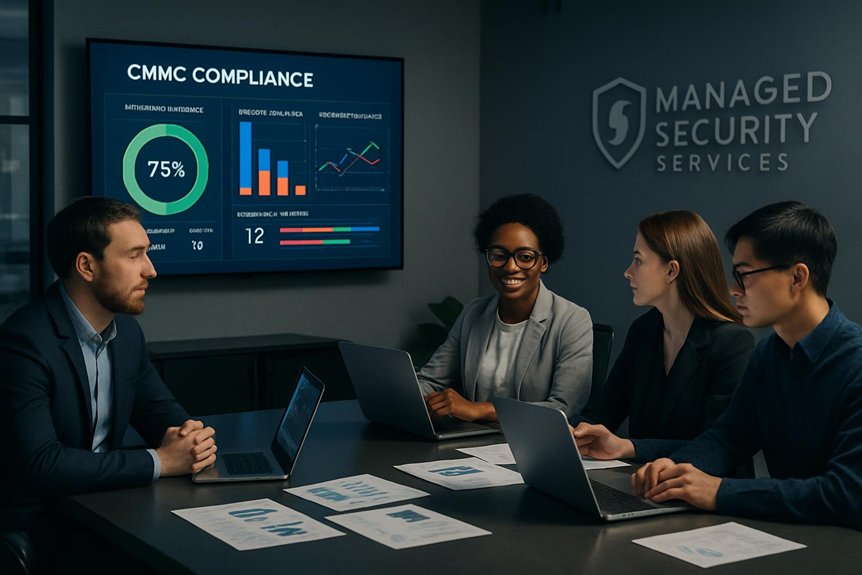
Your risk assessment and remediation roadmap become considerably more manageable when you partner with Managed Security Services Providers (MSSPs) who specialize in CMMC compliance.
These providers deliver cost-effective solutions that help small and medium businesses implement the 110 security controls required for CMMC Level 2 under NIST 800-171 standards.
MSSPs offer three key advantages for your compliance journey:
- Scalable expertise that adapts to your specific budget constraints and compliance needs
- Continuous monitoring and incident response support to maintain ongoing security posture
- Significant cost reduction by eliminating the need for extensive in-house compliance teams
Developing Comprehensive Staff Training and Awareness Programs
While technology controls form the backbone of CMMC compliance, human factors remain the weakest link in most cybersecurity frameworks. Your staff training program must address specific CMMC requirements, ensuring employees understand their responsibilities for protecting Controlled Unclassified Information and federal contract data.
Schedule regular awareness training sessions to address evolving cybersecurity threats and updated guidelines. Don’t rely on generic programs—tailor content to your organization’s policies and procedures. Incorporate hands-on simulations and real-world scenarios to improve training effectiveness and prepare staff for your incident response plan.
Document all training completion and measure effectiveness for compliance management purposes. This accountability demonstrates your commitment during audits while reinforcing cybersecurity practices throughout your organization.
Continuous education builds the security culture essential for sustained CMMC compliance.
Strengthening Vendor Management and Supply Chain Security
Since your organization’s CMMC compliance depends on every link in your supply chain, you must implement rigorous vendor management practices that extend security requirements beyond your direct control.
Effective supply chain security requires establishing clear cybersecurity requirements in vendor contracts and conducting regular assessments of vendor compliance to protect Controlled Unclassified Information (CUI).
Your vendor management strategy should include:
- Contract Integration – Embed specific cybersecurity standards and CMMC requirements directly into vendor agreements.
- Proactive Vendor Training – Implement awareness programs that educate partners about their security responsibilities.
- Accountability Measures – Establish periodic audits and performance evaluations to monitor ongoing compliance.
These practices create a robust framework that minimizes vulnerabilities and guarantees all vendors actively contribute to your organization’s overall security posture.
Creating Sustainable Documentation and Policy Management Systems
Beyond securing your supply chain partnerships, CMMC compliance requires a robust foundation of well-organized documentation and policy management systems that can withstand rigorous audits.
You’ll need to establish a centralized document management system that maintains audit-ready documentation, ensuring all policies reflect current CMMC requirements through effective version control.
Schedule regular reviews to keep your documentation current as requirements evolve. Involve key stakeholders in this process to create a culture of compliance throughout your organization. Their ownership and accountability are essential for sustainable compliance efforts.
Consider implementing automated documentation tools to streamline policy management and reduce human error. These tools provide real-time visibility into your compliance status, helping you maintain preparedness for future audits while minimizing administrative burden.
Building Long-Term Compliance Monitoring and Maintenance Processes

Building an effective CMMC compliance program requires establishing continuous monitoring processes that actively track your security controls and identify vulnerabilities before they become audit failures.
Your maintenance processes should incorporate automated tools that provide real-time visibility into compliance activities while maintaining thorough documentation.
Successful long-term CMMC compliance depends on three critical components:
Long-term CMMC compliance success hinges on three essential elements: continuous monitoring, regular internal audits, and ongoing employee education programs.
- Continuous Monitoring Systems – Deploy automated tools that track security controls and provide real-time alerts for compliance deviations.
- Regular Internal Audits – Conduct proactive assessments to identify gaps before external audits occur.
- Ongoing Education Programs – Implement training programs that keep employees updated on evolving cybersecurity policies and CMMC requirements.
You’ll need centralized document management systems to maintain updated policies and procedures.
Schedule regular maintenance reviews to guarantee your compliance monitoring adapts to changing standards and best practices.
Frequently Asked Questions
Does CMMC Require an Audit?
Yes, CMMC requires an audit that demonstrates critical CMMC audit importance for defense contractors.
You’ll undergo audit process evaluation by certified assessors who examine your audit compliance status. Level 1 requires annual self-assessments, while Levels 2-3 need biennial third-party audits. The audit frequency depends on your certification level.
Proper audit preparation and audit readiness are essential, as audit findings determine your eligibility for DoD contracts.
Audit documentation and following audit best practices help overcome audit challenges.
Is CMMC Replacing NIST?
No, CMMC isn’t replacing NIST—it’s built on NIST foundations.
This CMMC overview shows the framework incorporates NIST SP 800-171 standards, creating a NIST relationship rather than replacement.
You’ll face compliance differences through CMMC’s certification requirements versus NIST’s guidance-based approach.
These cybersecurity frameworks work together for risk management and maturity models.
The regulatory requirements create implementation challenges, but industry standards remain consistent.
Small business impact increases as you’ll need both frameworks for defense contracting.
What Are the Three Main Levels of the Revised CMMC Maturity Model and Their Respective Control Requirements?
Think of CMMC’s maturity levels as stepping stones to cybersecurity excellence.
You’ll encounter three distinct tiers: Level One requires 17 basic security practices with annual self-assessments. Level Two demands 110 control requirements aligned with NIST SP 800-171 through their thorough assessment methodology.
Level Three focuses on advanced implementation guidance for critical programs. Each compliance framework tier increases process maturity expectations, ensuring you’re adequately protecting sensitive information based on contract requirements.
How to Achieve CMMC Compliance?
You’ll achieve CMMC compliance by implementing extensive security frameworks and conducting thorough risk assessments.
Start with compliance checklists to identify gaps, then develop robust policies and documentation practices.
Establish CMMC training programs to boost employee awareness and create effective incident response procedures.
Implement continuous monitoring systems and strengthen vendor management protocols.
Focus on policy development that aligns with NIST 800-171 requirements while maintaining detailed documentation for audit readiness.
Conclusion
Think of CMMC compliance as tending a garden—you’ve planted the seeds through your audit, but now you’ll need constant nurturing to see growth. You can’t simply water once and expect flourishing results. Your remediation efforts require ongoing attention, from training your team to monitoring vendor relationships. Don’t let weeds of complacency choke your progress. With consistent care and the right tools, you’ll cultivate a thriving security posture that protects your business’s future.