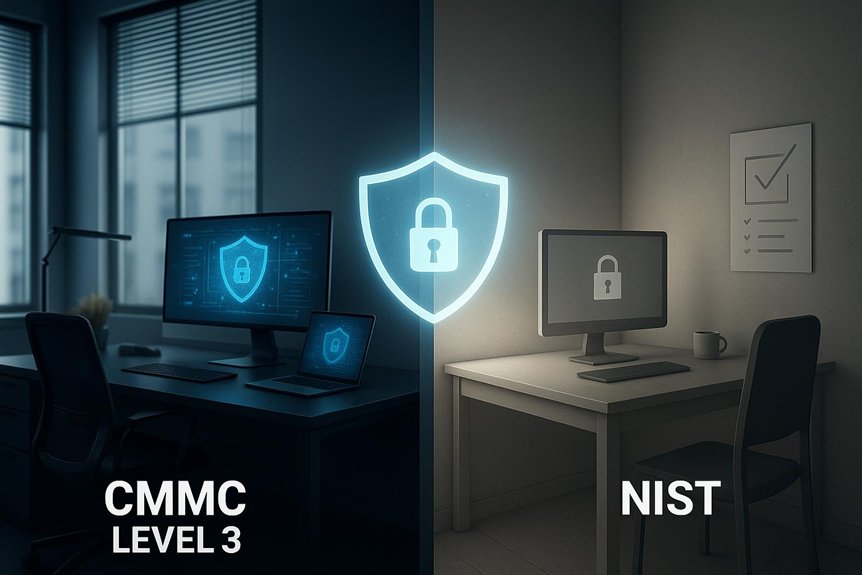
CMMC’s three-tier system contrasts sharply with NIST 800-171‘s single standard approach. You’ll face 17 basic practices at CMMC Level 1 with self-assessment, while Level 2 requires all 110 NIST 800-171 controls plus mandatory third-party verification every three years. Level 3 adds advanced NIST 800-172 protections against sophisticated threats. Unlike NIST 800-171’s flexible self-assessment model, CMMC demands complete resolution of all open items before certification, fundamentally changing your compliance strategy and organizational preparation requirements.
Key Takeaways
- CMMC Level 1 requires only 17 basic practices while NIST 800-171 mandates all 110 security requirements.
- CMMC Levels 2-3 require mandatory third-party assessments every three years, unlike NIST 800-171’s self-assessment approach.
- CMMC demands complete resolution of all security gaps before assessment, while NIST 800-171 permits ongoing remediation.
- NIST 800-171 serves as the foundation for CMMC Level 2, with Level 3 adding NIST 800-172 protections.
- CMMC certification expires after 1-3 years depending on level, while NIST 800-171 has no formal validity period.
Understanding CMMC’s Three-Tier Certification Framework
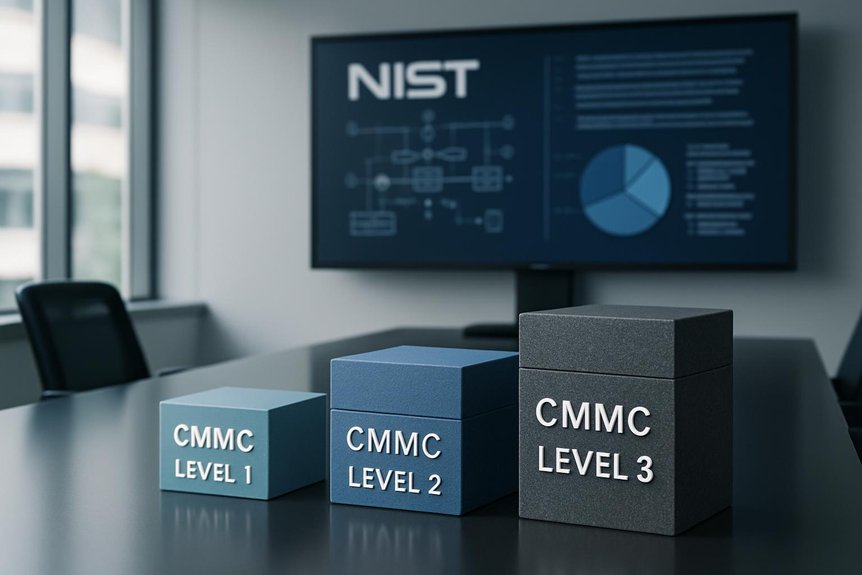
While the original CMMC framework included five certification levels, the streamlined Version 2.0 now operates on a three-tier system that directly aligns with your organization’s data handling responsibilities.
Level 1 requires 17 basic cybersecurity practices for protecting Federal Contract Information, allowing annual self-assessments.
Level 2 incorporates all 110 practices from NIST SP 800-171, specifically designed for safeguarding Controlled Unclassified Information (CUI) and requiring third-party assessments every three years.
Level 2 mandates comprehensive NIST SP 800-171 implementation with mandatory third-party verification for organizations handling Controlled Unclassified Information.
Level 3 builds upon Level 2 by adding advanced practices from NIST SP 800-172 for enhanced protection against sophisticated threats.
This CMMC certification framework guarantees your organization meets Department of Defense (DoD) contract requirements, with mandatory compliance beginning in 2026.
Each level corresponds to increasingly sensitive data handling and cybersecurity obligations.
NIST 800-171’s Single-Standard Approach to CUI Protection
NIST 800-171 takes a fundamentally different approach than CMMC’s tiered system by establishing a single, extensive standard of 110 security requirements that all organizations handling Controlled Unclassified Information must meet.
You’ll find these requirements organized across 14 families covering access control, incident response, and system integrity.
Unlike CMMC compliance, you can self-assess your adherence to these security requirements and report through the Supplier Performance Risk System (SPRS) without third-party certification.
You must develop a System Security Plan (SSP) and Plan of Action and Milestones (PoA&M) to identify compliance gaps.
This framework has become foundational for establishing robust cybersecurity practices in non-federal systems, directly informing higher-level CMMC requirements.
Assessment Methods: Third-Party Verification Vs Self-Assessment
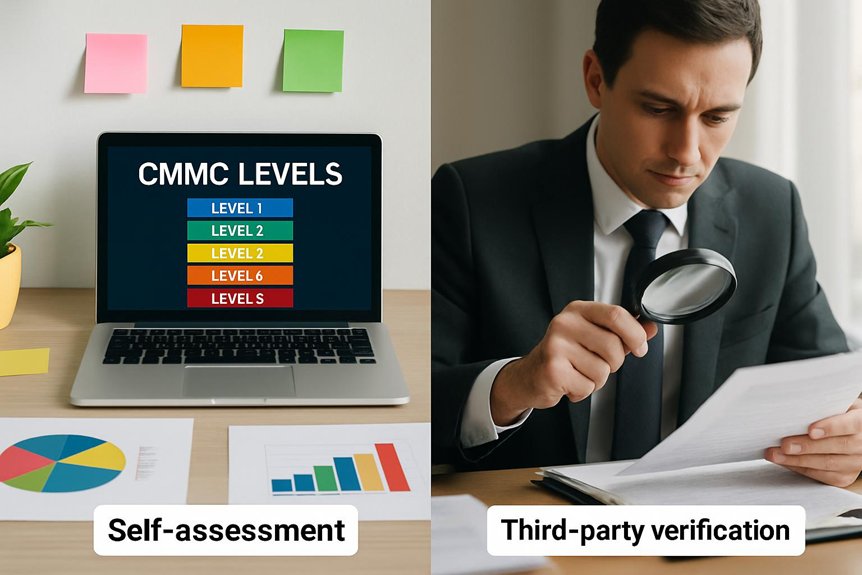
One key distinction between CMMC and NIST Standards lies in how you’ll demonstrate compliance with their respective requirements.
CMMC Levels 2 and 3 mandate third-party assessment through a Certified Third-Party Assessment Organization (C3PAO) every three years, while Level 1 requires annual self-assessment. In contrast, NIST 800-171 allows you to conduct self-assessment without third-party verification, providing greater flexibility.
For DoD contractors, CMMC certification becomes mandatory through C3PAO verification, ensuring standardized evaluation of cybersecurity practices.
You’ll need to resolve all Plan of Action and Milestones items before CMMC assessments, whereas NIST 800-171 permits having a PoA&M at assessment start.
This fundamental difference in verification approaches affects how you’ll prepare for and maintain compliance with each framework.
Compliance Requirements Across CMMC Levels 1, 2, and 3
Beyond the assessment methods themselves, each CMMC level carries distinct compliance requirements that directly impact your organization’s security posture and operational readiness.
CMMC Level 1 demands adherence to 17 basic cybersecurity practices for Federal Contract Information, allowing annual self-assessment. Level 2 escalates requirements to all 110 NIST standards from NIST 800-171, protecting Controlled Unclassified Information through mandatory third-party assessments every three years.
CMMC Level 1 requires 17 basic practices with self-assessment, while Level 2 mandates all 110 NIST 800-171 controls with third-party verification.
Level 3 incorporates those same security controls plus additional NIST 800-172 protections against advanced threats, requiring external certification process verification.
Unlike traditional NIST standards permitting ongoing Plan of Actions and Milestones during evaluations, CMMC levels mandate complete resolution of all open items before assessment.
This fundamental shift from self-assessment flexibility to rigid certification requirements guarantees contractors meet stringent compliance requirements before handling sensitive government information.
Documentation and Plan of Action Differences
While NIST 800-171 allows you to maintain an active Plan of Action and Milestones (PoA&M) during assessment periods, CMMC fundamentally changes this approach by requiring complete resolution of all open items before any formal evaluation begins.
This shift creates stricter compliance expectations under CMMC cybersecurity standards.
Your documentation requirements also differ greatly between frameworks.
CMMC imposes specific restrictions on which practices you can include in your PoA&M, while NIST 800-171 doesn’t limit these inclusions.
Additionally, CMMC Level 2 demands you provide a thorough System Security Plan (SSP) alongside demonstrating all 110 requirements through third-party assessments.
Unlike NIST 800-171’s self-assessment model, CMMC’s certification process guarantees verified compliance before issuing formal certificates, eliminating the flexibility of ongoing remediation during evaluations.
Certification Validity Periods and Renewal Processes
CMMC’s certification requirements extend beyond initial compliance verification to establish ongoing validity periods that fundamentally differ from NIST 800-171‘s continuous self-assessment approach.
Your CMMC certification timeline depends on which level you’re pursuing, while NIST 800-171 compliance operates without formal validity periods.
Here’s how certification timelines break down:
- Level 1: Valid for one year with annual self-assessment requirements
- Levels 2-3: Valid for three years requiring C3PAO third-party assessments
- NIST 800-171: No formal validity period, allowing continuous self-assessment
- Re-certification: Required every three years for DoD contracts eligibility
Unlike NIST 800-171’s flexible compliance status reporting, CMMC emphasizes structured external validation through scheduled evaluations.
You’ll need to plan your re-certification cycles carefully to maintain continuous eligibility for DoD contracts while ensuring adherence to cybersecurity standards.
Cloud Environment Compliance Considerations
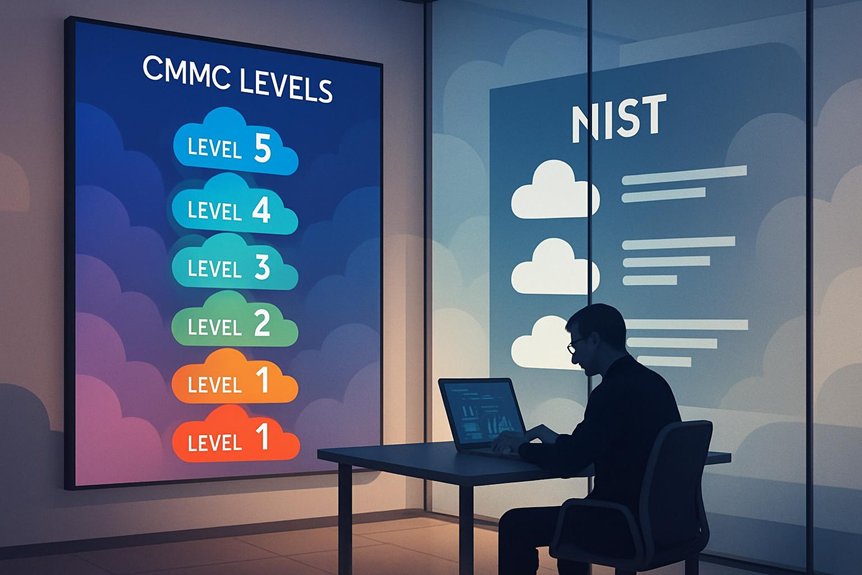
As organizations increasingly migrate to cloud infrastructures, both CMMC and NIST 800-171 impose distinct compliance requirements that directly impact your cloud service selection and configuration strategies.
Under CMMC, you must guarantee cloud service providers meet FedRAMP Moderate baseline security when handling Controlled Unclassified Information, requiring formal certification processes.
CMMC mandates FedRAMP Moderate baseline security for cloud providers handling Controlled Unclassified Information through formal certification processes.
NIST 800-171 offers more flexibility for DoD contractors using internal cloud systems, mandating adherence to all 110 security controls without requiring formal cloud provider certification.
Your cybersecurity requirements include timely incident reporting within 72 hours under CMMC’s federal regulations.
While both frameworks emphasize protecting sensitive information from unauthorized access, CMMC’s stringent cloud compliance standards contrast with NIST 800-171’s adaptable approach, directly affecting your eligibility for government contracts.
Frequently Asked Questions
Is CMMC Level 2 the Same as NIST 800-171?
CMMC Level 2 isn’t exactly the same as NIST 800-171, though they’re closely related cybersecurity frameworks.
You’ll find CMMC compliance includes all 110 NIST requirements but adds stricter assessment processes through third-party evaluators.
While NIST allows self-assessment, CMMC Level 2 demands you resolve all security controls deficiencies before certification.
These maturity levels enhance data protection for federal contracts, creating implementation challenges but stronger risk management than standard NIST requirements alone.
How Is CMMC Different From NIST?
You’ll find CMMC compliance differs considerably from the NIST framework through mandatory third-party assessment processes versus self-evaluation options.
CMMC’s tiered cybersecurity requirements create specific certification challenges you must overcome for DoD contracts, while NIST offers voluntary guidelines.
Your implementation strategies need different documentation standards and organizational readiness levels.
CMMC demands formal certification with continuous monitoring, whereas NIST focuses on flexible risk management approaches without mandatory external verification requirements.
Which Level of CMMC Is Most Closely Aligned With NIST 800-171?
You’ll find CMMC Level 2 most closely aligned with NIST 800-171, incorporating all 110 security controls for thorough data protection.
This CMMC alignment guarantees your NIST compliance through structured implementation strategies and rigorous assessment criteria.
You’ll need third-party certification, demonstrating your organization readiness through documented security frameworks and effective risk management.
The certification process requires audit requirements that verify you’ve fully implemented these controls, going beyond NIST 800-171’s self-assessment approach.
What Is the Difference Between 800 171 and 800 172?
Think of NIST 800-171 and 800-172 as building blocks for your cybersecurity framework.
You’ll find 800-171 provides 110 basic security controls for CUI data protection in federal contracts, while 800-172 adds 25 enhanced requirements targeting advanced persistent threats.
Your organizational readiness determines which you’ll need—800-171 meets CMMC requirements and NIST compliance basics, but 800-172 addresses sophisticated risk management challenges with advanced assessment methods and implementation strategies.
Conclusion
Think of cybersecurity compliance as choosing between a ladder and a single step. You’ll find CMMC’s three-tier framework offers a graduated climb with mandatory third-party verification, while NIST 800-171 provides one standard height with self-assessment flexibility. You’re not just picking certification requirements—you’re selecting your defense strategy. Whether you need CMMC’s structured levels or NIST’s streamlined approach, you’ll want to align your choice with your organization’s risk tolerance and contractual obligations.