You should prioritize cybersecurity risk assessment because it transforms your security approach from reactive firefighting to proactive threat prevention. It systematically identifies vulnerabilities in your IT environment, allowing you to allocate resources strategically and address critical threats first. Risk assessments guarantee regulatory compliance, enhance incident response capabilities, and provide cost-effective security investments by targeting high-priority vulnerabilities before they become costly breaches. This foundation strengthens your overall security posture and prepares you for emerging digital threats ahead.
Key Takeaways
- Cybersecurity risk assessments transform security posture from reactive firefighting to proactive strategic prevention against digital threats.
- Systematic evaluation enables strategic resource allocation, maximizing security investment impact while targeting critical vulnerabilities first within budget constraints.
- Regular assessments ensure regulatory compliance, avoid costly fines, and maintain certifications like CMMC by identifying security control gaps.
- Risk assessments enhance incident response capabilities by reducing threat detection time and developing customized plans for specific industry threats.
- Continuous risk evaluation adapts security measures to emerging threats, ensuring robust defenses through regular updates and stakeholder communication.
Understanding the Critical Role of Risk Assessment in Modern Cybersecurity

While cyberattacks grow more sophisticated and frequent each day, cybersecurity risk assessments have become your organization’s first line of defense against digital threats. These evaluations systematically identify vulnerabilities within your IT environment, enabling you to understand where threats could exploit weaknesses before attackers do.
Modern organizations can’t afford reactive approaches to cybersecurity. Risk assessment transforms your security posture from defensive to proactive, revealing hidden vulnerabilities across systems and applications. This visibility allows you to mitigate risks strategically rather than scrambling after breaches occur.
The evolving threat landscape demands continuous monitoring and regular evaluations. By integrating risk assessment into your extensive risk management strategy, you’ll adapt to emerging threats while addressing previously identified weaknesses, ensuring your cybersecurity defenses remain robust against increasingly complex attack vectors.
Proactive Threat Management Through Systematic Risk Evaluation
Because systematic risk evaluation transforms how organizations approach cybersecurity threats, you’ll shift from reactive firefighting to strategic threat prevention. Through thorough risk assessment processes, you can identify vulnerabilities before attackers exploit them, fundamentally strengthening your security posture.
When you conduct systematic risk evaluations, you’re analyzing both likelihood and impact of potential cybersecurity risks. This approach enables you to prioritize resources effectively, focusing on threats that pose the greatest danger to your operations.
You’ll develop targeted strategies that enhance your incident response capabilities while maintaining business continuity. Proactive threat management through ongoing assessments guarantees you’re prepared for emerging threats.
Strategic Resource Allocation and Cost-Effective Security Investment

When you strategically allocate cybersecurity resources based on thorough risk assessments, you’ll maximize your security investment’s impact while minimizing unnecessary expenditures.
You can prioritize risks based on their potential impact and likelihood, ensuring your budget targets the most critical vulnerabilities and threats first. This approach enables informed decisions about which security measures deserve immediate attention versus those that can wait.
Your cybersecurity risk assessments guide cost-effective security investment by revealing actual risk levels across your organization. Rather than spreading resources thin, you’ll concentrate efforts where they matter most.
Proactive addressing of high-priority vulnerabilities prevents costly breaches and reduces long-term remediation expenses.
- Budget optimization through data-driven resource allocation decisions
- Maximum ROI by focusing on highest-impact security measures
- Reduced breach costs via proactive vulnerability management
- Compliance efficiency avoiding regulatory fines and penalties
Meeting CMMC Requirements and Regulatory Compliance Standards
Seventeen distinct cybersecurity domains form the backbone of CMMC certification, and your organization must demonstrate measurable compliance across each one to secure DoD contracts.
Cybersecurity risk assessments become your roadmap for identifying gaps in security controls and implementing necessary security measures across domains like access control, incident response, and risk management.
Regular assessments help you maintain regulatory compliance while protecting critical assets from evolving threats. You’ll leverage threat intelligence to strengthen defenses and prevent data breaches that could jeopardize your certification status.
Meeting compliance requirements isn’t just about passing audits—it’s about building robust security frameworks that adapt to changing regulations.
When you prioritize thorough risk assessments, you’re positioning your organization to exceed CMMC standards and maintain competitive advantages in government contracting.
Enhanced Incident Response and Business Continuity Protection

While traditional security measures focus on prevention, cybersecurity risk assessments transform your incident response capabilities by identifying vulnerabilities before attackers exploit them.
Through proactive cybersecurity approaches, you’ll reduce detection time from the industry average of 287 days while developing tailored incident response plans specific to your organization’s threat landscape.
Risk assessment enables effective prioritization of critical vulnerabilities, directing resources toward your most pressing security gaps.
Strategic vulnerability prioritization transforms scattered security efforts into focused defense by targeting your organization’s most critical risk exposures first.
This strategic approach guarantees business continuity protection through thorough mitigation strategies that minimize operational disruption during incidents.
- Accelerated Response Times: Continuous monitoring and pre-identified vulnerabilities enable faster threat detection and containment
- Strategic Resource Allocation: Risk prioritization focuses efforts on critical vulnerabilities with highest business impact
- Customized Protection Plans: Tailored incident response plans address your specific industry threats and compliance requirements
- Enhanced Organizational Resilience: Proactive vulnerability management maintains stakeholder trust and operational stability during cyber incidents
Building a Foundation for Cybersecurity Maturity Model Certification
As organizations increasingly pursue defense contracts, cybersecurity risk assessments become the cornerstone for achieving Cybersecurity Maturity Model Certification (CMMC) compliance.
You’ll need to establish a systematic process that aligns with the NIST Cybersecurity Framework to identify vulnerabilities and prioritize actions effectively. Your organization must demonstrate how you identify, evaluate, and assess threats and vulnerabilities while protecting Controlled Unclassified Information.
CMMC’s five maturity levels demand continuous monitoring and regular reassessment of your security controls. You can’t simply conduct one-time evaluations—you need ongoing cybersecurity risk assessments that adapt to evolving threats.
This approach strengthens your overall security posture and develops a thorough mitigation strategy. By implementing these foundational practices, you’ll enhance your readiness for certification while building supply chain trust and organizational resilience.
Ongoing Risk Monitoring and Adaptive Security Posture Management
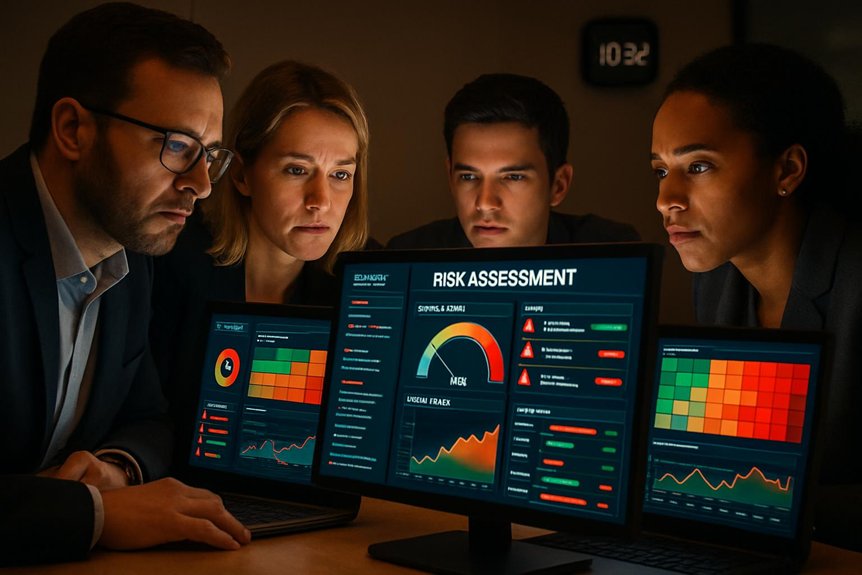
Once you’ve established your foundational cybersecurity practices for CMMC compliance, you must implement ongoing risk monitoring and adaptive security posture management to maintain and strengthen your defenses.
This continuous approach enables you to identify new vulnerabilities and adapt your cybersecurity measures to emerging threats in real-time.
Your adaptive security posture requires regular risk assessment updates to maintain accurate risk profiles. By leveraging predictive analytics, you’ll gain valuable insights into potential future threats and root causes of existing vulnerabilities.
This proactive monitoring guarantees your organization stays ahead of evolving attack vectors while maintaining compliance with changing regulatory requirements.
- Document and analyze vulnerability likelihood to prioritize remediation efforts effectively
- Utilize advanced analytical tools for predictive threat intelligence and risk forecasting
- Update security measures continuously based on emerging threat landscape changes
- Maintain regulatory compliance through systematic risk profile documentation and reporting
Frequently Asked Questions
Why Is Risk Prioritization Important?
You’ll maximize your security effectiveness by focusing limited resources on critical threats through proper risk prioritization.
It enables strategic application of risk identification techniques and vulnerability assessment strategies where they’re most needed. You can’t address every risk simultaneously, so prioritization helps you implement targeted risk mitigation plans based on impact assessment criteria and likelihood estimation models.
This approach guarantees you’re protecting high-value assets first while maintaining stakeholder communication strategies throughout your security program.
Why Is a Risk Assessment so Important?
Don’t put all your eggs in one basket when it comes to cybersecurity. You need risk assessment to identify threats lurking in your systems through thorough vulnerability analysis.
It guarantees you’re meeting compliance requirements while enabling smart resource allocation for maximum protection. Risk assessment strengthens your incident response capabilities, enhances stakeholder engagement, and maintains business continuity.
You’ll achieve effective risk mitigation and robust data protection, safeguarding your organization’s future.
What Are the Benefits of a Security Risk Assessment?
Security risk assessments provide you with extensive data protection by conducting thorough vulnerability analysis and threat identification.
You’ll achieve compliance adherence while improving incident response capabilities.
These assessments enable efficient resource allocation and enhance stakeholder engagement through transparent risk communication.
You’ll strengthen business continuity planning and reputation management by proactively addressing security gaps.
The cost efficiency gained from preventing breaches far outweighs assessment investments, making them essential for organizational resilience.
Why Is Risk Management Important in Cybersecurity?
Imagine you’re playing cybersecurity roulette—spinning the wheel blindfolded while hackers place their bets.
That’s life without proper risk management! You need systematic threat identification and vulnerability analysis to stop gambling with your data.
Through impact evaluation and mitigation strategies, you’ll meet compliance requirements while strengthening incident response capabilities.
Effective asset management, employee training, and third party risk oversight require continuous monitoring.
Don’t let cybercriminals cash in on your oversights.
Conclusion
You can’t afford to ignore cybersecurity risk assessment when 95% of successful cyberattacks result from human error, according to IBM’s latest security report. By implementing systematic risk evaluation, you’re not just checking compliance boxes—you’re building a resilient defense strategy that adapts to evolving threats. Your organization’s survival depends on understanding vulnerabilities before attackers exploit them. Don’t wait for a breach to realize assessment’s value; start strengthening your cybersecurity foundation today.