
Cybersecurity certification requirements are crucial because they’re your gateway to government contracts and protection from devastating financial losses. Without CMMC certification, you’ll lose access to the defense supply chain entirely, facing contract losses and penalties. A single data breach averages $4.45 million in costs, making compliance essential for your survival. These certifications don’t just meet regulatory demands—they strengthen your operational resilience, build client trust, and position your organization for sustained competitive advantage in an increasingly digital marketplace.
Key Takeaways
- Cybersecurity certifications are mandatory for defense contractors to maintain access to government contracts and supply chain opportunities.
- Compliance with certification requirements like CMMC protects organizations from costly data breaches averaging $4.45 million per incident.
- Certification demonstrates validated security posture through rigorous third-party assessments, building trust with clients and expanding market access.
- Meeting certification standards enhances operational resilience by implementing structured cybersecurity practices across critical security domains.
- Non-compliance results in contract losses, financial penalties, and exclusion from lucrative defense contracting opportunities.
Understanding CMMC Framework and Its Impact on Small Business Operations
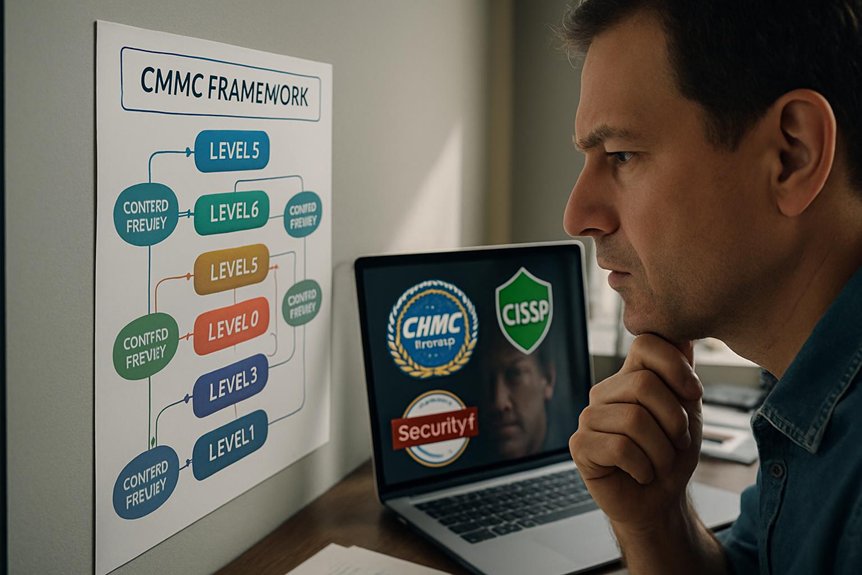
When your small business seeks Department of Defense contracts, you’ll encounter the Cybersecurity Maturity Model Certification (CMMC) framework—a thorough security standard that’s reshaping how defense contractors approach cybersecurity.
This certification system requires you to implement specific security practices across 17 domains, protecting sensitive data like Controlled Unclassified Information. Your CMMC level depends on the information sensitivity you’ll handle, ranging from basic cyber hygiene to advanced protocols.
Compliance isn’t just about winning federal contracts—it’s transforming how small businesses operate. You’ll develop stronger operational resilience through continuous cybersecurity improvements.
CMMC compliance transforms small business operations beyond contract requirements, building lasting cybersecurity resilience through systematic security improvements.
Non-compliance means losing access to the defense supply chain entirely. As of 2023, CMMC has become mandatory, making it essential that you understand these requirements before pursuing government opportunities that could greatly impact your business growth.
Mandatory Compliance Standards for Defense Contractors and Supply Chain Partners
As a defense contractor or supply chain partner, you must meet stringent compliance standards that go far beyond basic cybersecurity measures. The Department of Defense requires CMMC certification before you’re eligible for contracts, making these mandatory standards non-negotiable for your business survival.
You’ll need to demonstrate compliance with NIST SP 800-171 when handling Controlled Unclassified Information, ensuring your information security protocols meet federal requirements.
Cybersecurity professionals within your organization must prepare for rigorous third-party assessments that validate your security posture and certifications.
Failure to achieve required compliance levels means you’ll lose contracts, face financial penalties, and suffer reputational damage throughout the defense supply chain.
Your investment in meeting these mandatory standards isn’t optional—it’s essential for maintaining your competitive position in defense contracting.
Cost-Benefit Analysis of CMMC Implementation for Small Organizations

While CMMC implementation demands considerable upfront investment, small organizations must weigh these costs against the substantial benefits of certification eligibility.
You’ll face implementation costs ranging from $20,000 to $250,000, depending on your current cybersecurity posture and required compliance level. You’ll need external consultants, advanced cybersecurity tools, and regular assessments to maintain certification.
However, CMMC compliance opens doors to lucrative government contracts that many federal agencies now require. Without certification, you’ll face financial penalties, contract losses, and reputational damage.
The long-term benefits considerably outweigh initial expenses. You’ll gain enhanced cybersecurity resilience, protecting your organization from costly breaches. Additionally, certification builds trust with clients, demonstrating your commitment to protecting sensitive information and expanding your market opportunities beyond government contracts.
Essential Security Controls and Practices Required by CMMC Levels
Since CMMC establishes five distinct certification levels, you’ll need to understand the specific security controls and practices required at each tier to determine your organization’s compliance pathway.
Essential Security Controls by CMMC Levels:
- Level 1 – You’ll implement basic safeguarding measures including access control and identification to establish foundational cybersecurity practices for protecting sensitive information.
- Level 3 – Your organization must demonstrate enhanced capabilities like incident response and risk management, which are vital for safeguarding Controlled Unclassified Information effectively.
- Level 5 – You’ll deploy advanced security practices incorporating threat intelligence and proactive monitoring to counter sophisticated cyber threats.
All CMMC levels require compliance with NIST SP 800-171 controls, ensuring your cybersecurity framework meets federal standards while protecting critical defense supply chain information.
Timeline and Preparation Strategies for CMMC Assessment Readiness

When planning your CMMC assessment readiness, you’ll need to allocate several months for thorough preparation that addresses your organization’s current cybersecurity gaps.
Start by conducting a detailed gap analysis to identify weaknesses in your existing security controls and cybersecurity practices. This evaluation helps determine what changes you’ll need to implement to meet CMMC requirements.
Establish a readiness timeline that includes developing continuous training and awareness programs for your employees. They must understand their roles in maintaining compliance and strengthening your overall cybersecurity posture.
Document all processes, policies, and evidence meticulously to demonstrate adherence during certification evaluations.
Consider engaging certified CMMC consultants who can provide expert guidance and tailored strategies. Their expertise accelerates your preparation process and guarantees you’re implementing the most effective security controls for successful certification.
Long-Term Business Advantages of Achieving CMMC Certification
Your investment in CMMC certification preparation pays dividends that extend far beyond meeting compliance requirements. This cybersecurity standards achievement transforms your organization’s market position and financial outlook.
Key Long-Term Advantages:
- Enhanced Market Position – CMMC certification provides a competitive edge in defense contracting, demonstrating your commitment to protecting sensitive information and gaining access to broader government contracts that drive business growth.
- Financial Protection – You’ll considerably reduce exposure to costly data breaches averaging $4.45 million per incident, creating substantial long-term savings and improved financial stability.
- Operational Excellence – The certification process encourages structured cybersecurity approaches that enhance operational efficiency and strengthen risk management practices across your entire organization, positioning you for sustained success.
Frequently Asked Questions
Why Are Certifications Important in Cybersecurity?
You’ll gain significant certification benefits in cybersecurity through skill validation and knowledge acquisition that meet industry standards.
Certifications boost your professional credibility, giving you a competitive advantage when employer expectations demand proven expertise.
They’re essential for career advancement, as organizations increasingly require certified professionals to combat rising cyber threats.
You’ll demonstrate continuous learning commitment while opening doors to higher-paying specialized roles that non-certified candidates can’t access.
Why Is Cybersecurity Vital?
In today’s digital battlefield, you’re fundamentally fighting invisible enemies lurking in every click and connection.
Cybersecurity’s your shield against devastating data breaches that’ll drain millions from your organization. You need robust network security and threat analysis to stay ahead of evolving attacks.
Effective risk management, incident response protocols, and compliance with privacy regulations aren’t optional—they’re survival essentials.
Without proper information protection and security protocols, you’re leaving your digital doors wide open to catastrophic losses.
What Are the Five Essential Cyber Security Requirements?
You’ll need five essential cybersecurity requirements to protect your organization effectively.
First, implement robust network security with proper access controls and encryption techniques.
Second, conduct regular vulnerability analysis and threat assessment to identify weaknesses.
Third, establish thorough risk management protocols.
Fourth, develop swift incident response procedures for security breaches.
Finally, maintain strict compliance standards that align with industry security protocols, ensuring you’re meeting regulatory requirements while safeguarding sensitive data.
Why Cyber Security Professionals Are Necessary?
Imagine you’re a digital guardian standing against an endless storm of cyber threats.
You’ll find that pursuing a cybersecurity career offers exceptional job security as industry demand skyrockets. Through continuous skills development and knowledge application, you’ll excel in threat mitigation and incident response.
Your professional growth flourishes through team collaboration, protecting organizations from devastating breaches.
You’re not just building expertise—you’re becoming an essential shield in our interconnected world’s defense system.
Conclusion
You’ve survived the bureaucratic maze of CMMC requirements—congratulations! Now you’re officially certified to handle government secrets (like which coffee brand the Pentagon prefers). Sure, you’ve spent more on compliance than your CEO’s yacht, but hey, at least you can sleep soundly knowing your password policy meets federal standards. Welcome to the exclusive club where cybersecurity badges cost more than actual security. Your accountant’s crying, but your resume’s glowing.