
You’ll need to understand CMMC’s three certification levels to secure defense contracts and protect your business. Level 1 requires self-assessment of 17 basic practices, while Level 2 demands compliance with 110 NIST controls for handling sensitive information. You can choose between cost-effective self-attestation or credible third-party certification depending on your contract requirements. Focus on gap analysis, employee training, and partnering with managed service providers to build sustainable cybersecurity maturity that extends far beyond initial compliance requirements.
Key Takeaways
- Start with CMMC Level 1 self-assessment covering 17 basic cybersecurity practices to establish foundational security controls cost-effectively.
- Partner with managed service providers to access specialized cybersecurity expertise without hiring dedicated full-time security staff.
- Conduct thorough gap analysis to identify existing security infrastructure and prioritize the most critical cybersecurity upgrades first.
- Implement regular employee training programs to strengthen human defenses and reduce security breach risks from human error.
- Develop robust incident response plans with clear protocols to minimize damage and ensure swift recovery from security incidents.
Understanding CMMC Levels and Requirements for Small Businesses
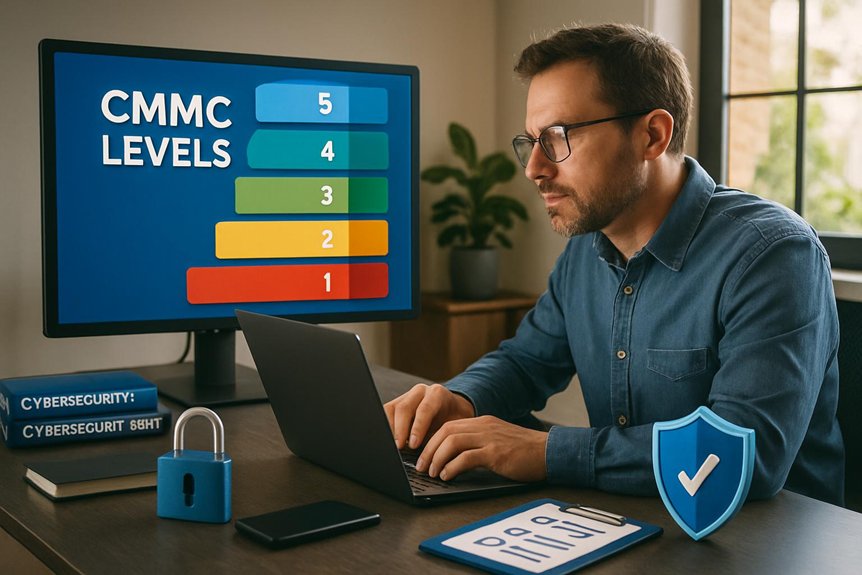
When your small business pursues defense contracts, you’ll encounter the Cybersecurity Maturity Model Certification (CMMC), which operates through three distinct levels designed to protect different types of sensitive information.
Level 1 requires self-assessment of 17 basic cybersecurity practices for Federal Contract Information.
Level 2 demands compliance with NIST SP 800-171‘s 110 security controls for handling Controlled Unclassified Information (CUI), involving either self-assessment or third-party assessment depending on contract requirements.
Level 3 necessitates mandatory third-party assessment by the Defense Contract Management Agency with additional advanced controls against persistent threats.
Small businesses must understand that CMMC compliance isn’t optional—it’s essential for accessing the Department of Defense (DoD) marketplace.
The streamlined CMMC 2.0 model, effective December 2024, simplifies certification while maintaining robust cybersecurity standards.
Self-Assessment vs. Third-Party Certification: Choosing the Right Path
How do you decide between self-assessment and third-party certification when pursuing CMMC compliance? Your choice depends on your CMMC requirements level and business needs.
For Level 1, you’ll implement 17 basic cybersecurity practices through self-assessment, making it perfect for small businesses with limited resources.
Level 2 offers flexibility—you can self-attest or pursue third-party certification to meet 110 NIST SP 800-171 practices.
However, Level 3 mandates third-party assessment to protect against Advanced Persistent Threats.
Self-assessment keeps costs low and suits resource-constrained operations, while third-party certification validates your cybersecurity measures more rigorously.
Self-assessment offers cost savings for budget-conscious organizations, while third-party certification provides stronger validation and enhanced credibility.
This enhanced credibility strengthens client relationships and competitive positioning.
Consider your budget, timeline, and strategic goals when choosing your compliance path—both approaches can effectively demonstrate your commitment to robust cybersecurity practices.
Preparing Your Organization for CMMC Level 1 Self-Certification

Since CMMC Level 1 serves as the entry point for Defense Industrial Base contractors, you’ll need to establish a solid foundation across 17 essential cybersecurity practices before pursuing self-certification.
Start by implementing core controls like user account management, firewalls, and regular software updates to protect your sensitive data effectively.
Documentation becomes critical for successful self-certification. You’ll need detailed records showing how you’ve implemented each required practice. This thoroughness demonstrates your compliance efforts during the annual self-assessment process.
Don’t overlook cybersecurity training for your team. Small businesses often underestimate this requirement, but employee awareness considerably strengthens your overall security posture.
Finally, designate a senior official to oversee the self-certification process, ensuring accountability and maintaining your organization’s eligibility for government contracts.
Navigating CMMC Level 2 Assessment Requirements
While CMMC Level 1 focuses on foundational practices, Level 2 demands considerably more rigorous compliance with 110 security controls derived from NIST SP 800-171. You’ll need to protect Controlled Unclassified Information (CUI) and Federal Contract Information through extensive measures.
CMMC Level 2 compliance requires implementing robust access control measures and developing detailed incident response plans. You must conduct regular risk assessments and maintain continuous monitoring of your cybersecurity posture.
Unlike Level 1’s self-certification, you’ll likely need third-party assessments through Certified Third-Party Assessment Organizations.
Documentation of compliance becomes critical at this level. You’ll need to prepare System Security Plans (SSPs) and Plans of Action and Milestones (POA&Ms) demonstrating your security implementation.
This thorough documentation proves your organization’s commitment to protecting sensitive information and adapting to evolving threats.
Essential Documentation and Evidence Collection Strategies

Although CMMC Level 2 assessment success hinges on rigorous preparation, your documentation strategy determines whether you’ll pass or fail the evaluation.
Essential documentation starts with developing a thorough System Security Plan that details your security controls implementation and a Plan of Action and Milestones addressing compliance gaps.
Your evidence collection strategies must include maintaining detailed records of employee training, security policies, incident reports, and audit logs demonstrating NIST 800-171 adherence.
You’ll need to conduct regular internal assessments and document results to verify compliance requirements readiness before third-party audits.
Implement automated tools to track vulnerabilities, manage patches, and monitor security controls effectively.
This systematic approach strengthens your cybersecurity posture while creating the documentation framework necessary for continuous improvement and successful CMMC certification.
Common Assessment Pitfalls and How to Avoid Them
Even with extensive documentation in place, small businesses frequently stumble during CMMC assessments due to preventable mistakes that can derail months of preparation.
You’ll avoid major setbacks by conducting a thorough gap analysis against NIST 800-171 controls before starting your CMMC compliance journey.
Don’t underestimate the complexity—incomplete preparation leads to failed assessments and certification delays.
Understanding the difference between self-assessments and third-party assessments is essential for developing an effective compliance strategy.
You can’t rely solely on software solutions; you must implement proper technical security, administrative controls, and physical safeguards.
Invest in extensive cybersecurity training to boost employee awareness.
Human error during assessments often stems from inadequate staff preparation.
Your security controls are only as strong as the people implementing them daily.
Cost-Effective Approaches to Meeting CMMC Standards

Proper preparation prevents costly assessment failures, but smart resource allocation makes CMMC compliance achievable without breaking your budget. Cost-effective strategies help small businesses meet cybersecurity requirements without overwhelming financial strain.
Strategic planning and efficient resource management transform CMMC compliance from a financial burden into an achievable cybersecurity investment for small businesses.
Start with these strategic approaches:
- Partner with managed service providers to access specialized cybersecurity expertise without hiring dedicated staff, reducing operational costs while maintaining robust security controls for sensitive data.
- Conduct thorough gap analysis to identify existing security infrastructure and prioritize essential upgrades, ensuring efficient resource allocation toward actual compliance needs rather than unnecessary expenditures.
- Implement compliance automation tools to streamline monitoring, reporting, and documentation processes, greatly reducing ongoing maintenance costs and administrative burden.
Additionally, explore available funding programs offering grants up to $75 million for CMMC compliance initiatives, providing critical financial support for necessary cybersecurity upgrades.
Building Long-Term Cybersecurity Maturity Beyond Certification
CMMC certification marks the beginning of your cybersecurity journey, not its destination. Building long-term cybersecurity maturity requires continuous improvement beyond initial compliance standards.
You’ll need ongoing monitoring systems and regular security assessments to identify vulnerabilities as threats evolve.
Invest in thorough employee training programs that create awareness and strengthen your human firewall. Your staff becomes your first line of defense when they’re equipped to recognize potential threats.
Develop a robust incident response plan that minimizes damage during security breaches. Swift reaction capabilities enhance your organization’s resilience and reduce recovery time.
Partner with cybersecurity experts and Managed Service Providers who understand the CMMC framework. They’ll provide tailored risk management strategies that sustain your cybersecurity maturity, ensuring your defenses remain effective against emerging threats.
Frequently Asked Questions
What Is the Best Maturity Model for Cybersecurity?
You’ll find the NIST Cybersecurity Framework stands out as the best maturity model for most organizations.
It offers flexible maturity frameworks that adapt to your risk assessment needs and compliance requirements. You can develop tailored implementation strategies, establish performance metrics, and create effective training programs.
The framework supports continuous improvement through structured incident response protocols, optimized resource allocation, and alignment with industry standards, making it ideal for progressive cybersecurity enhancement.
What Are the 5 C’s of Cyber Security?
Like a fortress with five defensive walls, the 5 C’s of cybersecurity protect your digital assets.
Confidentiality uses access control and data protection to guard sensitive information.
Integrity employs vulnerability management and security tools to prevent unauthorized changes.
Availability guarantees systems stay operational through backup solutions and incident response.
Compliance means following Compliance standards and conducting security audits.
Cybersecurity Culture builds cyber awareness through employee training and phishing attack prevention.
How Do You Assess Cybersecurity Maturity?
You’ll assess cybersecurity maturity by conducting thorough risk assessments and evaluating your security policies against industry standards.
Review your employee training programs, incident response capabilities, and vulnerability scanning processes.
Examine compliance requirements, threat intelligence gathering, and data encryption methods.
Analyze your network monitoring systems and access control mechanisms.
You’ll identify gaps through systematic evaluation, benchmark against frameworks like NIST or CMMC, and create improvement roadmaps addressing weaknesses in your security posture.
How to Protect Your Small Business From Cyber Attacks?
You’ll protect your small business by implementing thorough employee training focused on phishing awareness and strong password policies.
Conduct regular risk assessments to identify vulnerabilities and establish robust incident response procedures.
Secure your network security with data encryption and guarantee timely software updates.
Deploy reliable backup solutions to safeguard critical information.
Don’t overlook compliance requirements that may apply to your industry, as they’re essential for maintaining customer trust and avoiding penalties.
Conclusion
You’re not alone in this cybersecurity journey—78% of small businesses report feeling overwhelmed by compliance requirements initially. However, you’ll find that achieving CMMC certification isn’t just about meeting government standards; it’s about building a resilient foundation that protects your business and customers. You’ve got the roadmap now, so start with your current maturity level and take systematic steps forward. Your cybersecurity investment today becomes your competitive advantage tomorrow.