
You’ll need to assess your current cybersecurity knowledge first, then choose the right certification based on CMMC requirements like CompTIA Security+ for basic levels or CISSP for advanced positions. Create a structured study plan dedicating 10-15 hours weekly using official materials and practice exams. Gain hands-on experience through virtual labs and internships to bridge theory with real-world application. Finally, schedule your exam promptly and track renewal requirements since most certifications expire every three years. Continue below to discover the detailed strategies that’ll maximize your certification success.
Key Takeaways
- Assess your current cybersecurity knowledge and IT experience before choosing an appropriate certification level.
- Select certifications aligned with career goals, such as CompTIA Security+ for entry-level or CISSP for advanced roles.
- Create a structured study plan dedicating 10-15 hours weekly using official materials and practice exams.
- Gain hands-on experience through virtual labs, internships, and cybersecurity clubs to apply theoretical knowledge practically.
- Schedule your exam promptly and track renewal requirements to maintain certification compliance and industry relevance.
Assess Your Current Cybersecurity Knowledge and Experience Level
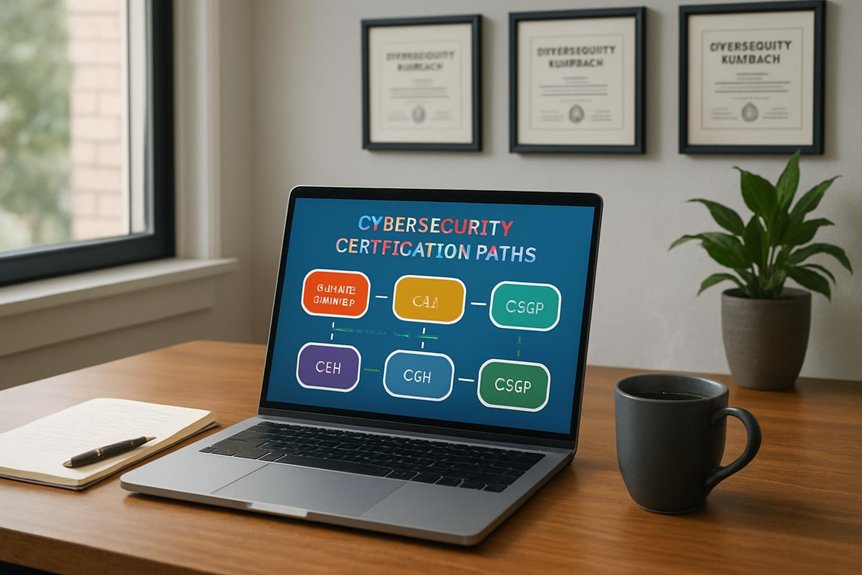
Before diving into cybersecurity certifications, you’ll need to honestly evaluate where you stand regarding knowledge and hands-on experience. Start by conducting a thorough self-assessment of your current cybersecurity skills and understanding of core concepts.
Review common job descriptions in the field, as nearly 50% require at least one certification, giving you insight into industry expectations.
Consider your professional background carefully. Entry-level certifications like CompTIA Security+ typically recommend two years of IT experience focused on security. Advanced certifications demand even more—CISSP requires five years of relevant work experience, though a degree can reduce this requirement.
Entry-level cybersecurity certifications require two years of IT experience, while advanced credentials demand five years of relevant professional background.
If you’re lacking foundational knowledge, engage in foundational cybersecurity courses from providers like CompTIA or (ISC)² before attempting certification exams. This preparation guarantees you’re ready for success.
Choose the Right Certification Based on CMMC Requirements
The CMMC framework demands specific cybersecurity competencies that directly influence which certifications you’ll need to pursue. For CMMC levels 1-3, foundational certifications like Certified in Cybersecurity (CC) provide essential cybersecurity knowledge and compliance understanding. CompTIA Security+ covers core security concepts that align with basic CMMC requirements.
Advanced certifications become vital for CMMC levels 4-5. You’ll need Certified Information Systems Security Professional (CISSP) or Certified Information Security Manager (CISM) to demonstrate complex security management capabilities. These address sophisticated governance skills required at higher maturity levels.
Consider CMMC’s specific domains when selecting certification paths. Access control, incident response, and risk management are key focus areas.
Cybersecurity professionals should choose certifications recognized by the CMMC Accreditation Body to strengthen organizational compliance efforts and enhance overall security posture effectively.
Develop a Structured Study Plan With Official Training Materials
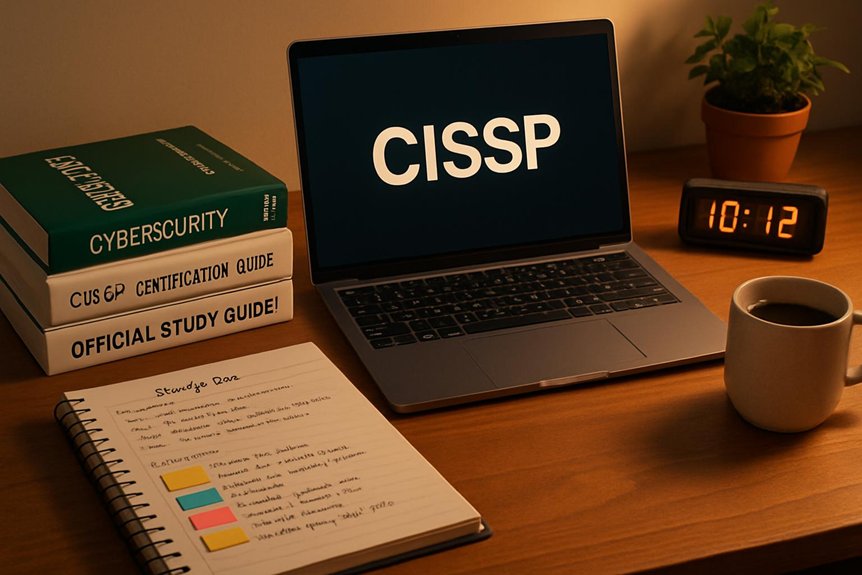
After selecting your target certification, you’ll need to create a thorough study strategy that maximizes your chances of success.
Develop a structured study plan by dedicating 10-15 hours weekly over several months to cover all cybersecurity certification domains. Utilize official training materials like CompTIA’s CertMaster Learn or ISC2’s training resources, as 90% of successful candidates find them essential for exam preparation.
Engage with interactive tools including virtual labs to gain hands-on experience with practical cybersecurity concepts. Incorporate practice exams into your routine—they increase first-time pass rates by 50% and familiarize you with exam formats.
Follow systematic approaches by conducting regular progress reviews and adapting your plan based on understanding. These training resources guarantee extensive preparation for your certification exam.
Gain Hands-On Practice Through Labs and Real-World Scenarios
While theoretical knowledge forms your foundation, hands-on practice through labs and real-world scenarios transforms you into a competent cybersecurity professional.
You’ll develop essential practical skills by engaging in guided problem labs that apply academic learning to actual security challenges.
Virtual labs provide safe environments where you can experiment with tools and techniques without compromising real systems. These cybersecurity labs simulate authentic scenarios you’ll encounter in the cybersecurity field.
Consider joining cybersecurity clubs and hack-a-thons to collaborate with peers and learn from industry professionals.
Pursue internships or part-time IT roles that bridge the gap between classroom theory and workplace reality.
Continuous learning through these practical experiences keeps you current with evolving threats and technologies, ensuring you’re prepared for certification exams and professional success.
Schedule Your Exam and Maintain Ongoing Certification Compliance

Successfully completing your hands-on practice marks the beginning of the final phase in your certification journey. You’ll need to schedule your exam promptly, as popular certifications like CompTIA Security+ fill up quickly. Research specific exam requirements including passing scores and time limits before booking.
Once certified, maintaining certification compliance becomes essential. Track your certification renewal dates—most cybersecurity credentials expire every three years. Your certifying body will require continuing education units through professional development activities.
Stay current by participating in certification-related communities and forums, which help you monitor industry trends and changing requirements. Don’t overlook ongoing education mandates from organizations like (ISC)² or CompTIA.
Budget for renewal fees and plan your continuing education strategy early to guarantee seamless compliance throughout your certification lifecycle.
Frequently Asked Questions
What Is the Best Cybersecurity Certification to Start With?
You’ll find CompTIA Security+ is the best entry-level certification to start with. It’s widely recognized across industries and doesn’t require prerequisites, making exam preparation accessible through online courses and study resources.
With over 63,000 job opportunities requiring this credential, you’ll gain significant career advancement potential. The certification costs are reasonable for the industry recognition you’ll receive, and it provides essential hands-on experience foundations while maintaining long-term certification validity for your cybersecurity journey.
What Are the 5 Steps Cybersecurity?
You’ll follow five core cybersecurity steps:
First, conduct thorough risk assessment to identify vulnerabilities.
Second, implement robust network security measures and security policies for data protection.
Third, deploy threat intelligence systems for proactive monitoring.
Fourth, establish incident response protocols to handle breaches effectively.
Fifth, guarantee compliance standards through regular penetration testing, malware analysis, and ethical hacking practices.
These steps create a thorough security framework that’ll protect your organization’s digital assets and maintain operational integrity.
What Is the Path for Cyber Security Certification?
Ready to climb the cybersecurity certification ladder? Start with entry-level certifications like CompTIA Security+ to master cybersecurity fundamentals, risk assessment, and network security.
Progress to intermediate certifications focusing on ethical hacking, penetration testing, and incident response. Advance to expert-level credentials covering security policies, compliance standards, data protection, and threat intelligence.
You’ll need increasing experience requirements at each level. Research prerequisites, dedicate 10-15 weekly study hours, and align certifications with your career goals.
How to Become Cyber Security Step by Step?
You’ll start by learning cybersecurity fundamentals including network security, cryptography basics, and security frameworks.
Develop skills in risk assessment, incident response, and security policies creation.
Practice ethical hacking and penetration testing through labs and simulations.
Study malware analysis and cloud security concepts.
Gain hands-on experience through internships or entry-level IT roles.
Pursue relevant certifications to validate your knowledge.
Join cybersecurity communities and continuously update your skills as threats evolve.
Conclusion
You’ve navigated the cybersecurity certification maze like a knight preparing for battle. You’ve assessed your armor, chosen your weapon, trained with dedication, sharpened your skills through combat practice, and scheduled your quest. Now you’re ready to defend digital kingdoms against unseen threats. Remember, earning your certification isn’t the end—it’s becoming a guardian who must continuously update their defenses as new dragons emerge from the cyber shadows.