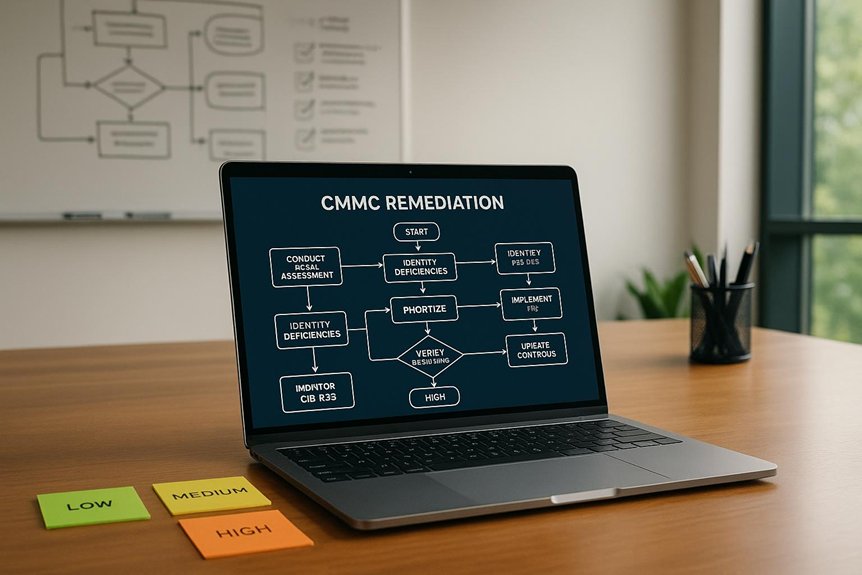
You’ll prioritize CMMC remediation tasks by conducting a thorough gap analysis to identify critical vulnerabilities, then implementing risk-based prioritization that focuses on controls protecting Controlled Unclassified Information (CUI). Establish a phased timeline with clear milestones, leverage existing security infrastructure like SIEM systems and vulnerability scanners, and streamline documentation using standardized templates. Focus on high-impact controls that improve your SPRS score while addressing the most severe compliance gaps within your 9-12 month timeline for maximum efficiency.
Key Takeaways
- Conduct gap analysis against CMMC requirements to identify critical vulnerabilities affecting Controlled Unclassified Information (CUI) protection.
- Implement risk-based prioritization by evaluating threat impact and likelihood to address highest-severity gaps within compliance timelines.
- Establish phased remediation timeline with clear milestones focusing on urgent security controls based on organizational maturity.
- Leverage existing security infrastructure, policies, and monitoring tools to streamline compliance efforts without complete system overhauls.
- Maintain comprehensive documentation using System Security Plans and standardized templates to validate control implementation and demonstrate compliance.
Conducting a Comprehensive Gap Analysis to Identify Critical Vulnerabilities
Before you can effectively address CMMC compliance gaps, you’ll need to conduct a thorough gap analysis that evaluates your current cybersecurity practices against the framework’s specific requirements.
This extensive review examines your existing policies, controls, and documentation to identify critical security vulnerabilities requiring immediate attention.
You should prioritize remediation tasks based on the severity of identified gaps and their potential impact on compliance.
Document all findings in a Plan of Action & Milestones (POA&M) to outline necessary remediation steps and track your progress effectively.
Engaging experienced CMMC practitioners during your gap analysis provides valuable insights for addressing vulnerabilities efficiently.
Their expertise helps you implement adequate security measures while streamlining the remediation process for faster compliance achievement.
Implementing Risk-Based Prioritization for Maximum Security Impact
Once you’ve identified gaps through your thorough analysis, implementing a risk-based prioritization approach becomes crucial for maximizing your security impact and resource allocation.
You’ll need to evaluate potential threats based on their impact and likelihood, focusing your remediation efforts on vulnerabilities that could greatly affect Controlled Unclassified Information (CUI).
Your risk management strategy should combine risk assessments with gap severity to address the most pressing security gaps within your 9-12 month CMMC compliance timeline.
Effective risk management merges assessment data with gap severity to tackle critical security vulnerabilities within your CMMC compliance timeframe.
Utilize SPRS score calculations to identify higher-priority vulnerabilities that are closer to compliance readiness.
Engaging experienced cybersecurity professionals provides valuable insights for prioritizing remediation tasks effectively.
Their expertise guarantees your risk-based prioritization aligns with industry best practices and CMMC requirements, delivering maximum security impact.
Establishing a Phased Remediation Timeline With Clear Milestones
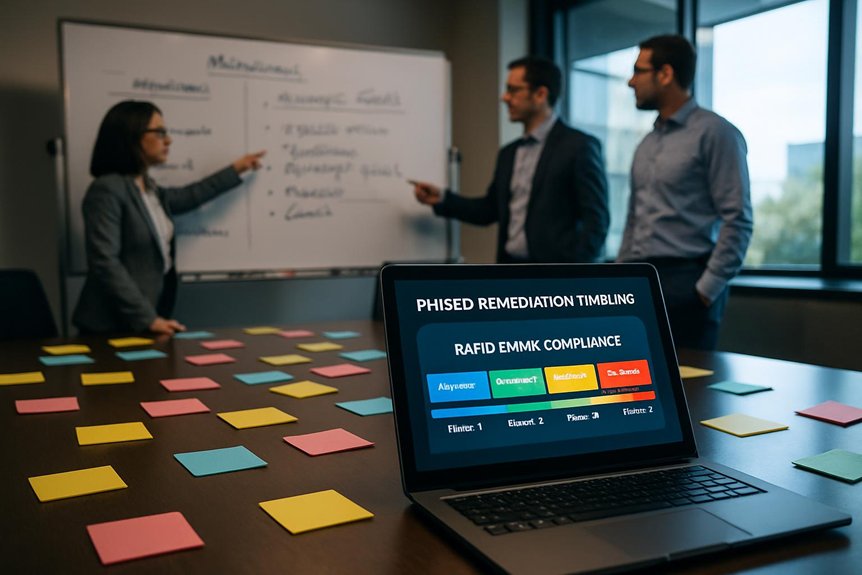
After completing your risk-based prioritization, you’ll need to establish a phased remediation timeline that breaks down the compliance process into manageable stages.
Focus your implementation on security controls based on risk and urgency, considering your company’s size and existing cybersecurity maturity.
Define clear milestones throughout your remediation process, including initial assessments, specific control implementations, and readiness evaluations.
The typical timeline for achieving CMMC Level 2 compliance spans 9-12 months, depending on your organization’s current state.
Schedule regular check-ins to track progress and address obstacles promptly. This guarantees your remediation process stays on track and maintains accountability across all phases.
Finally, conduct a final readiness assessment before your official C3PAO evaluation to confirm all necessary controls and documentation for compliance are properly implemented.
Leveraging Existing Resources and Technologies for Efficient Implementation
While implementing CMMC compliance might seem intimidating, you can greatly reduce costs and accelerate your timeline by strategically leveraging existing cybersecurity tools and technologies.
Start by conducting a thorough assessment of your current security infrastructure to identify existing resources that already support CMMC remediation requirements.
Your vulnerability scanning tools and SIEM systems can immediately begin identifying compliance gaps while providing continuous monitoring capabilities.
Don’t overlook pre-existing policies and procedures—integrate them into your compliance framework to streamline compliance efforts and avoid duplicating work.
Focus on targeted upgrades that enhance security posture without requiring complete system overhauls.
Implement security awareness training programs that empower your team to maximize existing tools’ effectiveness, creating a culture where employees actively contribute to maintaining compliance standards.
Streamlining Documentation and Control Validation Processes
Though documentation requirements can overwhelm organizations pursuing CMMC compliance, you’ll find that implementing standardized templates and formats transforms this challenge into a manageable process.
Streamlining documentation through consistent structures guarantees clarity while supporting your cybersecurity program’s thorough record-keeping needs.
Your System Security Plan (SSP) serves as the foundation for control validation, requiring detailed evidence for implementation of security controls. You’ll need to maintain accurate records that demonstrate compliance during assessments while integrating pre-existing policies to minimize redundancy.
Establish continuous monitoring processes to assess documentation regularly, identifying gaps before they impact compliance efforts. Update records promptly to reflect regulatory updates and program improvements.
This systematic approach maintains ongoing compliance readiness while supporting future audits through well-organized, accessible documentation.
Frequently Asked Questions
What Is the Typical Cost Range for CMMC Remediation Across Different Organizational Sizes?
CMMC remediation costs vary considerably by organizational size impact.
You’ll typically spend $50,000-$200,000 for small businesses, $200,000-$800,000 for medium enterprises, and $1M+ for large corporations.
Budget allocation strategies must account for compliance consulting fees, technology integration costs, training expenses overview, and tool investment options.
You’ll face human resources impact through staffing needs, ongoing maintenance budgets for continuous monitoring, and industry specific variations affecting your total investment requirements.
How Long Does the Average Organization Take to Achieve Full CMMC Compliance?
You’ll plan, you’ll prepare, and you’ll progress through your CMMC compliance timeline at varying speeds depending on your organizational readiness assessment. Most organizations need 12-18 months for full compliance, though cybersecurity maturity levels greatly impact duration.
You’ll find industry specific challenges, resource allocation strategies, and employee training programs affect your timeline. Documentation requirements, continuous monitoring practices, and risk management frameworks require substantial time investment, while executive leadership involvement accelerates progress considerably.
Which Third-Party Vendors Are Most Commonly Used for CMMC Assessment Services?
You’ll find several types of third-party vendors dominating CMMC assessment services. Major cybersecurity service firms like Deloitte, PwC, and KPMG lead the market alongside specialized CMMC compliance consultants.
Third-party auditors from established IT security vendors often partner with assessment tool developers to streamline processes.
Risk management specialists and regulatory advisory firms provide extensive support, while managed security services and compliance training organizations offer ongoing assistance throughout your CMMC journey.
What Are the Most Frequent Reasons Organizations Fail Their Initial CMMC Assessments?
Documentation issues are absolutely crushing organizations during initial CMMC assessments.
You’re typically failing due to compliance gaps in security policies, inadequate technical controls, and training deficiencies among staff.
Poor risk management practices, insufficient resource allocation, and weak employee awareness create significant vulnerabilities.
Your assessment preparedness often lacks proper continuous monitoring systems.
Without thorough documentation proving your controls work effectively, you’ll struggle to demonstrate CMMC compliance requirements successfully.
How Does CMMC Remediation Differ Between Manufacturing and Service-Based Defense Contractors?
Manufacturing challenges involve securing industrial control systems and production networks, while service adaptations focus on protecting client data and intellectual property.
You’ll find compliance procedures differ markedly—manufacturers need specialized technology integration for operational systems, whereas service contractors emphasize documentation requirements for project workflows.
Your employee training programs must address sector specific regulations, and resource allocation varies based on physical versus digital assets.
Both require tailored audit processes and risk management strategies.
Conclusion
You’ll accelerate your CMMC compliance by systematically addressing essential vulnerabilities first through thorough gap analysis and risk-based prioritization. By establishing phased timelines with clear milestones and maximizing existing resources, you’ll streamline your remediation process considerably. Don’t overlook documentation efficiency—it’s vital for validation. Consider this: organizations that implement structured remediation approaches achieve CMMC compliance 40% faster than those using ad-hoc methods. You can’t afford to approach remediation without a strategic framework.