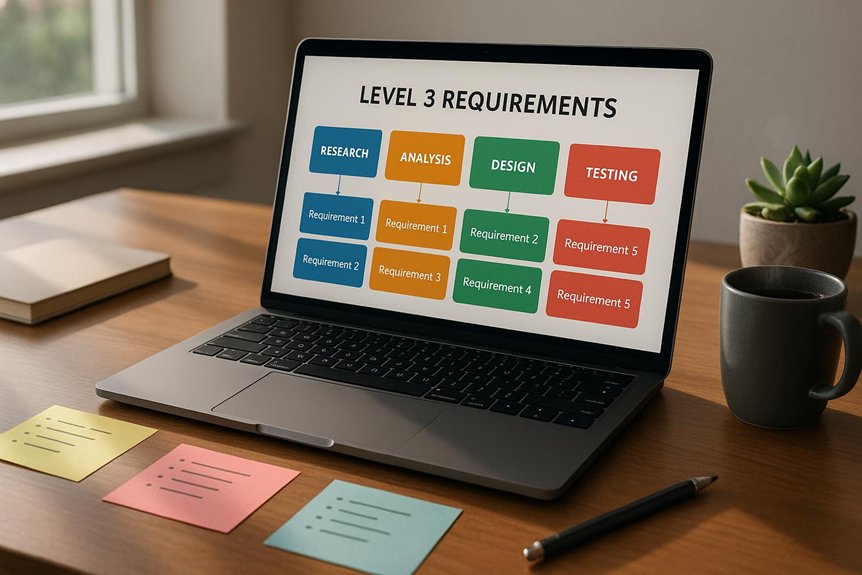
You’ll master CMMC Level 3 requirements faster by focusing on the three foundational pillars—security controls, risk management processes, and continuous monitoring capabilities—rather than getting overwhelmed by all 110 individual requirements at once. Start with a thorough gap analysis of your current security posture, then create a phased implementation timeline spanning several months. Prioritize documentation collection, establish continuous monitoring protocols, and invest in regular staff training through cybersecurity workshops and tabletop exercises to guarantee your organization stays prepared for the formal assessment process ahead.
Key Takeaways
- Conduct a comprehensive gap analysis against all 110 NIST SP 800-171 security requirements to identify implementation deficiencies.
- Break down CMMC Level 3 preparation into manageable phases: assessment, implementation, and continuous monitoring over several months.
- Establish systematic documentation processes with digital platforms to collect evidence for all 17 security control families.
- Implement regular internal audits and self-assessments using structured checklists to mirror formal evaluation processes.
- Invest in ongoing cybersecurity training including phishing simulations and tabletop exercises to ensure team competency.
Understanding the Core Components of CMMC Level 3
Three fundamental pillars form the foundation of CMMC Level 3 certification: extensive security controls, robust risk management processes, and continuous monitoring capabilities.
You’ll need to implement all 110 security requirements from NIST SP 800-171, which represents a significant leap from Level 1 and Level 2 frameworks. Make sure you understand that Level 3 encompasses 17 distinct security control families, including Access Control, Incident Response, and Risk Assessment.
Your organization must establish thorough policies and procedures for protecting Controlled Unclassified Information (CUI) while maintaining compliance with federal regulations.
Comprehensive CUI protection policies and federal compliance procedures are mandatory organizational requirements for maintaining regulatory standards.
Unlike lower certification levels, Level 3 demands documented evidence of effective implementation across every security domain. You’re required to demonstrate mature cybersecurity practices that can withstand rigorous third-party assessment and support DoD contracting opportunities.
Mapping Your Current Security Posture Against Level 3 Standards
Before pursuing CMMC Level 3 certification, you’ll need to conduct a thorough assessment of your organization’s existing security infrastructure against the stringent requirements.
Start by performing a detailed gap analysis that systematically evaluates your current controls against Level 3 standards. This process will reveal critical security gaps that require immediate attention.
Document your findings to identify specific improvement strategies for each deficient area. Focus particularly on incident response procedures, risk management frameworks, and user access controls.
Your risk assessment should prioritize vulnerabilities based on potential impact and likelihood of exploitation.
Create a detailed roadmap that outlines necessary upgrades, policy revisions, and staff training requirements. This systematic approach guarantees you’ll address all Level 3 requirements efficiently while building a robust security foundation for your organization’s sensitive data protection needs.
Developing a Comprehensive Implementation Timeline

Creating an effective implementation timeline requires breaking down your CMMC Level 3 journey into manageable phases with clear milestones and deadlines.
You’ll need to establish a thorough timeline that spans your entire compliance effort, typically lasting several months to a year depending on your organization’s complexity.
Start by mapping out three distinct phases: initial assessment and planning, active implementation, and continuous monitoring.
Schedule daily security practice sessions focusing on different control families, just as you’d dedicate specific time blocks for various exercise sections.
Gather necessary exercise equipment early—security tools, monitoring software, and documentation platforms that’ll facilitate your compliance activities.
Set measurable goals using assessment frameworks to track patient progress throughout implementation.
Plan regular follow-up meetings to evaluate adherence and adjust timelines based on organizational feedback and evolving requirements.
Building Essential Documentation and Evidence Collections
Once you’ve established your implementation timeline, you’ll need to focus on building robust documentation that proves your organization meets CMMC Level 3 requirements. Your documentation strategies must demonstrate thorough clinical decision-making across diverse patient scenarios while maintaining systematic evidence organization.
Effective clinical competencies documentation requires strategic planning and consistent execution. Here’s how to build your evidence collections:
- Maintain thorough patient records that showcase clinical decision-making skills across various presentations and treatment scenarios.
- Collect performance evaluations and feedback from supervising physicians to validate your competency claims with third-party verification.
- Log all clinical encounters systematically, organizing by competency domain or clinical presentation for streamlined assessment reviews.
- Utilize digital platforms to enhance efficiency in collecting, managing, and accessing your documentation during evaluations.
Establishing Continuous Monitoring and Assessment Protocols

While documentation establishes your compliance foundation, establishing continuous monitoring and assessment protocols guarantees your CMMC Level 3 implementation remains effective and adaptive over time.
You’ll need robust monitoring protocols that track system performance and security posture continuously. Implement assessment strategies using standardized evaluation frameworks, similar to how Fugl-Meyer assessments determine appropriate security control levels for different systems.
Create structured logs to monitor adherence to security procedures, ensuring daily compliance activities are completed effectively.
Utilize automated tools for real-time data collection, enhancing your ability to track compliance progress. Patient engagement translates to stakeholder involvement in your security program—consistent feedback during assessments helps you adjust controls based on system responses, optimizing your cybersecurity posture and improving overall security outcomes.
Training Your Team on Advanced Cybersecurity Practices
Effective monitoring systems mean nothing without a well-trained team that can recognize threats and respond appropriately.
A monitoring system is only as strong as the human expertise behind it.
You’ll need to invest in thorough cybersecurity workshops that keep your team current on evolving threats and defensive strategies.
Regular phishing simulations are essential since one in three employees still fall for these attacks without proper training.
Your incident response protocols must be clearly defined and practiced through tabletop exercises so everyone understands their role during a breach.
Key training components you should implement:
- Multi-factor authentication deployment – blocks 99.9% of automated attacks across all systems
- Regular phishing simulations – builds recognition skills for social engineering attempts
- Tabletop exercises – guarantees proper incident response execution
- Continuous threat updates – promotes knowledge sharing culture
Integrating Third-Party Risk Management Requirements

Since your cybersecurity team can’t control every vendor and partner in your supply chain, you’ll need a thorough third-party risk management framework that identifies vulnerabilities before they compromise your systems.
Start with extensive due diligence, conducting background checks and financial stability assessments before onboarding any third party. Implement regular third party evaluations that combine quantitative metrics with qualitative assessments to monitor ongoing risk exposure.
Develop robust risk mitigation strategies that include continuous monitoring through performance audits and compliance reviews.
You’ll want to establish clear contractual agreements that explicitly define risk management expectations, responsibilities, and breach response procedures. These contracts should outline specific security standards and provide mechanisms for addressing identified risks promptly, ensuring your third-party relationships don’t become your organization’s weakest link.
Preparing for the Formal CMMC Level 3 Assessment Process
After establishing thorough third-party risk controls, you’ll face the formal CMMC Level 3 assessment—a rigorous evaluation that determines your organization’s compliance across 130 security practices spanning 17 domains.
Assessors will scrutinize your documentation through interviews, observations, and evidence examination.
Your preparation strategy should include:
- Develop extensive self-assessment strategies that mirror the formal evaluation process
- Create a detailed compliance checklist covering all 130 required security practices
- Conduct regular internal audit cycles to identify and remediate gaps before assessment
- Implement staff training programs focused on CMMC requirements and procedures
You must guarantee continuous monitoring of your security practices to maintain alignment with evolving standards.
Thorough self-assessment increases your likelihood of passing while establishing sustainable compliance frameworks for future assessments.
Maintaining Compliance Through Ongoing Security Controls

While passing your CMMC Level 3 assessment marks a significant milestone, maintaining compliance requires establishing robust ongoing security controls that operate continuously.
You’ll need continuous monitoring systems to detect breaches in real-time and respond swiftly to maintain regulatory adherence. Regular software updates and patches are essential for mitigating vulnerabilities and ensuring security control effectiveness.
Conduct periodic risk assessments to identify gaps and implement necessary controls using proven risk mitigation techniques. Train your employees consistently on security policies, fostering a compliance culture where everyone understands their responsibilities.
Document and review your security controls regularly, creating clear audit trails that demonstrate compliance during future assessments.
Establish compliance measurement strategies that track your organization’s security posture continuously, ensuring you’re always assessment-ready.
Leveraging Technology Solutions to Meet Level 3 Objectives
Although manual processes can handle basic CMMC Level 3 requirements, you’ll accelerate compliance and reduce operational burden by implementing strategic technology solutions.
Strategic technology solutions transform CMMC Level 3 compliance from a manual burden into an accelerated, streamlined process.
These digital tools enhance your security posture while streamlining documentation and monitoring processes.
Consider these technology-driven approaches to strengthen your Level 3 compliance:
- Deploy tablet monitoring solutions for real-time tracking of security control implementation and adherence across your organization’s endpoints and network infrastructure.
- Implement interactive training modules that demonstrate proper cybersecurity protocols, ensuring your team understands and follows essential security practices consistently.
- Establish digital progress tracking systems to monitor compliance milestones, document remediation efforts, and maintain audit trails for assessors.
- Collaborate with specialized security technology developers to create customized platforms that address your organization’s unique Level 3 requirements and operational challenges.
Frequently Asked Questions
What Are the Typical Costs Associated With Achieving CMMC Level 3 Certification?
You’ll face significant expenses when pursuing CMMC Level 3 certification.
Your cost breakdown typically includes $50,000-$200,000 for technology upgrades, $25,000-$75,000 in certification fees, plus ongoing compliance costs.
You’ll need effective budgeting strategies since consultant fees range $150-$300 hourly, and staff training costs $5,000-$15,000.
Don’t forget annual maintenance expenses of $20,000-$50,000.
You’re looking at total first-year investments between $150,000-$500,000 depending on your organization’s size and current security posture.
How Long Does CMMC Level 3 Certification Remain Valid Before Renewal Is Required?
Your CMMC Level 3 certification remains valid for three years from the date it’s issued.
You’ll need to undergo the complete renewal process before this validity period expires to maintain your certification status.
The certification timeline requires you to start planning for renewal well in advance, as the assessment process can take several months.
You can’t let your certification lapse if you want to continue working on DoD contracts requiring Level 3 compliance.
Can Organizations Skip Level 2 and Go Directly to Level 3 Certification?
You can’t skip Level 2 and jump directly to Level 3 CMMC certification.
The certification process overview requires sequential progression through each maturity level. Level skipping implications include missing foundational security controls and practices essential for higher levels.
While exploring alternative pathways might seem appealing, CMMC’s structured approach guarantees you’ve properly implemented and matured cybersecurity practices at each stage before advancing to more complex requirements.
What Happens if We Fail the Initial CMMC Level 3 Assessment?
If your assessment doesn’t go as planned, you’ll face certification implications that temporarily delay your goals.
You’ll need to develop thorough remediation strategies addressing identified gaps before pursuing the reassessment process. Your organization can’t bid on certain contracts until you’re certified, so you’ll want to work closely with your assessor to understand deficiencies.
Most organizations use this setback as valuable learning, strengthening their cybersecurity posture for successful certification.
Are There Specific Industry Sectors Exempt From CMMC Level 3 Requirements?
You won’t find specific industry sectors that are exempt from CMMC Level 3 requirements.
The exemptions aren’t based on your industry but rather on the type of defense contracts you’re pursuing.
If you’re handling Controlled Unclassified Information (CUI), you’ll face these compliance challenges regardless of whether you’re in aerospace, manufacturing, or IT services.
All exempt sectors must meet the same rigorous industry standards when working with sensitive defense data.
Conclusion
You’ve now equipped yourself with the roadmap to tackle CMMC Level 3‘s demanding requirements. Remember, organizations that achieve Level 3 compliance see an average 40% reduction in cybersecurity incidents within the first year. You’ll need to stay committed to continuous improvement and regular assessments. Don’t underestimate the time investment—most companies require 12-18 months for full implementation. Start with your current security posture assessment and you’ll build momentum toward successful certification.