
Start by determining your required CMMC level based on your defense contracts, then conduct a thorough gap analysis against applicable security controls. You’ll need extensive documentation including a System Security Plan, plus employee cybersecurity training to address human vulnerabilities. Partner with experienced CMMC consultants for expert guidance, develop realistic timelines and budgets, and prepare with mock audits before third-party assessments. These strategic steps will transform your certification journey from overwhelming challenge into manageable competitive advantage.
Key Takeaways
- Identify your required CMMC level by checking defense contracts for DFARs 252.204-7012 references to focus resources appropriately.
- Conduct thorough gap analysis against all applicable security controls to identify weaknesses before third-party assessments.
- Develop comprehensive System Security Plans and document all cybersecurity policies to meet strict CMMC documentation requirements.
- Partner with experienced CMMC consultants and managed service providers for expert guidance throughout the certification process.
- Implement regular employee cybersecurity training and conduct mock audits to prepare for official assessments.
Understand Your Required CMMC Level Before Starting the Certification Process
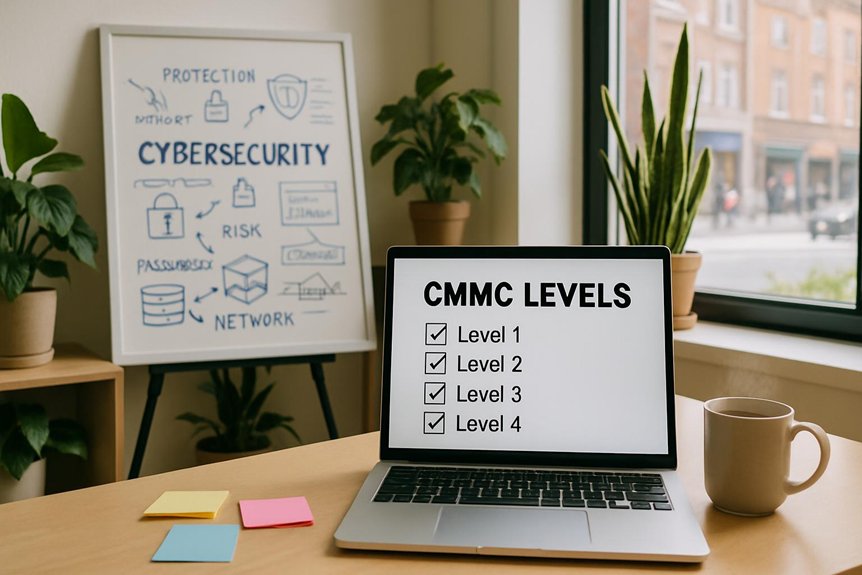
Before diving into the certification process, you must determine which CMMC level applies to your business based on the types of information you’ll handle in defense contracts.
Small businesses in the Defense Industrial Base face three compliance levels. Level 1 requires basic cybersecurity practices for Federal Contract Information and allows self-assessments. Levels 2 and 3 demand third-party assessments, with Level 2 following NIST SP 800-171 standards for Controlled Unclassified Information.
Check your contracts for DFARs 252.204-7012 references, which indicate CMMC compliance requirements. The simplified three-level framework makes identifying your required CMMC level more straightforward than previous models.
Understanding your specific level upfront allows you to allocate resources effectively and focus on implementing the precise cybersecurity practices needed for successful certification.
Conduct a Comprehensive Gap Analysis to Identify Security Weaknesses
Once you’ve identified your required CMMC level, you’ll need to evaluate how your current cybersecurity practices measure up against the specific requirements.
A thorough gap analysis will assess your existing security measures against CMMC compliance standards, helping you identify areas where improvements are needed.
For CMMC Level 2, you’ll need to review all 110 security controls outlined in NIST SP 800-171.
Consider engaging a cybersecurity consultant who can provide expert insights and help prioritize your remediation efforts based on risk assessments.
Document your findings thoroughly, as they’ll form the foundation for developing your System Security Plan.
Don’t treat this as a one-time effort—conduct regular gap analyses to adapt to evolving threats and CMMC updates, ensuring ongoing compliance.
Implement Strong Documentation Practices for All Security Controls
While conducting your gap analysis reveals where improvements are needed, implementing strong documentation practices guarantees you can prove compliance during CMMC assessments.
Poor documentation leads to audit failures and certification delays, making thorough record-keeping essential for meeting documentation requirements.
Your documentation strategy should include:
- Develop a detailed System Security Plan (SSP) that details all security controls and cybersecurity policies, serving as your compliance foundation.
- Document incident responses and security assessments with clear, accessible records that demonstrate your adherence to compliance requirements.
- Create written policies addressing security gaps ensuring all employees understand their roles in maintaining CMMC compliance.
- Schedule regular updates to documentation as threat landscapes evolve and compliance requirements change, keeping your strong documentation practices current and effective.
Partner With Experienced CMMC Consultants or Managed Service Providers
Even with thorough documentation in place, maneuvering through CMMC’s complex requirements can overwhelm small business teams who lack specialized cybersecurity expertise.
CMMC consultants offer tailored guidance that simplifies compliance processes and helps you navigate CMMC 2.0’s specific requirements effectively. Managed service providers with CMMC expertise can implement necessary cybersecurity controls while reducing burden on your internal teams.
Experienced consultants conduct extensive assessments to identify compliance gaps, allowing you to address vulnerabilities before formal evaluations. They provide ongoing support and training, ensuring your employees maintain compliance with evolving cybersecurity standards.
Many consulting firms have proven track records guiding organizations through the certification process successfully. This expertise can greatly enhance chances of obtaining certification on your first attempt, making professional partnerships invaluable for small businesses.
Invest in Employee Cybersecurity Training and Awareness Programs

Since human error accounts for approximately 90% of data breaches, your employees represent both your greatest cybersecurity vulnerability and your strongest defense against threats.
Investing in thorough employee cybersecurity training is essential for meeting CMMC requirements and protecting Federal Contract Information.
Regular security awareness training can increase your team’s threat recognition by up to 75%, directly supporting your compliance efforts:
- Implement basic cybersecurity hygiene practices – Train employees on password management, software updates, and safe browsing habits required for CMMC Level 1
- Conduct simulated phishing attacks – Help staff identify and respond to real cyber threats through hands-on experience
- Use real-world scenarios – Make training relevant to your small business’s specific risks and vulnerabilities
- Foster a security culture – Encourage ongoing awareness that strengthens your overall cybersecurity posture
Develop a Realistic Timeline and Budget for Your Certification Journey
Planning serves as the cornerstone of successful CMMC certification, and developing a realistic timeline and budget will make the difference between a smooth compliance journey and costly setbacks.
You’ll need 1-3 months for Level 1 self-assessments, 6-12 months for Level 2, and 12-18 months for Level 3 CMMC compliance. Your budget must account for gap analyses, cybersecurity practices implementation, consulting fees, and third-party assessment costs.
Small businesses should consider phased implementation through POA&M strategies, allowing gradual investment while addressing critical gaps.
With compliance deadlines starting Q1 2025, you can’t afford delays. Engage experienced CMMC consultants early to refine your timeline and prevent overspending. This strategic approach guarantees adequate preparation without overwhelming your resources during your certification journey.
Prepare Thoroughly for Third-Party Assessments With Mock Audits
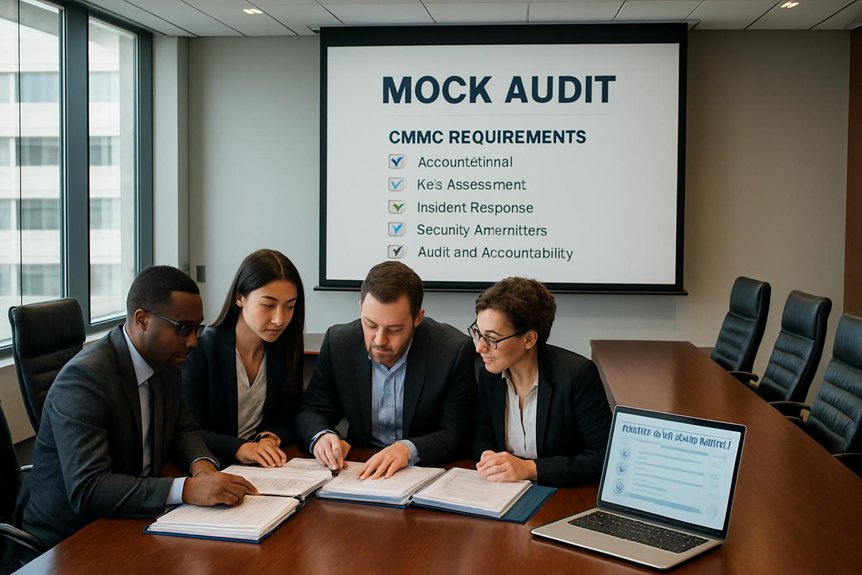
Mock audits represent your most powerful weapon for ensuring third-party assessment success, transforming potential surprises into manageable checkpoints along your certification path.
These simulated assessments help small businesses identify compliance gaps and strengthen cybersecurity practices before facing actual CMMC certification evaluations.
Your preparation strategy should include:
- Schedule multiple mock audits to track progress and make necessary adjustments to documentation and procedures over time.
- Engage experienced consultants who provide valuable insights and feedback specific to your CMMC level requirements.
- Focus on documentation gaps by ensuring all policies and procedures are clearly documented and easily accessible.
- Target specific CMMC levels particularly Level 2 and Level 3 requirements, to streamline your certification process.
Mock audits build confidence while revealing areas needing improvement before third-party assessments begin.
Frequently Asked Questions
Is CMMC Certification Hard?
CMMC certification challenges can seem overwhelming, but it’s not insurmountably hard. Certification process complexity varies by level—Level 1’s self-assessment is manageable, while Levels 2-3 present greater compliance barriers overview.
Small business struggles often stem from limited IT expertise and documentation necessities. You’ll find success through proper certification preparation tips, understanding CMMC levels thoroughly, and recognizing security measures importance.
Training resources availability and consulting services help you navigate CMMC requirements effectively, making certification achievable with dedicated effort.
Can You Self-Certify for CMMC?
Think of self-certification as your training wheels for cybersecurity compliance.
You can self-certify for CMMC Level 1 through a streamlined self certification process that covers 17 basic practices protecting Federal Contract Information. This approach eliminates third party audits and reduces compliance challenges for small businesses.
However, you’ll need proper documentation necessities and must follow cybersecurity best practices.
How to Achieve CMMC Compliance?
To achieve CMMC compliance, you’ll start with a thorough CMMC requirements overview and develop a compliance roadmap essentials plan.
Address common compliance challenges by implementing security best practices and risk management strategies.
Create an essential documentation checklist, establish employee training programs, and set up continuous monitoring techniques.
Follow the certification process timeline, prepare for third party assessments, and maintain ongoing documentation to make certain you’re ready for evaluation.
How Much Does It Cost to Get CMMC Certified?
CMMC certification costs vary greatly based on your required level.
You’ll face initial expenses of $15,000-$30,000 for Level 2 preparation, plus $10,000-$50,000 for third-party assessments.
When budgeting for CMMC, consider hidden costs like cybersecurity tools and training.
Financial planning tips include exploring grants for compliance and small business financing options.
Managed service providers offer cost-effective solutions at $1,000-$3,000 monthly.
Don’t forget ongoing CMMC compliance expenses of $5,000-$10,000 annually for maintenance and audits.
Conclusion
You’ve got the roadmap to CMMC certification success, but remember—this isn’t about checking boxes on parchment with a quill pen. It’s about building genuine cybersecurity resilience that’ll protect your business and your clients’ sensitive data. Don’t rush the process or cut corners. Take each step seriously, invest in the right resources, and you’ll emerge with more than just certification—you’ll have a robust security foundation that’s truly worth defending.