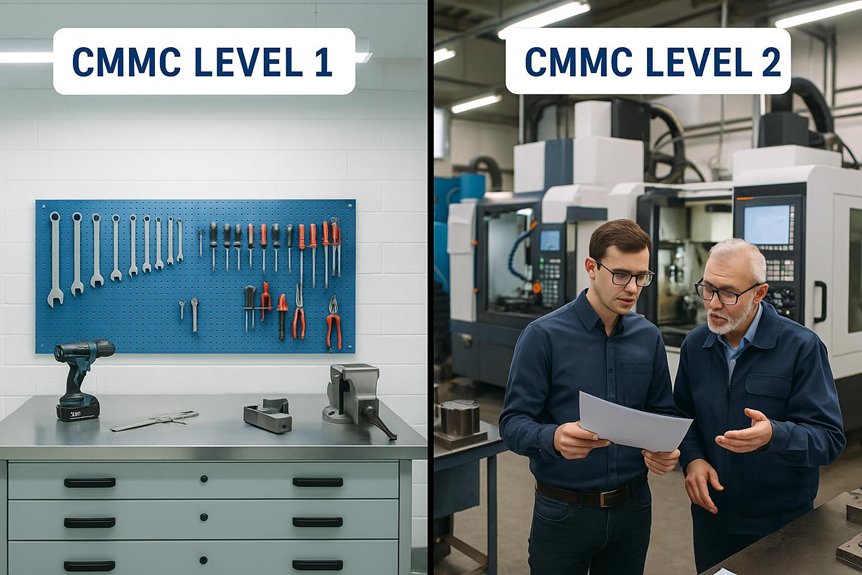
Your machine shop’s CMMC level depends on the information you handle. You’ll need Level 1 (17 basic practices, self-assessment) for Federal Contract Information or Level 2 (110 advanced controls, third-party assessment) for Controlled Unclassified Information. Level 1 costs less with annual self-assessments, while Level 2 requires expensive third-party evaluations every three years but opens more lucrative contract opportunities. Starting fiscal year 2025, proper certification becomes mandatory for DoD contracts, making this decision essential for your competitive positioning.
Key Takeaways
- Level 1 requires 17 basic practices for FCI protection; Level 2 demands 110 advanced controls for CUI safeguarding.
- Level 1 uses annual self-assessments while Level 2 requires costly third-party assessments every three years.
- Choose Level 1 if handling Federal Contract Information only; Level 2 is mandatory for Controlled Unclassified Information.
- Level 2 compliance costs significantly more due to third-party assessment fees and extensive cybersecurity infrastructure requirements.
- Both levels become mandatory for DoD contract bidding starting fiscal year 2025, affecting competitive positioning.
Understanding CMMC Requirements for Machine Shops
When your machine shop pursues defense contracts, you’ll need to understand which CMMC level applies to your operations based on the type of information you handle.
If you process only Federal Contract Information (FCI), Level 1 compliance suffices with 17 basic cybersecurity requirements and annual self-assessments.
However, handling Controlled Unclassified Information (CUI) mandates Level 2 certification, requiring implementation of 110 practices aligned with NIST SP 800-171.
The distinction matters considerably for your defense contracting eligibility. Level 2 demands third-party assessments every three years, creating more rigorous compliance obligations than Level 1’s streamlined approach.
You must accurately identify your information types because processing CUI without proper certification disqualifies you from DoD contracts.
Understanding these cybersecurity requirements guarantees you choose the appropriate CMMC path for sustainable defense contracting success.
Starting in fiscal year 2025, no bidding on DoD contracts will be permitted without proper certification, and contractors should review contracts for DFARS 252.204-7012 references that indicate compliance requirements.
CMMC Level 1: Basic Cybersecurity for Federal Contract Information
Since your machine shop handles only Federal Contract Information like delivery schedules and pricing data, CMMC Level 1 provides the appropriate cybersecurity framework without overwhelming complexity.
CMMC Level 1 delivers essential cybersecurity protection for machine shops handling federal contract data without unnecessary operational burden.
This certification level implements 17 basic safeguarding practices designed specifically for small contractors who need foundational cybersecurity hygiene without extensive overhead.
You’ll focus on essential security requirements including robust password policies, physical access controls, and regular system updates. These practices align with Federal Acquisition Regulation Clause 52.204-21, ensuring you meet government standards for protecting Federal Contract Information (FCI).
The most attractive aspect of CMMC Level 1 is its annual self-assessment requirement. You won’t need costly third-party evaluations, making basic cybersecurity compliance accessible and manageable.
This streamlined approach helps your machine shop demonstrate security readiness while maintaining operational efficiency and controlling certification costs.
New sentence: Annual self-assessments must be affirmed by a senior company official and submitted to the Supplier Performance Risk System to document ongoing compliance.
CMMC Level 2: Advanced Protection for Controlled Unclassified Information
CMMC Level 2 steps up dramatically from basic safeguarding practices to protect Controlled Unclassified Information (CUI) – the sensitive technical data, engineering specifications, and proprietary information that flows through defense contractor networks.
You’ll need to implement 110 cybersecurity practices based on NIST SP 800-171 framework, covering critical domains like access control, awareness training, and audit accountability.
This advanced security level requires third-party assessments every three years to verify compliance with CMMC requirements.
You can’t self-certify anymore – independent assessors will evaluate your robust protection measures against cyber threats.
Achieving compliance with CMMC Level 2 isn’t just about security; it’s essential for maintaining your competitive edge in the defense contracting marketplace where handling CUI is standard business practice.
While Level 2 focuses on NIST SP 800-171, contractors pursuing Level 3 must also implement Zero Trust Architecture and continuous monitoring as part of 24 additional advanced controls.
Key Differences Between Level 1 and Level 2 Compliance
Although both CMMC levels aim to strengthen cybersecurity across the defense industrial base, the gap between Level 1 and Level 2 compliance represents a considerable leap in security rigor and organizational commitment.
Level 1 compliance requires implementing 17 basic cybersecurity practices through annual self-assessments, while Level 2 compliance demands 110 advanced security controls based on NIST SP 800-171 standards. You’ll face third-party assessments every three years for Level 2, greatly increasing compliance complexity and costs.
The fundamental distinction lies in data sensitivity: Level 1 protects basic Federal Contract Information, whereas Level 2 safeguards Controlled Unclassified Information (CUI).
Defense contractors handling sensitive data must navigate this 600% increase in required practices, transforming from foundational cyber hygiene to extensive security frameworks protecting critical defense information.
Pursuing Level 2 early can provide a competitive advantage by positioning your shop favorably for DoD contracts and building trust with prime contractors through independently validated cybersecurity.
Assessing Your Machine Shop’s Information Handling Requirements
When determining your machine shop’s CMMC requirements, you’ll need to carefully evaluate the specific types of information flowing through your operations.
If you’re handling Federal Contract Information (FCI) like basic contract details, CMMC Level 1 certification with 17 fundamental security practices will suffice.
However, processing Controlled Unclassified Information (CUI) such as technical drawings or proprietary designs requires CMMC Level 2 compliance, implementing 110 cybersecurity measures aligned with NIST SP 800-171.
Examine your contract portfolio’s sensitivity of information and volume. Higher-sensitivity projects typically demand enhanced certification requirements.
Audit your current cybersecurity measures to identify gaps between existing protocols and required security practices. This assessment determines whether your machine shop needs basic Level 1 protections or thorough Level 2 safeguards for regulatory compliance.
For a cost-effective and scalable path, consider a Secure Outsourced Enclave that can address most controls while minimizing disruption to daily operations.
Cost-Benefit Analysis: Investment Vs Contract Opportunities
After identifying your machine shop’s specific CMMC requirements, you’ll need to weigh the financial investment against potential contract opportunities. This cost-benefit analysis determines whether CMMC Level 1 or Level 2 compliance delivers ideal returns.
Consider these financial factors:
- CMMC Level 1 costs $60K-$80K for Federal Contract Information handling, granting access to basic DoD contracts.
- CMMC Level 2 requires $100K-$200K investment for Controlled Unclassified Information processing, opening up considerably more contract opportunities.
- Non-compliance risks include losing existing DoD contracts and missing future opportunities in the defense marketplace.
Your investment extends beyond compliance costs. Enhanced cybersecurity protections can reduce insurance premiums and prevent costly data breaches.
With 1-1.5 years needed for audit readiness, strategic planning guarantees you’ll capitalize on expanded contract opportunities while building long-term business resilience.
Additionally, remember that third-party assessment fees for Level 2 can be substantial, with limited C3PAO availability driving higher costs and longer timelines.
Self-Assessment Vs Third-Party Certification Requirements
Your compliance level depends on information type—handling Controlled Unclassified Information (CUI) requires Level 2 certification requirements.
Level 1 self-assessments must follow DoD criteria with proper documentation, while Level 2 third-party assessments involve thorough technical controls reviews, determining your certification pathway.
CMMC 2.0 features a streamlined three-level framework, and Level 2 aligns with NIST SP 800-171 requiring 110 practices and typically third-party assessments.
Building Your CMMC Compliance Implementation Plan
Once you’ve determined your compliance level, developing a structured implementation plan becomes crucial for achieving CMMC certification efficiently.
Your machine shop needs a systematic approach to address CMMC Level 1 or CMMC Level 2 requirements effectively.
Your CMMC compliance implementation should follow these critical steps:
- Conduct thorough assessment – Evaluate your current cybersecurity posture against NIST 800-171 security practices, identifying gaps in protecting sensitive data and systems.
- Develop System Security Plan – Create detailed documentation outlining how you’ll implement required security practices, including physical access controls and monitoring procedures.
- Prepare for certification process – Document all policies and procedures for self-assessment or engage accredited C3PAOs for third-party assessments, depending on your target compliance level.
This structured approach guarantees your machine shop meets CMMC requirements systematically.
Engage an accredited C3PAO early to understand assessment methodology, conduct mock audits, and schedule your evaluation through The Cyber AB Marketplace.
Preparing for Future Defense Contract Success
As the defense contracting landscape becomes increasingly competitive, machine shops that proactively align their cybersecurity infrastructure with CMMC requirements position themselves for sustained success in government markets.
You’ll need to evaluate whether you handle Controlled Unclassified Information (CUI) or just Federal Contract Information (FCI) to determine if CMMC Level 1 or CMMC Level 2 compliance best serves your objectives.
Investing in robust cybersecurity practices now gives you a competitive edge as compliance requirements tighten.
Proactive cybersecurity investments today create tomorrow’s competitive advantages as defense contracting compliance standards continue to evolve and strengthen.
While CMMC Level 1 involves self-assessments, CMMC Level 2 requires third-party assessments every three years, demanding thorough preparation.
Machine shops pursuing defense contracts should view CMMC compliance as a strategic investment rather than a regulatory burden, opening doors to lucrative government opportunities while safeguarding sensitive information throughout the supply chain.
For planning purposes, note that CMMC 2.0 requires Level 1 annual self-assessments and Level 2 third-party assessments aligned to 110 NIST SP 800-171 controls.
Frequently Asked Questions
What Is the Difference Between Level 1 and Level 2 CMMC?
You’ll find CMMC Level 1 requires 17 basic practices for Federal Contract Information, while Level 2 demands 110 stringent controls for Controlled Unclassified Information.
Level 1 allows self-assessments with lower implementation costs, but Level 2 needs third-party verification, creating greater compliance challenges.
Your cybersecurity maturity advances markedly between levels, with Level 2’s assessment processes aligning to NIST standards, extending certification timelines and requiring enhanced risk management capabilities.
Who Needs CMMC Level 1?
Are you handling basic Federal Contract Information without sensitive data?
You’ll need CMMC Level 1 if you’re a machine shop providing fundamental services like maintenance or basic manufacturing for government contracts.
These CMMC requirements establish essential cybersecurity framework foundations with manageable cost implications.
The compliance benefits include maintaining contract eligibility while implementing straightforward risk management practices.
Level 1’s self-assessment approach and basic training programs make implementation strategies accessible for smaller operations meeting industry standards.
What Is the Difference Between CMMC and Soc2?
CMMC requirements target defense contractors protecting government data through mandatory cybersecurity standards, while SOC 2 compliance focuses on service organizations managing customer information.
You’ll find CMMC emphasizes security controls for sensitive federal data with required third-party audits, whereas SOC 2 offers flexible audit processes covering broader data protection areas.
Both compliance frameworks strengthen your risk management, but CMMC’s industry relevance centers on defense work, while SOC 2 provides certification benefits for tech services.
Can You Self Assess CMMC Level 2?
You can’t typically use CMMC self assessment for Level 2 compliance verification since third-party assessments are required.
However, you should conduct internal self-assessments using self assessment tools to prepare for certification process. Focus on compliance documentation, implementing security controls, and audit preparation.
These implementation strategies help identify gaps in Level 2 requirements while supporting risk management and continuous monitoring before your official third-party assessment.
Conclusion
You’re now equipped to navigate the CMMC waters and chart your machine shop’s course toward defense contracting success. Whether you’re pursuing Level 1’s foundational protections or Level 2’s extensive security framework, you’ll need to align your cybersecurity investments with your business goals. Don’t let compliance requirements become roadblocks—transform them into stepping stones that’ll open doors to lucrative federal contracts and long-term growth opportunities.