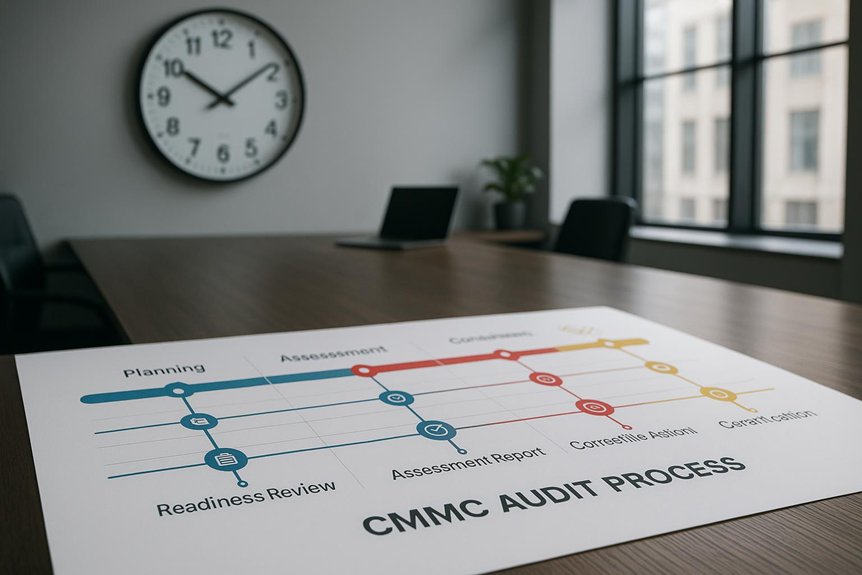
Your CMMC certification timeline will range from 30 days to 24 months depending on your readiness level and complexity. Level 1 self-assessments can be completed quickly if you’re prepared, while Levels 2 and 3 require third-party evaluations that typically take 6-12 months. The process includes gap analysis, remediation, implementation, and assessment phases, with preparation being essential for success. Understanding each phase’s requirements and potential bottlenecks will help you plan your certification journey more effectively.
Key Takeaways
- CMMC certification timeline ranges from 30 days to 24 months depending on compliance level and organizational readiness.
- Three-month preparation period includes gap analysis, remediation planning, security controls implementation, and C3PAO scoping calls.
- Final documentation submission occurs 21 days before assessment, followed by intensive evaluation week with three possible outcomes.
- Conditional certification allows 180 days for remediation with maximum 10 business days per POA&M item.
- Timeline factors include current cybersecurity posture, resource availability, IT infrastructure complexity, and C3PAO scheduling constraints.
Understanding the CMMC Certification Process Overview
When you’re preparing for CMMC certification, understanding the process timeline becomes essential for strategic planning and resource allocation. Your certification journey can range from 30 days to 24 months, depending on which of the three certification levels you’re pursuing and your organization’s current cybersecurity readiness.
The process involves several critical phases: conducting a thorough gap analysis, developing remediation plans, implementing required security controls, and performing internal audits.
Success in CMMC certification requires methodical execution of gap analysis, remediation planning, security control implementation, and comprehensive internal auditing.
You’ll need to meet specific assessment criteria that vary by level, with Level 1 allowing self-assessment while Levels 2 and 3 require third-party evaluations.
Your timeline depends on organizational size, existing security practices, available resources, and C3PAO availability. Proper preparation greatly impacts your certification success and duration. Additionally, contractors should confirm whether their contracts include DFARS clauses, which directly dictate the required CMMC level and assessment type.
Pre-Assessment Preparation: The Critical 3-Month Foundation Period
Once you’ve decided to pursue CMMC certification, the three-month pre-assessment preparation period becomes your most critical foundation phase. This timeframe allows you to align your security measures with compliance requirements while implementing effective preparation strategies.
Key preparation activities include:
- Upload essential documentation – Submit current SSPs, networking diagrams, and policies before your initial C3PAO scoping call.
- Ensure documentation accuracy – Verify your System Security Plan accurately reflects actual security implementations to prevent costly “false starts.”
- Participate in weekly planning meetings – Collaborate with your C3PAO post-scoping to develop your Assessment Plan, covering logistics and scheduling.
You’ll want to implement a change freeze during final preparation stages, ensuring your environment remains consistent with submitted documentation throughout the assessment process. Additionally, confirm whether your contracts involve CUI to determine if CMMC Level 2 with its NIST SP 800-171 aligned practices and likely third-party assessment applies during this phase.
Scoping Calls and Assessment Plan Development Timeline
The formal CMMC assessment process begins with your scoping call, scheduled 60-90 days before your actual assessment date. This 90-minute session with your C3PAO discusses your information system and data flow, highlighting the scoping call importance for assessment success. You’ll need to upload your current System Security Plan, networking diagrams, policies, and procedures beforehand to facilitate productive discussions. Following your scoping call, assessment plan development begins through weekly meetings with your C3PAO. These sessions establish logistics, identify assessors, and create your assessment week schedule. Your C3PAO will finalize the Assessment Plan 14 days before your assessment, confirming all necessary details. Additionally, if you’re requiring an on-site assessment, travel arrangements get confirmed 30 days prior, ensuring smooth coordination between all parties involved. To prepare effectively, small businesses should conduct a gap analysis and develop a detailed System Security Plan well before the scoping call to streamline assessment planning.
Final Evidence Submission and Documentation Requirements
Twenty-one days before your scheduled CMMC assessment, you must submit all final evidence and documentation to your C3PAO for review.
This critical deadline guarantees your assessor can thoroughly examine all materials before the actual assessment begins. Meeting documentation standards requires meticulous preparation and organization to prevent delays that could force rescheduling. Ensure your submission includes objective evidence mapped to the 320 assessment objectives so assessors can validate implementation claims efficiently.
Your final evidence submission must include:
- Updated Security System Plan (SSP) with current network diagrams and system configurations
- Complete policies and procedures aligned with your target CMMC level requirements
- Implementation evidence demonstrating how controls are actively functioning in your environment
Once you’ve submitted your final evidence, you’ll need to implement a change freeze on your environment.
This guarantees consistency between your documented systems and the actual configuration your assessor will evaluate during the assessment week.
The Assessment Week: What Happens During Active Evaluation
When your assessment week arrives, you’ll enter the most intensive phase of the CMMC certification process. This week-long evaluation period involves thorough assessment activities where C3PAO assessors review your submitted documentation, conduct detailed interviews with key personnel, and perform meticulous evaluations of your security practices either on-site or virtually.
You’ll need effective communication strategies throughout this period, maintaining regular contact with your C3PAO to address questions and resolve issues quickly. It’s essential that your environment exactly matches your submitted documentation, so implement a change freeze beforehand to prevent discrepancies.
The C3PAO schedules assessments back-to-back for efficiency, meaning you must be fully prepared and available during your designated timeframe. Your responsiveness and preparation during this intensive week directly impact your certification success.
To support a successful assessment, ensure your team can speak to NIST SP 800-171 control implementation details and demonstrate robust logging and monitoring practices aligned with CMMC expectations.
Post-Assessment Outcomes and Supplemental Evidence Deadlines
Once your assessment week concludes, you’ll face one of three distinct outcomes that determine your next steps and timeline requirements.
Your C3PAO will deliver one of these results:
- Full certification – You’ve met all requirements and can proceed with contract bidding.
- Conditional certification – You’ll receive certification but must close all POA&M items within 180 days.
- Failure – Your organization didn’t meet minimum standards and must restart the process.
If your initial score falls below 110, you’ve got exactly 10 business days for evidence submission to potentially improve your results. This window is essential for your post assessment strategies.
For conditional certifications, you must remediate all identified POA&M items before scheduling your close-out assessment.
Your C3PAO then performs a quality review and uploads results to eMASS within 10 business days.
Note that for CMMC Level 2 assessments, organizations must undergo third-party assessments by an accredited C3PAO, and any remaining gaps may be remediated within a 90-day period when applicable.
Managing POA&M Items and the 180-Day Close-Out Period
Conditional certification brings immediate relief, but your real work begins with managing the 180-day countdown to close out all POA&M items.
You’ll need solid POA&M management to track every identified deficiency and maintain your certification status.
Your remediation strategies must address each item systematically within the maximum 10 business days allocated for completing requirements.
Maximum 10 business days per POA&M item – systematic remediation strategies are essential for maintaining conditional certification status.
Once you’ve implemented fixes, you’ll schedule a close-out assessment with your C3PAO to verify remediation efforts.
The C3PAO Quality Assurance team performs a thorough quality review of your work and uploads results to eMASS.
Remember, all POA&M items must be fully remediated before the 180-day deadline expires.
Missing this critical timeframe means losing your conditional certification status and potentially restarting the entire assessment process.
To stay ahead of deadlines, establish continuous monitoring protocols with your MSSP to track remediation progress and sustain compliance momentum.
Factors That Impact Your Overall CMMC Timeline
While you’ve mapped out your assessment strategy, several key factors will ultimately determine how quickly you’ll achieve CMMC certification.
Your organization’s current cybersecurity posture serves as the foundation for your timeline. Resource availability plays a vital role—having dedicated internal staff with cybersecurity expertise or budget for consultants accelerates your progress considerably.
The three primary factors affecting your certification timeline include:
- IT Infrastructure Complexity – Organizations with complex networks and numerous endpoints require more time to implement security controls.
- Gap Analysis Results – Early identification of deficiencies through thorough assessment streamlines remediation efforts.
- C3PAO Scheduling – Availability of Certified Third-Party Assessment Organizations can create bottlenecks, potentially extending your timeline by months.
Compliance complexity increases with higher CMMC levels, directly impacting preparation time and resource requirements for successful certification. To maintain momentum and avoid delays after certification, build in time for continuous monitoring and documentation updates, as ongoing commitment is essential to sustain CMMC compliance.
Frequently Asked Questions
Can CMMC Certification Be Expedited for Urgent Contract Opportunities?
You can’t officially expedite CMMC certification through standard channels, as urgent certification processes follow established timelines for thoroughness.
However, some Third Party Assessment Organizations (C3PAOs) may offer expedited audit options with faster scheduling or dedicated resources for an additional fee.
You’ll need to contact certified assessors directly to discuss accelerated timelines.
Start your preparation immediately and consider engaging consultants to streamline your readiness process before the audit begins.
What Happens if Key Personnel Leave During the Certification Process?
Like a ship losing its captain mid-voyage, you’ll face significant personnel impact when key staff depart during CMMC certification.
You must immediately replace them with qualified individuals who understand your cybersecurity framework. This creates certification delays as new personnel need time to learn systems, processes, and documentation.
You’ll likely need to reschedule assessments, potentially adding weeks or months to your timeline, depending on the departing person’s role and responsibilities.
Are There Seasonal Variations in C3PAO Availability That Affect Scheduling?
Yes, you’ll encounter seasonal variations in C3PAO availability that impact your scheduling.
You’ll find higher seasonal demand during fiscal year-end periods (September-October) when organizations rush to meet compliance deadlines.
Additionally, you’ll see increased C3PAO availability constraints during budget cycle periods when defense contractors simultaneously seek certification.
You should plan your assessment timeline accounting for these predictable busy seasons.
Book your C3PAO early, especially if you’re targeting certification during peak demand windows to avoid delays.
Can Organizations Appeal a Failed CMMC Assessment Decision?
Don’t throw in the towel just yet—you can appeal a failed CMMC assessment decision.
You’ll need to submit your appeal through the official appeal process within specified timeframes, typically challenging how the assessment criteria were applied or interpreted during your evaluation.
The appeals board reviews your case objectively, examining whether assessors correctly followed standards and procedures.
While appeals don’t guarantee reversal, they provide recourse when you believe the assessment wasn’t conducted fairly or accurately according to established guidelines.
How Often Must CMMC Certifications Be Renewed or Recertified?
You’ll need to renew your CMMC certification every three years regardless of which level you’ve achieved.
The recertification frequency remains consistent across all CMMC levels to guarantee your organization maintains current cybersecurity standards.
You must demonstrate ongoing adherence to compliance requirements throughout this three-year period and undergo a complete reassessment before your certification expires.
Don’t wait until the last minute—start planning your recertification process well in advance to avoid any lapses in your certified status.
Conclusion
You’ll find that CMMC certification typically takes 6-12 months from start to finish, but here’s what’s surprising: 78% of organizations underestimate their preparation time by at least three months. Don’t let inadequate planning derail your timeline—the three-month foundation period isn’t optional, it’s essential. You’re investing significant resources in this certification, so you’ll want to build realistic expectations and buffer time into your schedule to avoid costly delays and guarantee successful compliance.