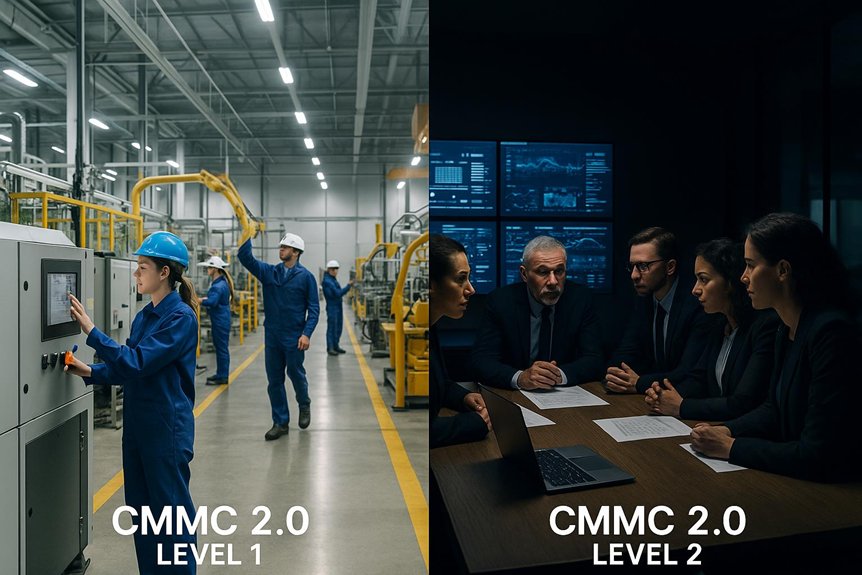
Your manufacturing firm needs CMMC Level 1 if you only handle Federal Contract Information like schedules and pricing, requiring 17 basic cybersecurity practices and annual self-assessments costing $4,000-$6,000. However, you’ll need Level 2 if you manage Controlled Unclassified Information, demanding 110 security controls and third-party assessments every three years costing $50,000-$118,000. The certification level depends on your data types and DoD contract requirements, and understanding these distinctions will help you make the right investment decision.
Key Takeaways
- Choose Level 1 if your firm only handles Federal Contract Information like schedules and pricing data.
- Select Level 2 if your manufacturing operations involve Controlled Unclassified Information from DoD contracts.
- Level 1 requires 17 basic practices with affordable self-assessments costing $4,000-$6,000 annually.
- Level 2 demands 110 security practices with third-party assessments costing $50,000-$118,000 every three years.
- Level 2 preparation takes 6-12 months while Level 1 offers streamlined annual compliance processes.
Understanding CMMC 2.0 Framework and Its Impact on Manufacturing
Since the Department of Defense introduced CMMC 2.0, manufacturers across the supply chain have faced new cybersecurity requirements that directly impact their ability to secure and maintain federal contracts.
This framework establishes three certification levels specifically designed to protect sensitive information, with each level addressing different cybersecurity trends and manufacturing challenges you’ll encounter.
The framework’s tiered approach recognizes that not all manufacturers handle the same types of sensitive data.
If you’re dealing with basic Federal Contract Information, you’ll need Level 1’s 15 fundamental safeguarding practices.
However, if your operations involve Controlled Unclassified Information like technical drawings or sensitive specifications, Level 2’s extensive 110 security practices become mandatory.
Understanding which level applies to your specific situation is vital for maintaining DoD contract eligibility.
Under CMMC 2.0, Level 2 typically requires third-party assessments, aligning with NIST SP 800-171 to validate protection of CUI.
CMMC Level 1 Requirements: Basic Cybersecurity for Federal Contract Information
When your manufacturing operation handles Federal Contract Information like pricing data or delivery schedules, CMMC Level 1‘s 17 basic cybersecurity practices provide the foundational protection you need to maintain DoD contract eligibility.
You’ll find Level 1 requirements align with FAR Clause 52.204-21, establishing essential cybersecurity hygiene standards. Your organization must complete annual self-assessments to verify compliance with these fundamental controls.
Key aspects of CMMC Level 1 include:
- Self-assessment approach – You conduct your own compliance verification annually
- Basic security controls – 17 foundational practices covering essential cybersecurity hygiene
- FCI protection focus – Safeguards general federal contracts information like schedules and pricing
- Small contractor friendly – Designed for less complex operations including maintenance, food services, and basic suppliers
This certification level targets manufacturers with straightforward data handling needs and lower-complexity federal contracts.
Staying current with regulatory updates helps prevent disqualification from federal contracts and supports continuous compliance with DoD requirements.
CMMC Level 2 Requirements: Advanced Protection for Controlled Unclassified Information
While Level 1 covers basic federal contract information, CMMC Level 2 steps up protection considerably by requiring your organization to implement 110 thorough security practices aligned with NIST SP 800-171 standards.
You’ll need to focus on protecting Controlled Unclassified Information (CUI) through extensive security domains including access control, incident response, and audit accountability.
Your assessment involves third-party evaluation by Certified Third-Party Assessor Organizations (C3PAOs) every three years, though some non-critical contracts allow annual self-assessments.
C3PAOs conduct mandatory third-party assessments every three years, with annual self-assessments permitted for select non-critical contracts.
You must achieve a minimum score of 88 out of 110 to pass. Effective CMMC compliance strategies require robust CUI protection measures that demonstrate your cybersecurity readiness.
This certification doesn’t just meet federal requirements—it notably enhances your defense against cyber threats when handling sensitive government information.
Achieving Level 2 also positions firms for competitive advantage by signaling strong cybersecurity to prime contractors and DoD buyers, often improving partnership opportunities and trust.
Key Differences Between Level 1 and Level 2 Assessments
Although both CMMC levels aim to strengthen cybersecurity across the defense industrial base, the assessment processes differ dramatically in scope and complexity.
You’ll find Level 1 requirements focus on 15 basic practices through annual self-assessments, making compliance manageable for smaller contractors handling Federal Contract Information.
However, Level 2 practices demand rigorous third-party evaluations every three years.
The key distinctions you should understand include:
- Assessment frequency: Level 1 requires annual self-assessments vs. Level 2’s triennial third-party evaluations
- Practice requirements: 15 basic controls for Level 1 vs. 110 extensive practices for Level 2
- Scoring standards: Level 1 follows basic compliance vs. Level 2’s minimum 88/110 score requirement
- Regulatory alignment: Level 1 aligns with FAR Clause 52.204-21 while Level 2 requires NIST SP 800-171 adherence
Starting in fiscal year 2025, contractors handling FCI or CUI will need proper CMMC certification before bidding on DoD contracts.
Evaluating Your Information Types and Contract Requirements
How do you determine which CMMC level applies to your manufacturing operation? Start with thorough information classification of all data your firm handles.
If you’re processing only Federal Contract Information (FCI), you’ll need CMMC Level 1 certification with 15 basic safeguarding practices. However, if your operations involve Controlled Unclassified Information (CUI), you must pursue Level 2 certification, which requires implementing 110 security practices aligned with NIST SP 800-171 standards.
Contract analysis is equally critical in this determination process. Carefully review your DoD contracts to identify any CUI clauses or requirements.
Your contract terms will explicitly dictate the necessary CMMC level, making this review essential for compliance. Don’t assume—verify your information types and contractual obligations to confirm you’re pursuing the appropriate certification level. Additionally, early compliance with CMMC certification can provide a significant competitive advantage and preserve access to lucrative DoD opportunities.
Assessment Methods: Self-Assessment vs. Third-Party Certification
Once you’ve identified your required CMMC level, you’ll face distinctly different assessment pathways that greatly impact your time, resources, and compliance strategy.
Level 1’s self-assessment approach offers considerable advantages for manufacturers handling Federal Contract Information. You’ll evaluate your organization against 15 foundational controls independently, without external verification requirements. This method provides flexibility and lower immediate costs.
However, Level 2 presents substantial third party challenges. You must engage a Certified Third-Party Assessor Organization (C3PAO) to validate compliance with 110 security practices aligned with NIST SP 800-171 standards.
As of March 2025, CMMC assessments become mandatory for small businesses handling federal contract information, making early preparation critical.
Key Assessment Considerations:
- Self-assessments cost considerably less than third-party evaluations ($50,000-$118,000)
- Level 2 requires independent validation you can’t control internally
- Self assessment benefits include scheduling flexibility and internal ownership
- Third-party assessments provide credible compliance verification for CUI handling
Cost Analysis: Level 1 vs. Level 2 Compliance Investment
While assessment methods differ dramatically between CMMC levels, the financial implications create an even starker contrast that’ll directly impact your compliance budget and business planning.
Level 1’s annual self-assessment costs just $4,000-$6,000, making it budget-friendly for small manufacturers handling Federal Contract Information.
Level 1 self-assessments offer an affordable $4,000-$6,000 annual entry point for small manufacturers entering CMMC compliance.
Level 2 requires substantially more investment—third-party assessments every three years range from $50,000-$118,000, with self-assessments for non-critical contracts costing $37,000-$49,000.
The cost implications extend beyond initial assessments. Level 2 demands ongoing expenses including continuous monitoring ($6,500-$13,000 annually) and employee training ($15-$25 per user yearly).
This reflects the complexity difference: 15 basic practices for Level 1 versus 110 security practices for Level 2.
Your financial planning must account for this significant investment increase as cybersecurity requirements intensify.
Additionally, remember that C3PAO assessments introduce fixed expenses and that ongoing maintenance typically ranges from $5,000 to $30,000 annually.
Timeline Considerations for Each Certification Level
Beyond the substantial cost differences, your certification timeline varies dramatically between CMMC levels and will determine when you can compete for specific government contracts.
Level 1 offers a streamlined path with annual self-assessments, making it ideal for small firms handling basic Federal Contract Information.
You’ll face minimal timeline challenges since there’s no third-party verification required.
Level 2 demands considerably more preparation time, typically requiring 6-12 months for medium-sized contractors to achieve certification.
You’ll need strategic compliance strategies to navigate the complex assessment process.
Key timeline considerations include:
- Gap analysis and remediation can extend Level 2 timelines based on existing cybersecurity maturity
- Third-party assessments occur every three years for Level 2
- Implementation phases begin late 2025, with full requirements by 2028
- Contract opportunities become available immediately upon certification completion
For Level 2, organizations must undergo third-party assessments by an accredited C3PAO, and Level 1 allows only self-assessments, which can significantly influence timeline planning.
Common Manufacturing Scenarios and Recommended CMMC Levels
Manufacturing contractors face distinct cybersecurity requirements depending on the type of federal information they handle.
If you’re processing only Federal Contract Information like delivery schedules and pricing data, Level 1 certification addresses your manufacturing risks through basic cyber hygiene practices and simple self-assessment requirements.
However, when you’re managing Controlled Unclassified Information such as technical specifications or sensitive project details, Level 2 becomes essential.
This certification tackles more complex compliance challenges through 110 thorough security practices aligned with NIST SP 800-171.
Small contractors typically find Level 1 accessible for basic operations, while medium-sized firms handling CUI need Level 2’s robust framework.
Critical defense supply chain participants must pursue Level 2 to meet DoD’s stringent requirements and remain competitive within the defense industrial base.
As of 2023, CMMC compliance is mandatory for pursuing government contracts, and non-compliance can result in exclusion from the defense supply chain.
Preparing Your Organization for CMMC Assessment Success
Understanding your required CMMC level sets the foundation, but achieving certification demands strategic preparation and methodical execution.
You’ll need to conduct a thorough gap analysis to identify existing security measures and pinpoint areas requiring enhancement for your target certification level.
- Partner with a C3PAO early – Engage a Certified Third-Party Assessor Organization for guidance on compliance requirements and audit readiness.
- Implement required controls systematically – Execute 15 basic practices for Level 1 or 110 additional NIST SP 800-171 requirements for Level 2.
- Establish extensive employee training – Deploy regular awareness programs to equip staff with cybersecurity knowledge and compliance understanding.
- Document security policies thoroughly – Develop robust procedures that demonstrate compliance and streamline the assessment process.
To sustain readiness, maintain an updated System Security Plan and POA&M, and collect objective evidence for the 320 assessment objectives required under NIST 800-171A.
Frequently Asked Questions
Can Manufacturing Firms Downgrade From Level 2 to Level 1 Certification?
Picture your certification as a ladder you can climb down. Yes, you can downgrade from Level 2 to Level 1 CMMC certification if your contracts no longer require the higher level.
The downgrade process involves reassessment to guarantee you still meet Level 1’s certification criteria. However, you’ll lose access to contracts requiring Level 2 controls.
Consider carefully whether downgrading aligns with your business goals and future contract opportunities before proceeding.
Do CMMC Requirements Apply to International Manufacturing Subsidiaries and Partners?
CMMC requirements don’t automatically apply to your international manufacturing subsidiaries and partners unless they’re directly handling DoD contracts or controlled unclassified information (CUI).
However, you’ll face international compliance challenges when CUI flows to overseas operations. Your subsidiary obligations depend on contractual relationships and data access levels.
If your international entities process, store, or transmit CUI for DoD contracts, they’ll need appropriate CMMC certification regardless of their location.
What Happens if We Lose CMMC Certification During an Active Contract?
If you lose CMMC certification during an active contract, you’ll face immediate contract implications including potential suspension of work and payment holds.
The DoD can terminate your contract for non-compliance, and you’ll lose access to CUI systems.
These certification consequences also prevent you from bidding on new contracts until you regain compliance.
You must notify the contracting officer immediately and work quickly to remediate issues and restore your certification status.
Are There Industry-Specific CMMC Exemptions for Certain Manufacturing Sectors?
No, there aren’t CMMC exemptions for specific manufacturing industry sectors.
You’ll find that CMMC requirements apply uniformly across all manufacturing companies that handle Controlled Unclassified Information (CUI) or work on Department of Defense contracts.
Whether you’re in aerospace, automotive, electronics, or any other manufacturing sector, you must meet the same CMMC standards.
The requirements don’t vary based on your particular industry – they’re determined by your contract’s security requirements instead.
Can We Maintain Different CMMC Levels for Separate Business Divisions?
Think of your company as a tree with different branches—yes, you can maintain separate CMMC levels across business divisions.
This divisional compliance approach allows level differentiation based on each division’s specific contract requirements and CUI handling.
You’ll need to clearly segment your IT infrastructure, data flows, and personnel access between divisions.
However, you must demonstrate complete separation to auditors, ensuring no cross-contamination of compliance requirements between different organizational branches.
Conclusion
You’ve got the roadmap—now it’s time to choose your path. Like selecting the right gear for a challenging hike, picking between CMMC Level 1 and Level 2 depends on your specific terrain. Analyze your contract requirements, assess your information types, and calculate your investment capacity. Don’t wait until the last minute; start preparing today. Your manufacturing firm’s cybersecurity posture and federal contracting future depend on making this decision thoughtfully and acting decisively.